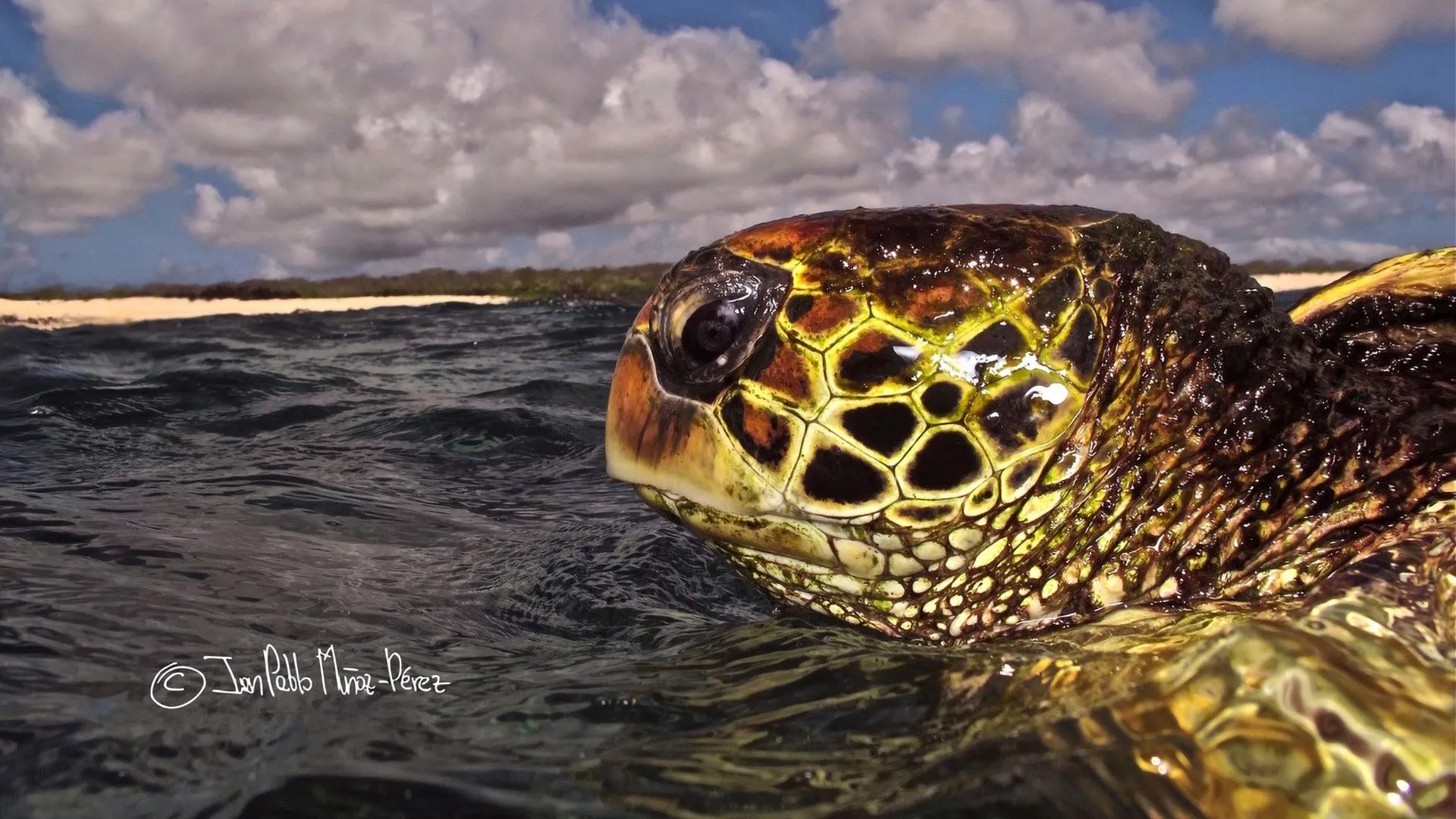
# Galápagos Sea Turtles Defy Migration Patterns, Revealing Critical Habitat Dependencies
Scientists tracking yellow-morph green sea turtles in the Galápagos Islands discovered an unexpected pattern: these animals abandoned their reputation for epic ocean wandering and remained within the marine reserve boundaries throughout the study period. The finding challenges conventional understanding of sea turtle behavior and underscores the ecological value of protected coastal zones.
Satellite tracking data revealed that none of the monitored yellow-morph green sea turtles ventured beyond the Galápagos marine reserve, contradicting the widespread assumption that sea turtles undertake extensive migratory journeys across ocean basins. Researchers expected these animals to follow patterns observed in other sea turtle populations, which routinely travel thousands of kilometers between feeding and nesting grounds. Instead, the tracked individuals remained in localized coastal habitats, suggesting that the Galápagos islands provide sufficient resources to support their life cycles without demanding long-distance travel.
The research carries implications for conservation strategy. Most sea turtle management focuses on protecting nesting beaches and international migration corridors. This study indicates that year-round resident populations depend entirely on the integrity of specific coastal ecosystems. If yellow-morph green sea turtles cannot sustain themselves through migration, habitat degradation within the reserve poses direct, immediate threats to population viability.
Yellow-morph green sea turtles represent a distinct population of the species Chelonia mydas, identifiable by their pigmentation. The Galápagos population maintains genetic uniqueness that warrants specific protection. Understanding their actual movement patterns enables scientists to tailor conservation efforts rather than applying generic sea turtle management protocols developed for migratory species.
The Galápagos Marine Reserve encompasses approximately 133,000 square kilometers and protects one of the world's most biodiverse marine ecosystems. The reserve functions as a closed system for these turtles, meaning their entire existence depends on conditions within this bounded area. Threats including climate change, fishing pressure, and pollution become particularly acute for populations that cannot relocate to alternative habitats.
Previous research established that some sea turtle populations exhibit philopatry, the tendency to return to the same geographic location. This study extends that understanding by suggesting that certain populations may be entirely non-migratory. The yellow-morph green turtles represent an extreme case where satellite tracking detected zero emigration during the monitoring period.
The tracking technology itself represents a methodological advance. Satellite transmitters allow researchers to monitor individual movements continuously, generating detailed behavioral datasets impossible to obtain through traditional observation methods. This capability revealed a pattern that conventional field studies might have missed.
Future work should investigate whether this sedentary behavior reflects optimal environmental conditions or represents a constrained response to threats. If yellow-morph green sea turtles possess the physiological capacity for long-distance migration but choose not to migrate because the Galápagos provides adequate resources, conservation priorities should emphasize maintaining those local conditions. Conversely, if these animals lack the behavioral flexibility for migration, they face heightened vulnerability to environmental changes that degrade the reserve.
The findings suggest that ocean islands function as complete ecosystems for certain populations rather than temporary way-stations along migratory routes. Management frameworks must reflect this ecological reality to ensure the survival of species that depend entirely on circumscribed geographic areas.