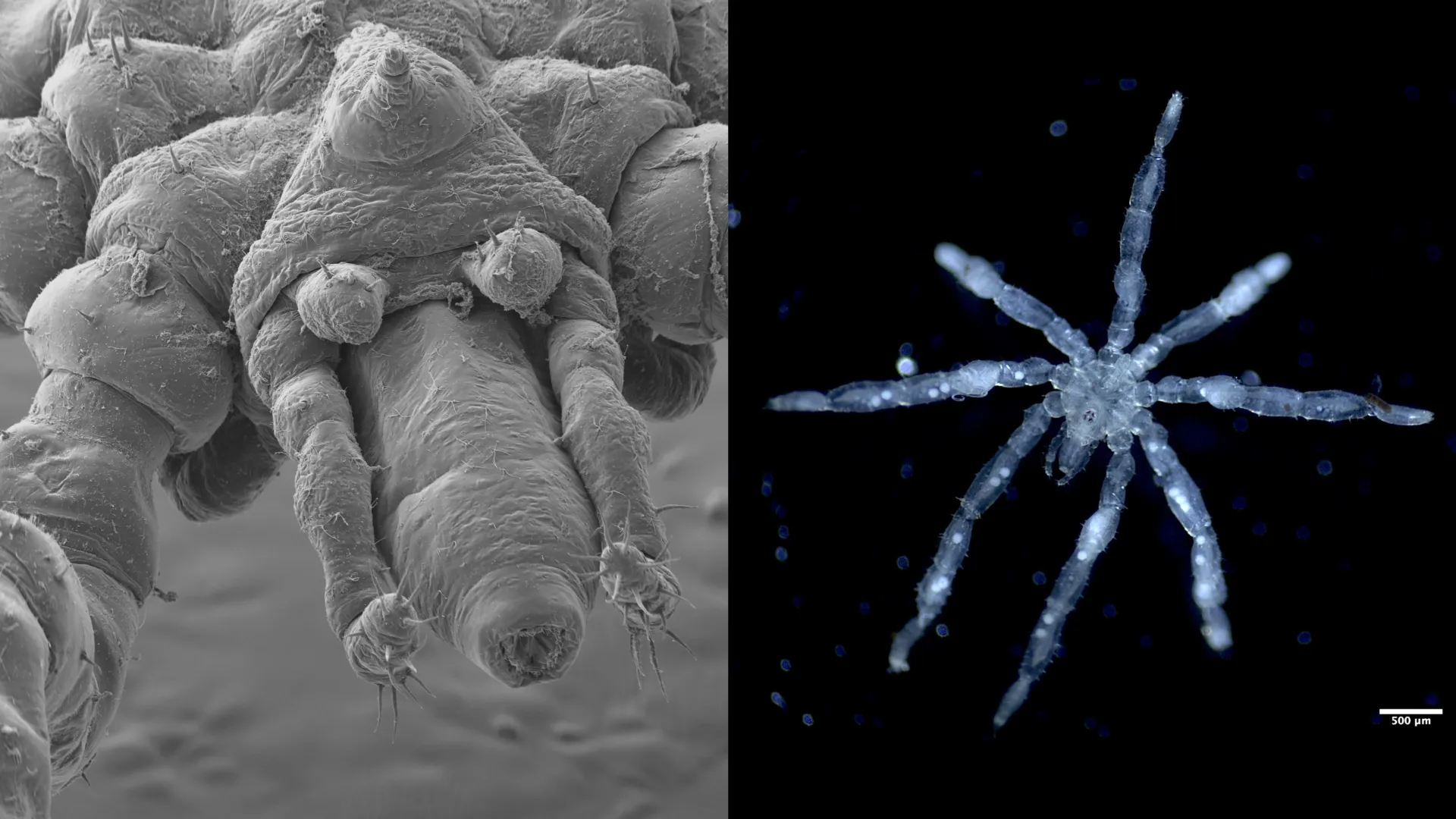
Researchers exploring the Salish Sea, the body of water between Washington and British Columbia, have identified two previously unknown sea spider species with features that defy conventional notions of elegance in marine life.
The first species boasts striking red eyes and legs covered in hair-like setae, or bristles. Most notably, it possesses comb-like appendages it uses to groom itself, a behavior rarely documented in sea spiders. This self-cleaning mechanism suggests the creature invests energy in maintaining its appearance, possibly to remove parasites or algae that could compromise its movement through water.
The second species presents a different problem entirely. Researchers observed it covered in tiny parasites that appear to be permanent residents on its exoskeleton. Rather than viewing this as a death sentence, scientists recognize this as an evolutionary adaptation. Some organisms develop resistance to parasitic loads that would overwhelm other species.
Sea spiders, technically pycnogonids, occupy an unusual place in marine taxonomy. Despite their spider-like appearance and legs, they are not true arachnids. Most sea spiders remain microscopically small, though some deep-sea species reach leg spans of several feet. The creatures have existed largely unstudied in accessible waters until recently, partly because their small size and cryptic behavior render them difficult to observe without specialized sampling techniques.
The Salish Sea hosts exceptional biodiversity due to its unique oceanographic conditions. Cold water currents, nutrient upwelling, and protected bays create habitats where specialized organisms thrive. Yet the region has received comparatively little systematic taxonomic study compared to tropical coral reefs or polar waters. This knowledge gap means countless species remain undescribed.
The discovery team employed standard marine sampling methods, likely including dredging or fine-mesh netting focused on seafloor sediments and rocky substrates where sea spiders congregate. Once specimens were collected, researchers examined morphological characteristics including leg structure, body proportions, and appendage arrangement to establish them as distinct from known species. DNA analysis probably supplemented traditional taxonomic work, a standard approach in modern invertebrate systematics.
The researchers hypothesize that many more undiscovered sea spider species inhabit the Salish Sea. This prediction rests on several factors. First, sea spider diversity tends to correlate with substrate diversity. The Salish Sea contains varied habitats from soft mud to rocky reefs. Second, remote sensing has expanded access to previously unreachable areas. Third, species described from a given region often represent only a fraction of actual diversity, particularly for small organisms with limited public profile.
Understanding sea spider ecology and taxonomy matters beyond academic curiosity. These creatures serve as predators of small invertebrates and bryozoans. Their population dynamics may indicate broader ecosystem health. Additionally, sea spider physiology offers insights into extreme body plans and unusual respiratory systems that function without centralized hearts, relying instead on open circulatory networks.
Future work in the Salish Sea should employ standardized sampling across depth zones and seasons. Combining molecular techniques with traditional morphological description will accelerate species discovery and establish evolutionary relationships. Collaborations between local institutions like the University of Washington and British Columbia research centers position the region well for sustained biodiversity surveys that could reveal dozens of additional sea spider species within the next decade.