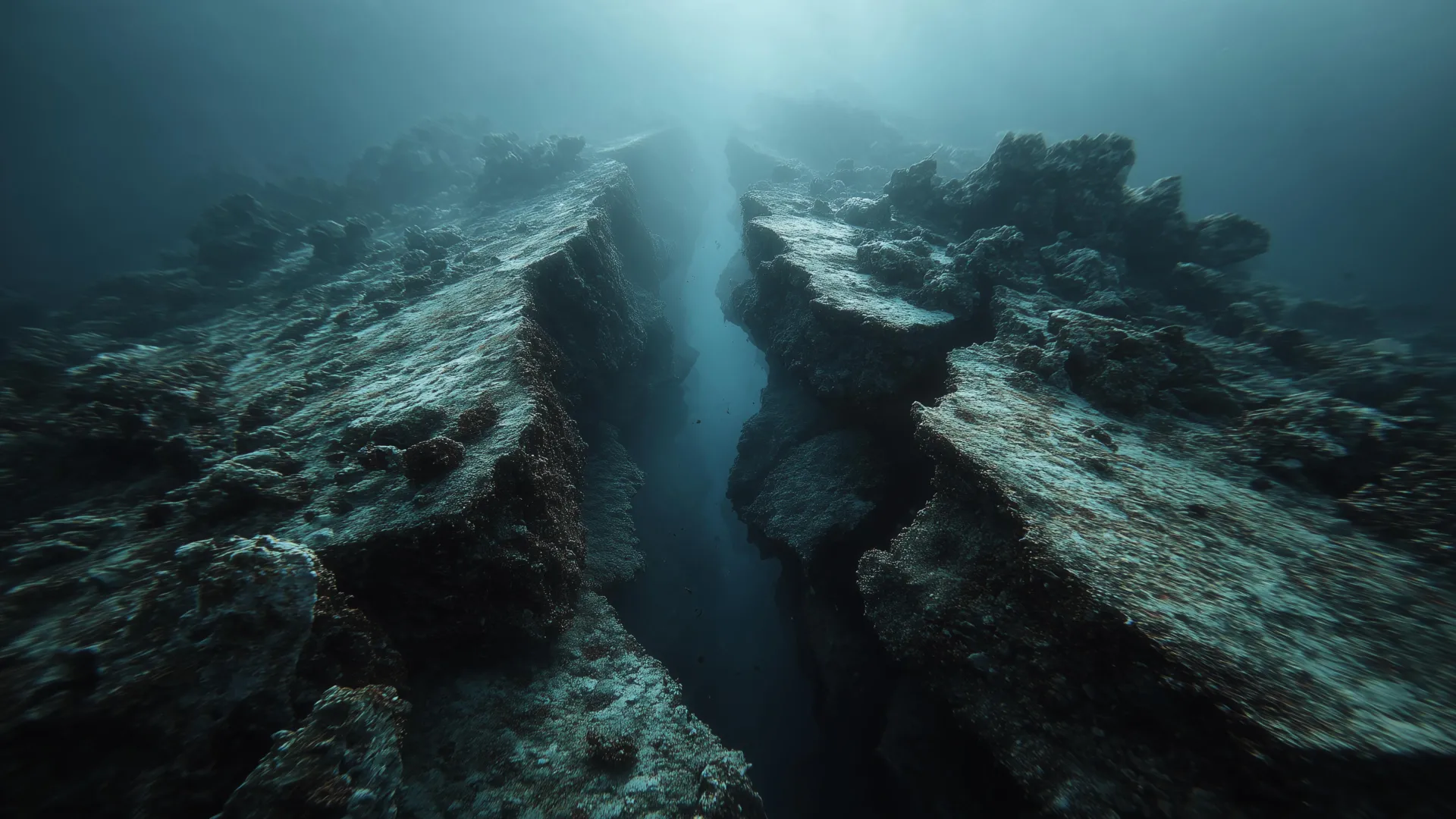
A team of scientists using seismic monitoring has detected active fracturing within the Juan de Fuca subduction zone beneath the Pacific Northwest, capturing evidence that tectonic plates tear apart in distinct stages rather than splitting simultaneously across their entire span.
Subduction zones form where one tectonic plate slides beneath another. The Juan de Fuca plate descends beneath North America at a rate of about 1.6 inches per year. This collision generates the region's earthquakes, volcanic activity, and geological complexity. What researchers have now documented is the internal disintegration of this system—a process scientists theorize happens gradually, with pieces breaking off progressively.
The research team, based at institutions monitoring the Cascadia subduction zone, deployed dense networks of seismometers off Vancouver Island to detect subtle motions within the descending plate. These instruments recorded evidence of fractures propagating through the oceanic lithosphere, the rigid outer shell of the Earth. The seismic data revealed distinct ruptures rather than a unified breakup, suggesting the plate splits into smaller fragments as it ages and cools.
This piecemeal failure process explains geological puzzles that have long perplexed researchers. Ancient oceanic plate fragments scattered throughout the geological record had unclear origins. The new observations suggest these orphaned pieces are remnants of dead subduction zones that fractured and broke apart over millions of years. Some fragments were incorporated into continental margins, while others persisted as independent lithospheric blocks.
The implications extend to volcanic activity patterns. As subduction zones fail, their death changes the thermal structure and stress conditions that drive magmatism. The Juan de Fuca zone shows regional differences in volcanism intensity along the Cascade volcanic arc, possibly reflecting the uneven tearing process happening at depth. Areas above more severely fractured segments may experience different volcanic behavior than adjacent regions.
For earthquake hazards, the findings introduce nuance to understanding the Cascadia subduction zone, which generates public concern given its potential for producing massive megathrust earthquakes. The presence of internal fractures may locally weaken the megathrust interface where ruptures occur, but it could also compartmentalize large earthquakes into smaller events rather than one plate-wide rupture. Researchers need more monitoring data to determine whether these fractures reduce, increase, or redistribute earthquake risk across the region.
The study employed advanced seismic tomography and focal mechanism analysis to map stress patterns within the plate. This methodology represents improved capability compared to earlier studies, allowing scientists to visualize three-dimensional plate structure with unprecedented clarity.
Future research will involve expanding seismic networks along the entire Cascadia margin and incorporating geodetic data from GPS stations to track deformation. Understanding the timeline and mechanics of subduction zone death could fundamentally reshape models of plate tectonics and long-term geological evolution. The work demonstrates how careful monitoring of active tectonic systems provides windows into processes that typically operate across millions of years, but leave diagnostic signatures researchers can detect today.