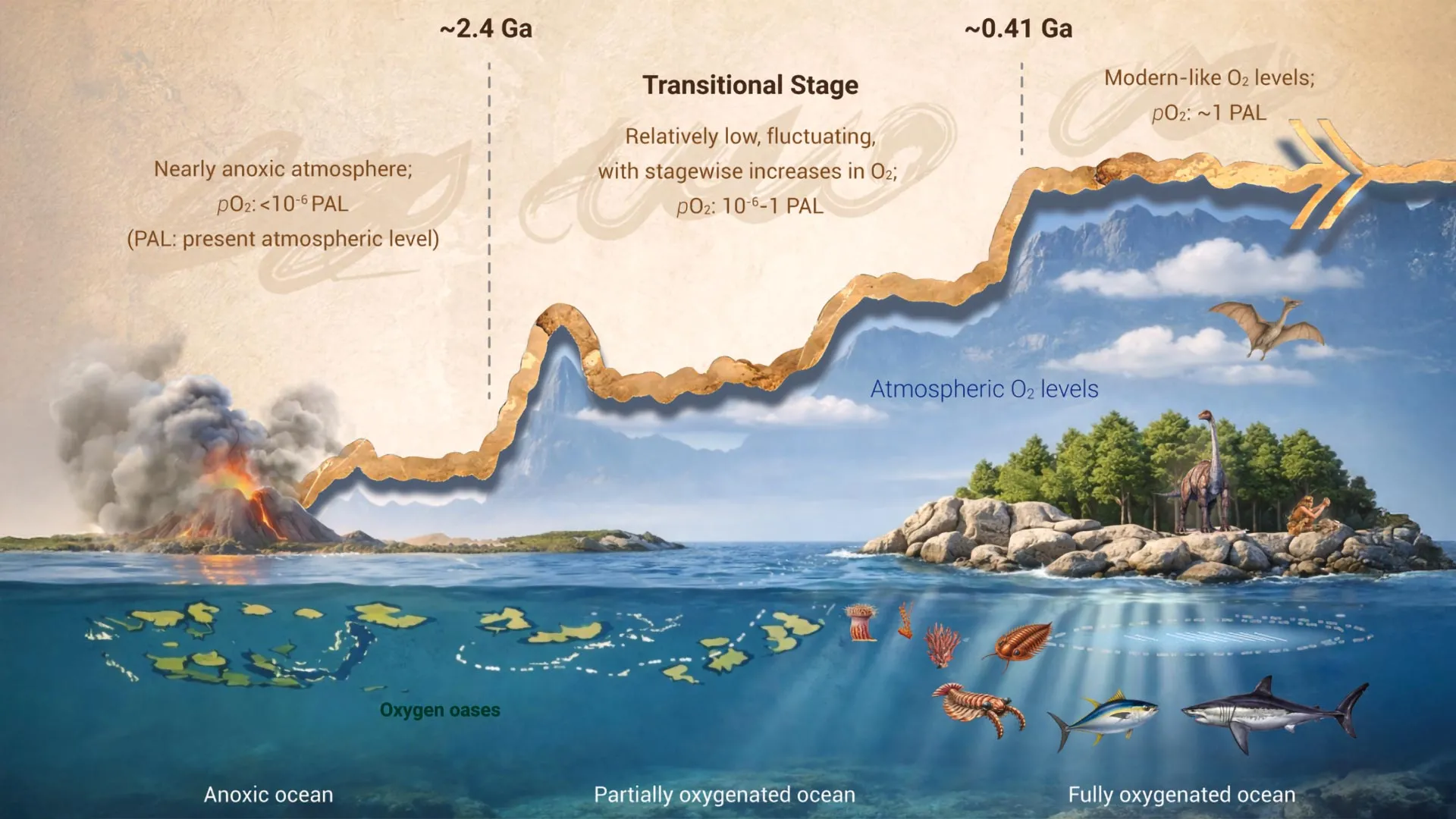
Two geochemists from Chengdu University of Technology have proposed a revised timeline for Earth's oxygen history, presented in The Innovation. Their analysis suggests that atmospheric oxygen accumulated during three major stages, while deep oceans took hundreds of millions of years longer to develop oxygen.
The researchers challenged the traditional approach of using ocean sediment chemistry to reconstruct atmospheric oxygen levels. Ocean oxygen concentrations depend on nutrient availability, biological productivity, ocean circulation, and basin shapes, making them an imperfect measure of atmospheric conditions.
Instead, the researchers examined sulfate preserved in sedimentary rocks. Reactions involving oxygen, ozone, and carbon dioxide in the atmosphere create a distinctive shortage of the oxygen-17 isotope. When sulfide minerals weather, this chemical fingerprint transfers to sulfate. By analyzing these signatures, the team tracked atmospheric oxygen changes more directly.
According to their evidence, Earth's first major oxygen increase occurred during the Great Oxidation Event between 2.4 billion and 2.1 billion years ago, rising from less than one-millionth of today's concentration to between 0.1% and 10% of modern levels. A second increase happened approximately 1.3 billion to 1.0 billion years ago, and a third between 440 million and 410 million years ago.
The researchers propose that the well-known Neoproterozoic and Paleozoic oxygenation events, traditionally dated to 800 million to 500 million years ago and 420 million to 360 million years ago, primarily reflect delayed changes in ocean oxygen. The oceans responded roughly 200 million and 30 million years after corresponding atmospheric increases.
Charcoal appears in the geological record around 420 million years ago. Charcoal formation requires atmospheric oxygen concentrations of approximately three-quarters of modern levels, suggesting oxygen remained too scarce before then to support widespread burning.
The researchers describe an unexpected relationship between atmospheric and ocean oxygen. Over long periods they generally increased together, but on million-year timescales they could move in opposite directions. When additional oxygen entered oceans, it could react with accumulated organic carbon and sulfide, consuming oxygen and potentially reducing atmospheric oxygen.
Oxygen-rich pockets existed in seawater as early as 3 billion years ago, produced by photosynthetic microorganisms, even when the atmosphere and most oceans contained little free oxygen. The deep ocean did not become fully oxygenated until approximately 410 million years ago.
The researchers acknowledge that uncertainties remain. The isotope record does not capture every change in detail, and absolute atmospheric oxygen concentrations after 1 billion years ago remain difficult to establish.