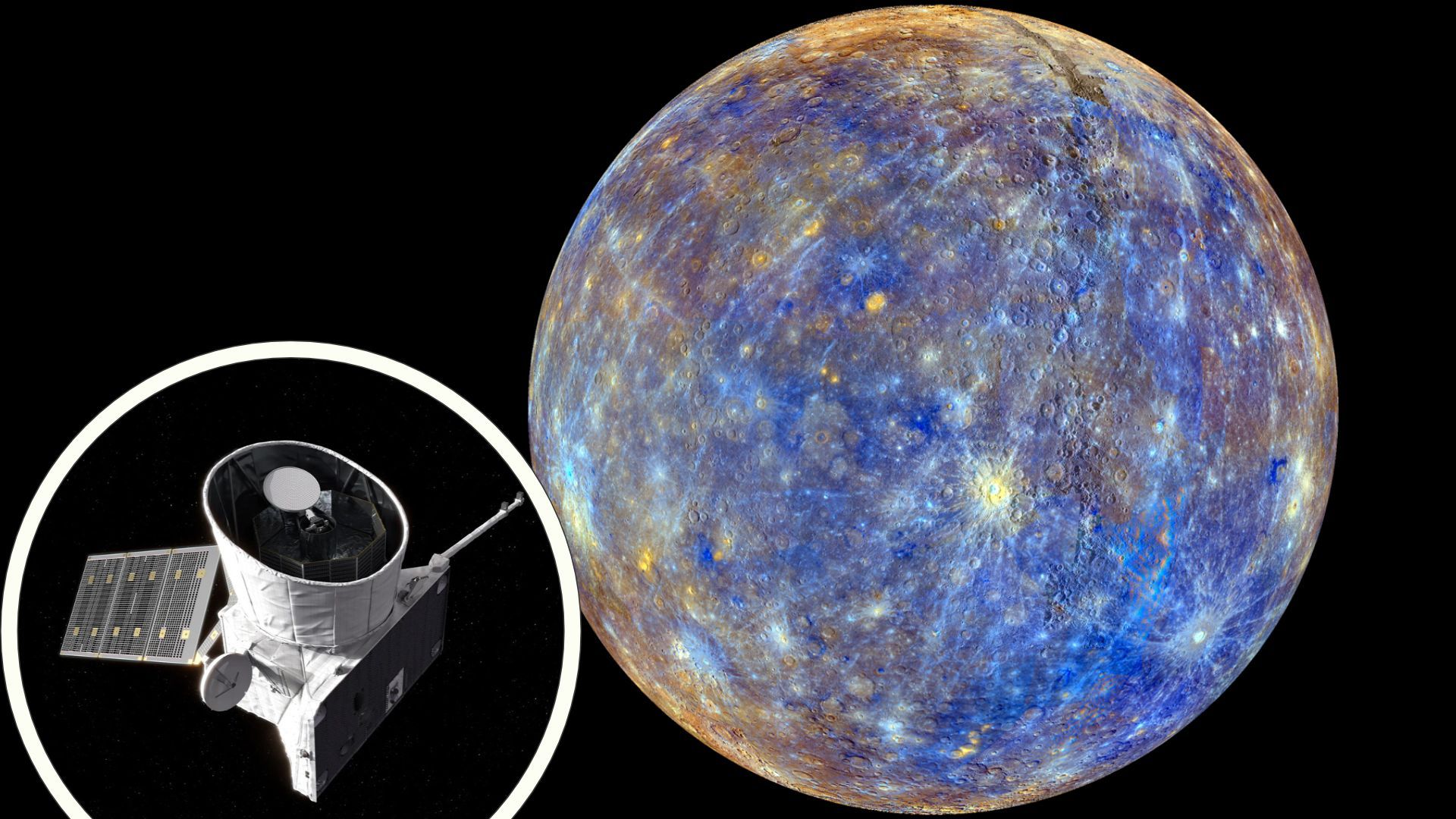
BepiColombo, a joint European-Japanese spacecraft, entered orbit around Mercury on November 21 after an eight-year journey through the inner solar system. The spacecraft is only the second ever to orbit Mercury, following NASA's MESSENGER probe.
The European Space Agency confirmed the orbital insertion occurred but noted a software glitch prevented the thrusters from firing for the full 37 minutes needed to slow the spacecraft's approach. ESA stated that BepiColombo remains safe while the agency investigates the issue and its implications for the trajectory.
BepiColombo consists of two separate probes currently stacked together: the Mercury Planetary Orbiter, built by ESA, and the Mercury Magnetospheric Orbiter, built by JAXA. The spacecraft launched in October 2018 aboard an Ariane 5 rocket and traveled past Earth, the moon, and Venus before passing Mercury six times during its journey. One flyby in January 2025 captured detailed images of Mercury's north pole.
The two probes are expected to separate in early December. The JAXA probe will enter a highly elliptical polar orbit, while the ESA orbiter will move into a lower circular polar orbit in March 2027, with science operations beginning in April. Each probe will complete multiple orbits daily.
The mission will observe Mercury across the electromagnetic spectrum, including X-rays, gamma-rays, and ultraviolet light, while measuring the planet's magnetic field. The instruments aim to answer questions about Mercury's interior composition, the origin of its magnetic field, its formation, and ongoing tectonic activity. A radio experiment will also test Einstein's theory of general relativity using precise measurements of the spacecraft's orbit.