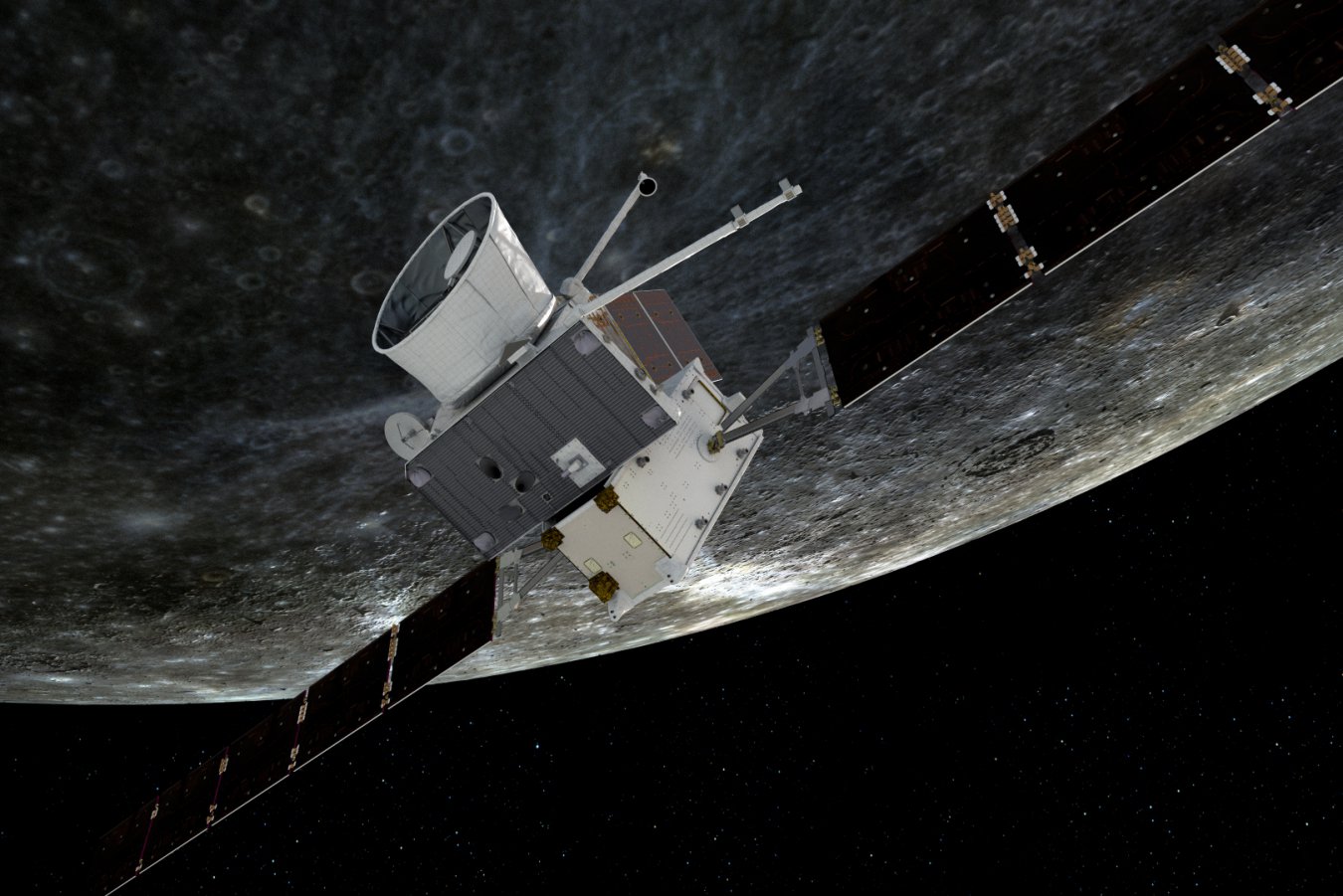
The BepiColombo spacecraft will enter orbit around Mercury on 21 November after an eight-year journey from its October 2018 launch. The joint mission of the European Space Agency and the Japan Aerospace Exploration Agency took a long, looping path past Venus and Mercury multiple times to reach the planet without overshooting into the sun. A thruster issue in 2024 pushed the arrival date from 2025 to 2026.
BepiColombo comprises two separate orbiters that will split in December. The European Space Agency's Mercury Planetary Orbiter will move to a near-circular orbit taking 2.3 hours to complete, while the Japan Aerospace Exploration Agency's Mercury Magnetospheric Orbiter will enter a more distant elliptical orbit taking 9.3 hours.
The Mercury Planetary Orbiter carries 11 scientific instruments, including spectrometers to measure surface composition, a laser altimeter to map terrain, and instruments to study Mercury's thin atmosphere. The Mercury Magnetospheric Orbiter, positioned at a greater distance, carries five instrument sets to study the planet's magnetic field, atmosphere, and the solar wind.
The primary mission lasts one Earth year, or slightly more than four Mercury years, with potential for a one-year extension. Researchers aim to investigate Mercury's unusual magnetic field, which originates 400 kilometres above the planet's centre and should have faded long ago. They also plan to study how the planet's thin atmosphere receives material from the surface and to understand why Mercury has an iron core proportionally larger than any other planet's.