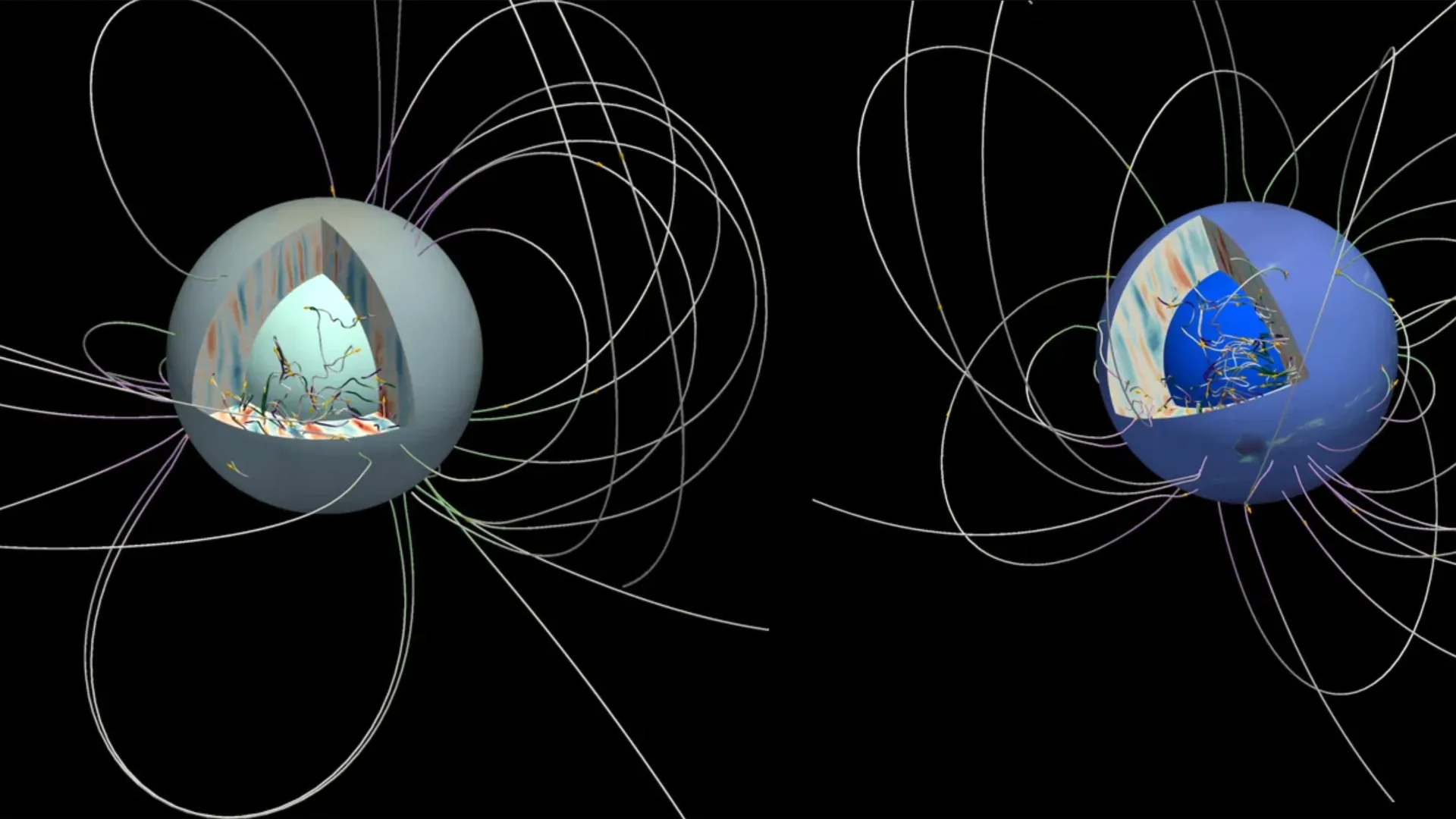
Voyager 2's visits to Uranus and Neptune in the 1980s revealed magnetic fields dramatically different from Earth's. While Earth's magnetic axis tilts only 11 degrees from its rotation axis, Uranus tilts 59 degrees and Neptune tilts 47 degrees. For decades, scientists struggled to explain these extreme distortions.
A new study published in Communications Physics proposes that changes in electrical conductivity at extreme depths inside these ice giants could account for the unusual magnetic patterns. Chi Yan, lead author and research associate at the UT Jackson School of Geosciences, explains that under the enormous pressure and temperature deep inside Uranus and Neptune, water molecules break apart into ions. This increases electrical conductivity with depth, potentially reshaping how the planets' magnetic fields generate.
Researchers at the University of Texas at Austin, UCLA, Imperial College London, and Northumbria University developed computer simulations mimicking the magnetic fields Voyager 2 recorded. The models tested varying internal structures and assumed electrical conductivity increases deeper in the planets. Results suggested changing electrical properties could produce the observed magnetic anomalies.
The simulations revealed something unexpected. While Earth's magnetic tilt drifts about one degree per 50 years, the models show Uranus and Neptune's magnetic axes could shift tens of degrees within just decades in some scenarios. These remain predictions from computer models, not confirmed observations.
Tom Stallard, a professor at Northumbria University who reviewed the paper, notes that the James Webb Space Telescope's infrared images of the planets' auroras could provide evidence. Auroras form when charged solar particles interact with atmospheric gases and connect to magnetic fields. Changes in aurora shape and structure since Voyager 2's observations could reveal whether magnetic poles have shifted.
Scientists emphasize that fully understanding these worlds requires future spacecraft missions, but improved simulations and telescope observations may help resolve this magnetic mystery.