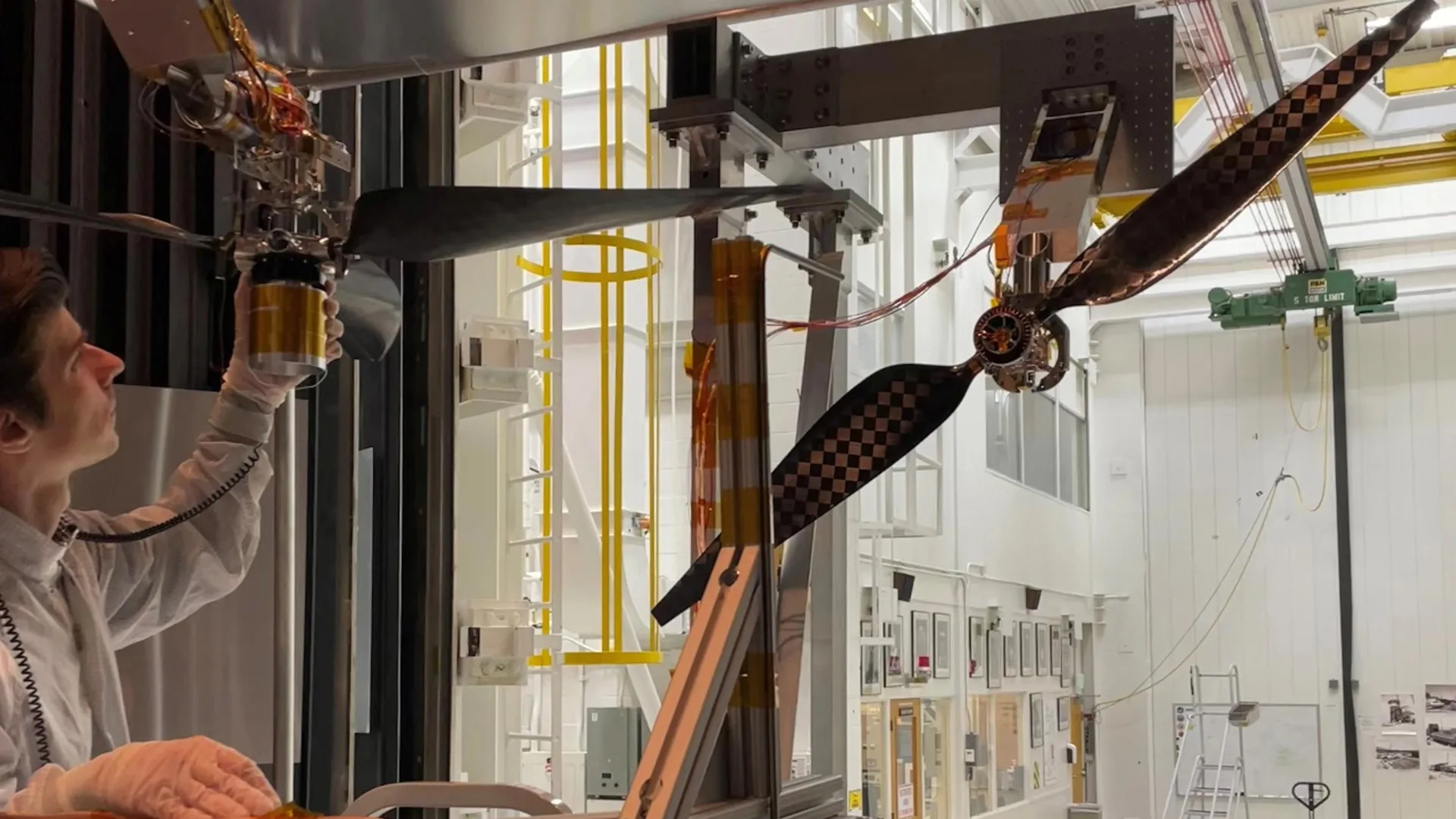
NASA engineers tested experimental Mars helicopter rotor blades at supersonic speeds in March at the Jet Propulsion Laboratory in Southern California. The team spun the blades to Mach 1.08, exceeding the speed of sound on Mars, without structural failure. The tests used JPL's 25-Foot Space Simulator chamber filled with carbon dioxide to recreate Mars' thin atmosphere.
The rotor reached 3,750 revolutions per minute before simulated headwinds pushed the blade tips past Mach 1.08. This supersonic operation increased lift capability by 30% compared to subsonic speeds. During Ingenuity's 72 flights on Mars, engineers limited that helicopter's rotors to 2,700 revolutions per minute, keeping blade tips at Mach 0.7 to maintain safety margins.
Mars presents extreme challenges for helicopter flight because its atmosphere is only about 1% as dense as Earth's. The speed of sound on Mars is roughly 540 mph, compared to 760 mph at sea level on Earth, because the Martian atmosphere is colder and composed primarily of carbon dioxide.
Jaakko Karras, rotor test lead at JPL, stated: "With that in mind, we planned Ingenuity's flights to keep the rotor blade tips at Mach 0.7 with no wind so that if we encountered a Martian headwind while in flight, the rotor tips wouldn't go supersonic. But we want more performance from our next-gen Mars aircraft. We needed to know that our rotors could go faster safely."
The team tested rotor systems developed by AeroVironment in Simi Valley. After the three-bladed design succeeded, engineers evaluated a two-bladed rotor intended for NASA's SkyFall project, which would carry three helicopters to Mars in December 2028. The findings allow development of helicopters capable of transporting heavier scientific instruments and remaining airborne longer than Ingenuity.