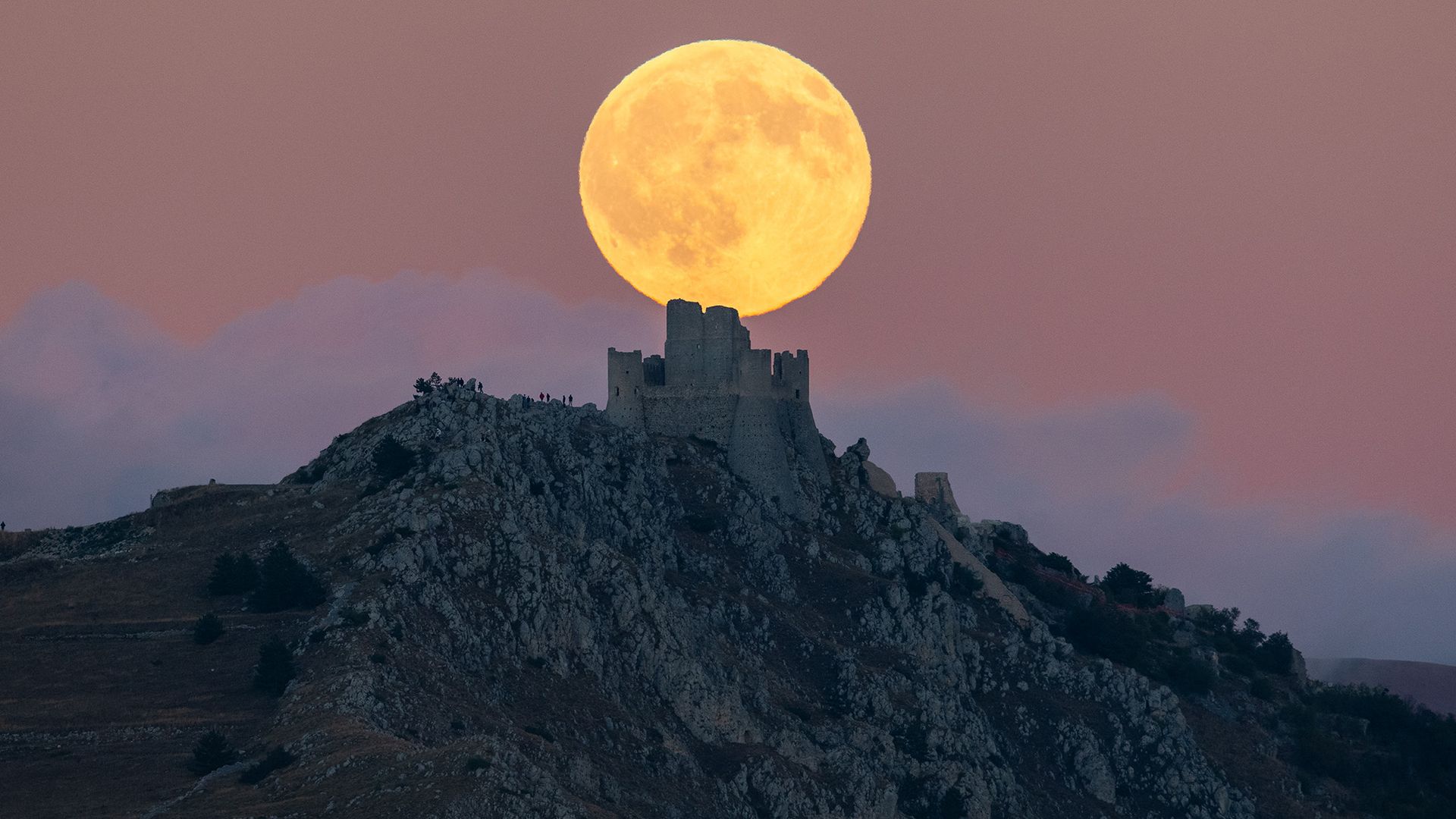
November's full moon, the "Beaver Moon," will rise in the east on Tuesday, November 24, marking the first of three consecutive supermoons. The moon reaches its full phase at 9:53 a.m. ET that day, but it will be below the horizon in North America at that time. The best viewing opportunity comes at moonrise that evening, when the moon appears against the twilight sky.
The Beaver Moon gets its name from the time when beavers in North America traditionally build dams and prepare for winter under the full moon. The Anishinaabeg people call it Baashkaakodin Giizis, or the Freezing Moon.
A supermoon occurs when a full moon coincides with the moon being at perigee, its closest point in its elliptical orbit around Earth. The moon will be 224,170 miles (360,768 kilometers) from Earth on November 24.
Two more supermoons follow. December's full moon, also called the Cold Moon, will occur on December 24 at a distance of 221,667 miles (356,740 kilometers), making it the closest, biggest, and brightest full moon of 2026. According to late astrophysicist Fred Espenak, this represents the moon's closest approach to Earth since January 2, 2018. January's Wolf Moon supermoon will occur on January 22, 2027, with the moon at 222,229 miles (357,644 kilometers) away.