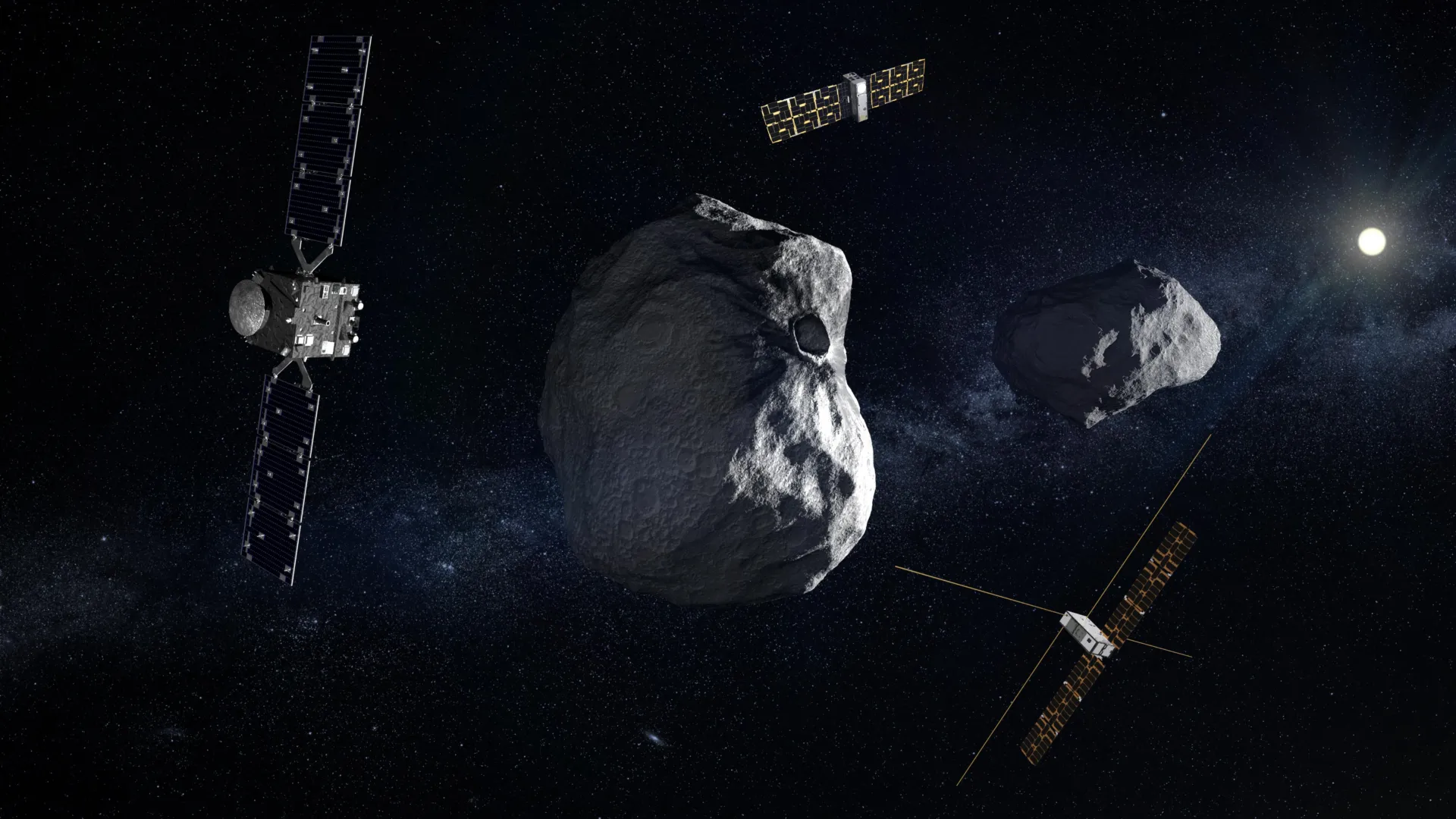
The European Space Agency's Hera spacecraft has arrived near the Didymos asteroid system, approximately 25 to 30 kilometers away, to begin its first scientific observations of two asteroids. The mission follows NASA's DART spacecraft collision with Dimorphos, the smaller asteroid, in September 2022.
Hera travels in rectangular flight paths around the asteroids because their gravity is extremely weak. Didymos measures about 780 meters across and exerts gravitational pull roughly 40,000 times weaker than Earth's. Dimorphos is 151 meters wide with gravity about 200,000 times weaker than Earth's. The spacecraft moves at approximately 12 centimeters per second, comparable to an insect crawling. Every three to four days, Hera fires thrusters while moving away from the asteroids, changing direction by 90 degrees to maintain its distance.
Mission scientist Michael Kueppers stated, "During this phase, our images will reveal for the first time what a small asteroid looks like globally, having experienced a hypervelocity impact in the context of the first asteroid deflection test, when NASA's DART spacecraft impacted it to change its orbit in 2022."
The current early characterization phase aims to understand the asteroids and their surroundings. Next month, Hera will enter a detailed characterization phase at closer distances of approximately 20 kilometers, using more complex hyperbolic trajectories.
Mission control at ESA's ESOC center in Darmstadt, Germany maintains contact with Hera for about eight hours daily through four 35-meter Deep Space Antennas in Argentina, Spain, and Australia, despite the spacecraft being approximately 196.5 million kilometers away.
Hera will investigate unanswered questions from NASA's DART impact. The collision in 2022 shortened Dimorphos' orbit around Didymos by about 33 minutes but produced larger orbital changes than computer simulations predicted. Scientists still need to determine whether the impact excavated a large crater or reshaped the entire asteroid, and require more precise data on Dimorphos' composition, internal structure, and mass. The spacecraft will release two shoebox-sized CubeSats to collect additional measurements closer to the asteroid.