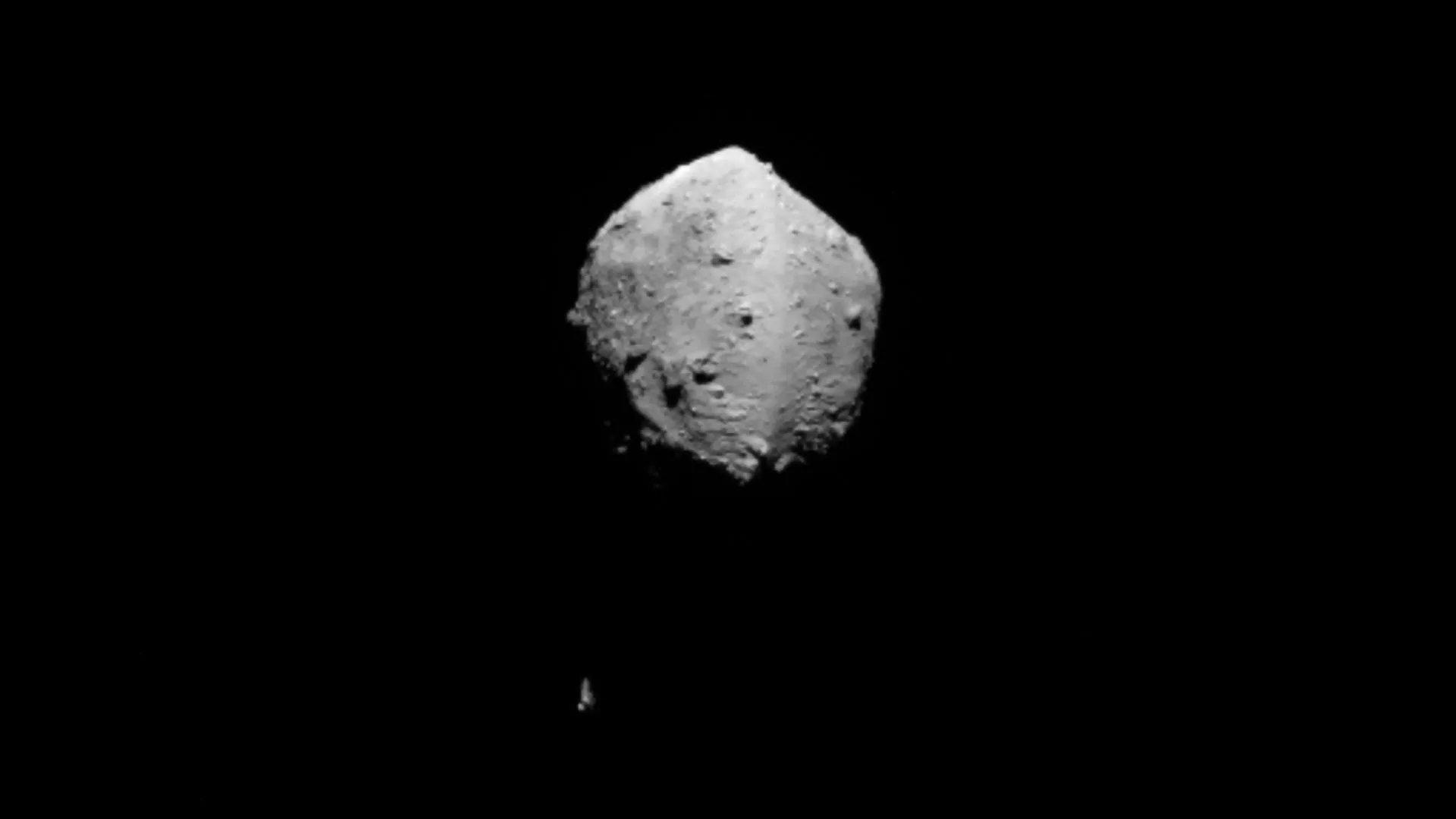
The European Space Agency's Hera spacecraft captured its first close-up image of the Didymos asteroid system on September 26, 2022, revealing a previously unseen side of the larger asteroid. The image was taken from 60 km away using Hera's monochromatic Asteroid Framing Camera.
The view shows Didymos, which measures 780 m across, in clear detail. The smaller Dimorphos, 151 m in diameter, appears mostly in shadow. Patrick Michel, Hera Principal Investigator and Director of Research at CNRS / Observatoire de la Côte d'Azur, said: "This is the other side of Didymos from the one that DART's camera showed us shortly before impact, so this feels like looking at a whole new world."
This side of Didymos displays a central ridge along its equator, multiple boulders, craters, and what appear to be patterns of grooves or ridges. The newly visible terrain raises questions about surface development and whether NASA's impact with Dimorphos left traces on its larger neighbor.
On September 26, 2022, NASA's DART spacecraft deliberately collided with Dimorphos at approximately 6.1 km/s. The impact sent material into space that scientists believe may have traveled across the roughly 1 km gap separating the two asteroids and reached Didymos. Michael Kueppers, Hera mission scientist, stated: "Since we expect a lot of impact-ejected material to have made it across the approximately 1 km of space from Dimorphos to Didymos, it may be that some of these characteristics originate from this transport of material, and we have exciting work ahead of us to sort it out."
The DART collision reduced the time Dimorphos takes to orbit Didymos by about 33 minutes, making it the first object in the Solar System to have its orbit measurably altered by human activity. The change exceeded scientists' predictions.
Hera arrived at the system after a two-year journey. The spacecraft will conduct a detailed investigation to understand the physical processes behind the orbital change and help improve predictions for future asteroid deflection attempts. Detailed images of both asteroids are scheduled for release on November 25.