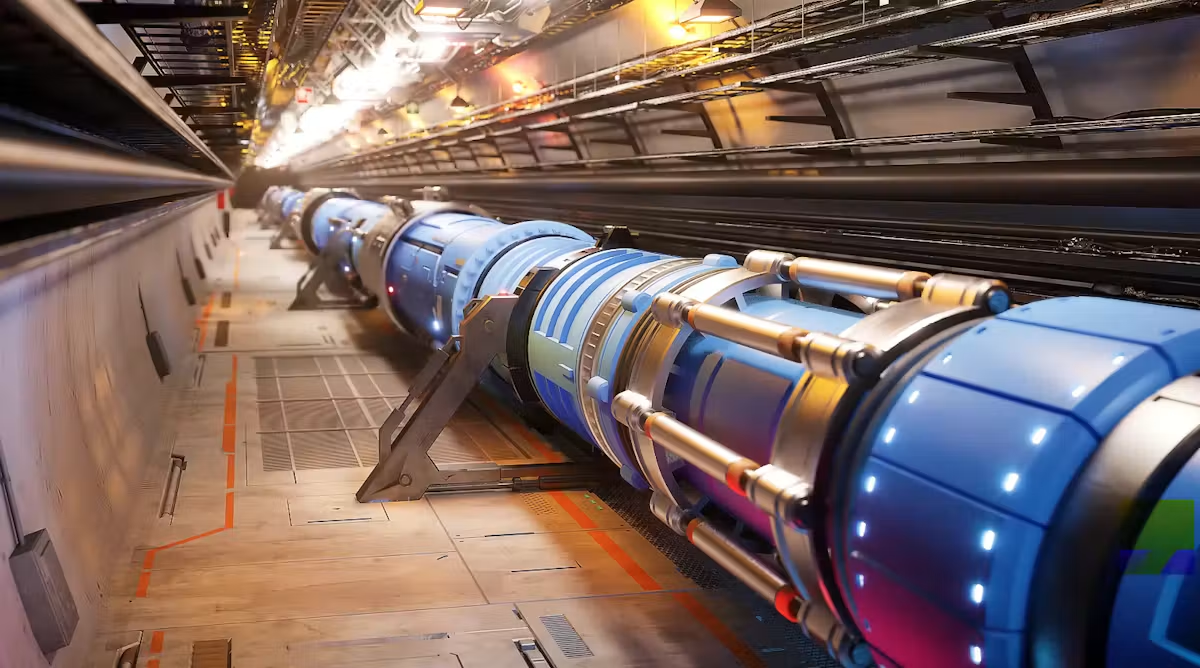
Physicists have never confirmed how electrons acquire their mass, a property that determines atom size and affects all chemistry and biology. A proposed collider at Cern called FCC-ee, the first stage of the $19 billion Future Circular Collider, could finally test this question in the 2040s.
In 1964, physicist Peter Higgs and colleagues proposed that fundamental particles obtain mass by interacting with a field. The stronger a particle's interaction with this field, the heavier it becomes. This mechanism was confirmed with the discovery of the Higgs boson at Cern's Large Hadron Collider, earning Higgs and François Englert the 2013 Nobel Prize in Physics.
However, the electron interacts extremely weakly with the Higgs field, making it impossible to measure at current colliders. The Standard Model also cannot explain why fundamental particle masses span an enormous range. The heaviest particle, the top quark, has a mass 300,000 times larger than the electron.
FCC-ee would accelerate electrons and positrons around a 91-kilometer-long ring under the French-Swiss border before colliding them inside detectors. Unlike proton-proton colliders, this setup can directly produce Higgs bosons by smashing electrons and positrons together, allowing researchers to probe the strength of the electron-Higgs interaction.
A recent preprint by physicists used machine learning to distinguish Higgs decay signals from other processes. Their simulations showed this approach could improve sensitivity to the electron-Higgs interaction by nearly a factor of 200 compared with current Large Hadron Collider limits.
Benjamin Smith and colleagues at the University of Glasgow recently examined how new, undiscovered particles could modify electron-Higgs interactions. They found that many theoretical candidates for such particles could be indirectly searched for through planned measurements of electron magnetic properties at physics experiments worldwide. A hypothetical electron-specific form of the Higgs boson, if it exists, would be uniquely testable by the Future Circular Collider.