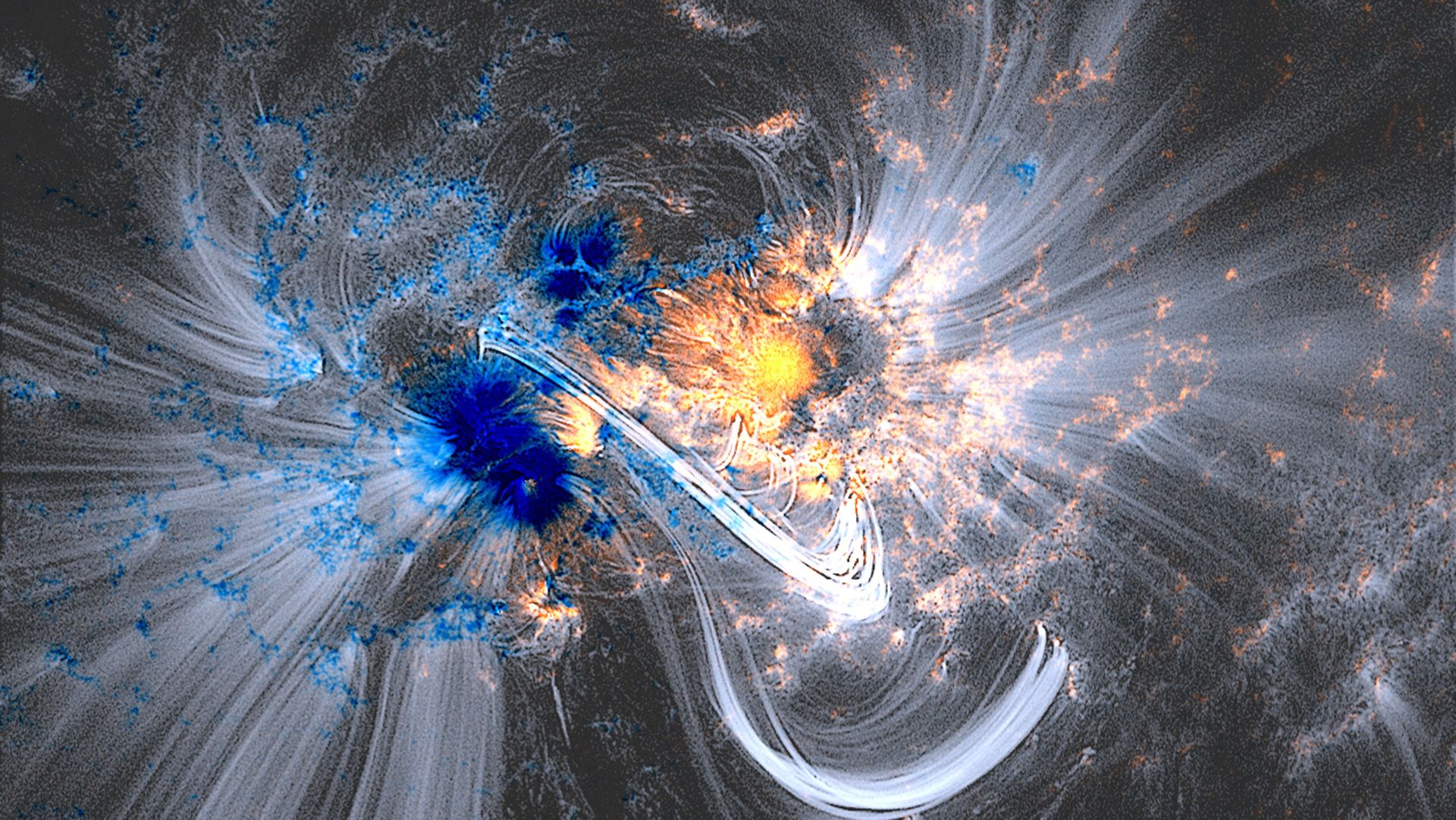
Luca Comisso, an astrophysicist at Columbia University, and Felipe Asenjo, a physicist at Adolfo Ibáñez University in Chile, discovered that gravitational fields may undergo a process similar to magnetic reconnection observed in the sun's plasma. Using Einstein's theory of general relativity expressed through a mathematical framework called the tetrad formulation, they found that sheet-like structures in gravitational fields can break apart and reconnect in new arrangements.
The researchers published their findings on October 28 in the journal Physical Review D. They showed that gravitational field sheets, which extend through both space and time, can snap and rejoin under certain conditions. This occurs only when no alternative flow exists to keep the sheets frozen in place while slipping relative to their carriers.
"Gravitational field sheets can break and reconnect in a different arrangement, much like magnetic field lines do in plasmas," Comisso said in an email. The reconnection process changes how gravity and matter exchange energy and momentum locally, and can create or destroy gravitational helicity, a property measuring how twisted and interlinked gravitational field lines are.
Comisso emphasized that the findings require no new physics. "Everything follows from Einstein's general relativity," he said. The researchers derived equations describing how quickly gravitational reconnection can occur and how it affects energy and momentum transfer.
What could trigger gravitational reconnection in nature remains unclear. Candidates include singularities at the centers of black holes, accumulations of very small gravitational ripples, and quantum effects linked to Hawking radiation. Comisso suggested that gravitational reconnection might play a role in extreme events like merging black holes or colliding neutron stars, and could potentially leave signatures in gravitational waves detected by observatories like LIGO.