An international team of researchers has identified a 237-million-year-old armored amphibian that lived entirely in the ocean, marking the first convincing fossil evidence of an amphibian with this ability. The species, Gerrothorax maritimus, was discovered in two exceptionally preserved skeletons from China's Guizhou Province and described in Nature Ecology & Evolution.
The finding surprises scientists because modern amphibians cannot survive in saltwater. Of more than 8,000 living amphibian species, none spend their entire lives in marine environments, and fewer than 2% tolerate salt at all. Mammals, reptiles, and birds all include fully marine species, but amphibians have never shown this capability until now.
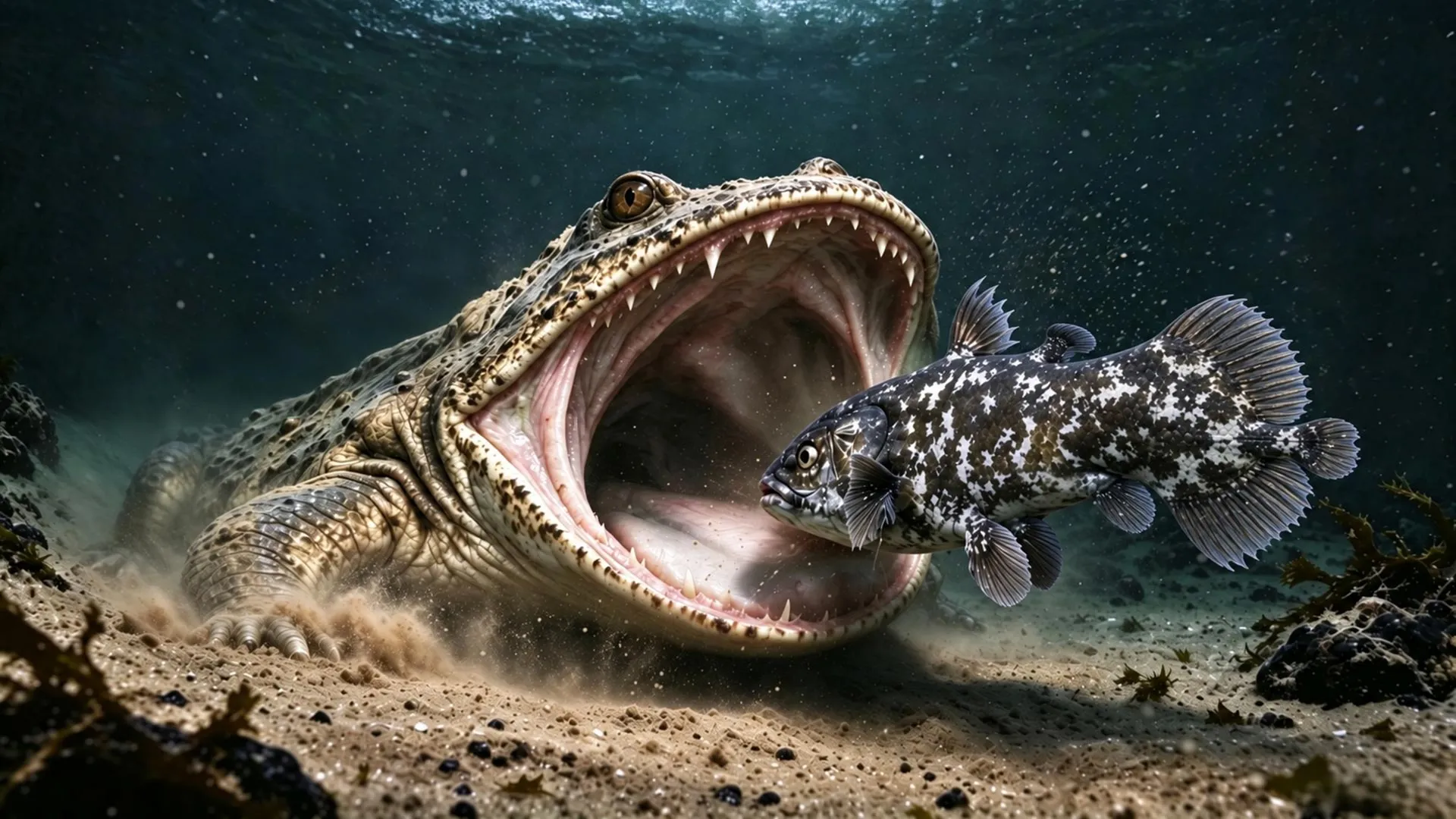
Gerrothorax maritimus measured nearly three feet long with a broad, flattened body covered in thick bony armor. Ryosuke Motani, a professor in the Department of Earth and Planetary Sciences at UC Davis and corresponding author, described it as "chunky" compared to modern elongated salamanders. Its skull structure and heavy armor suggest it was an ambush predator that waited on the seafloor for prey to approach, then used suction to capture food.
The animal likely overcame saltwater's toxicity through multiple adaptations. Amphibian skin is permeable, allowing water and gases to pass through, which poses problems in salt water. Researchers propose that Gerrothorax maritimus' extensive bony armor restricted water movement through its skin, reducing dependence on absorbing water directly. The animal may have ingested seawater through its mouth instead, absorbing water through its digestive tract while gills eliminated excess salt.
Multiple lines of evidence confirm the animal lived at sea. The skeletons came from deep marine sediment deposits. Their completeness, including preserved fingers, indicates the bodies did not travel far before sinking. Chemical analysis of strontium isotopes in the fossils matched signatures expected in Late Triassic ocean water.