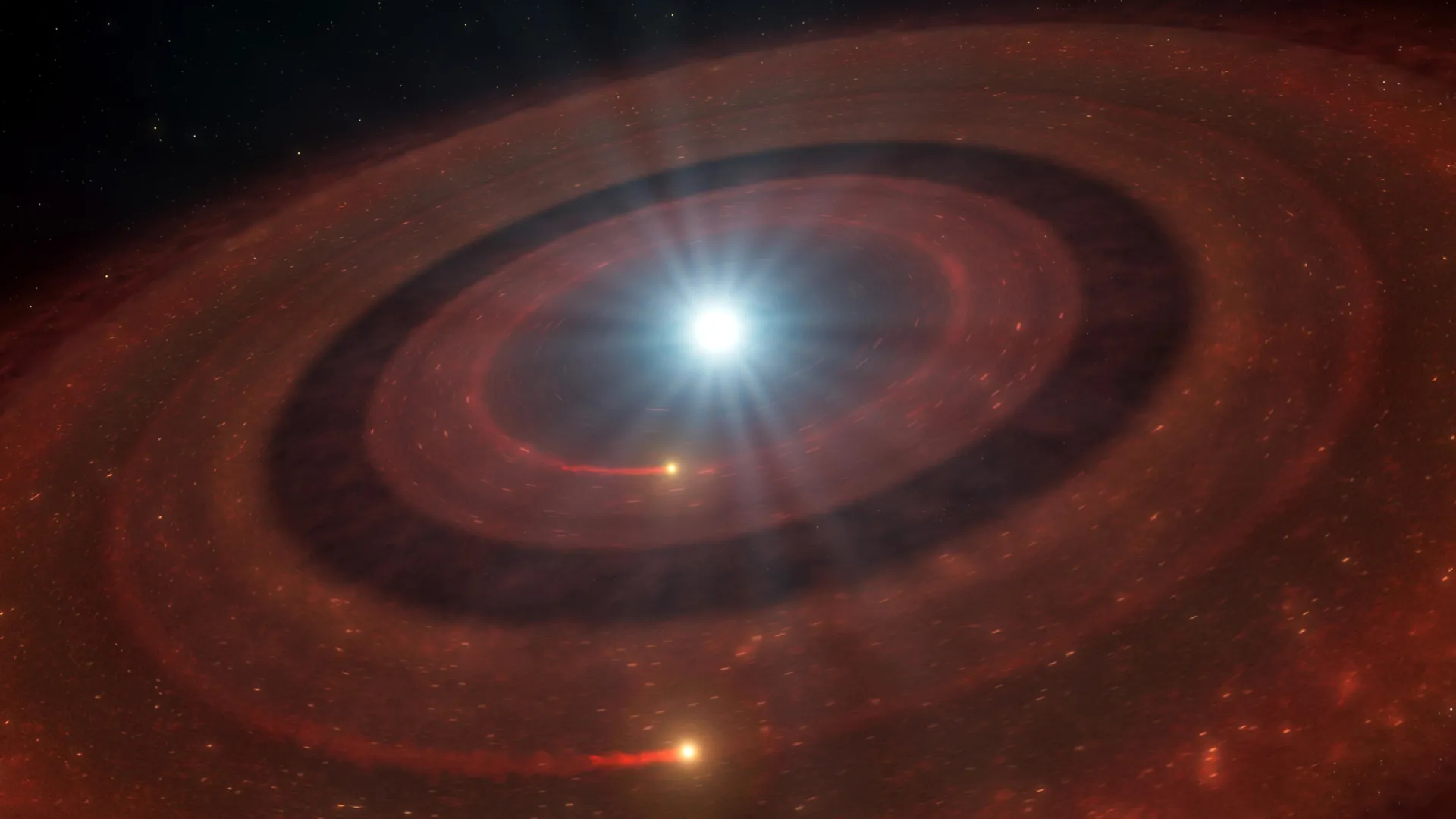
Astronomers using the European Southern Observatory's Very Large Telescope discovered an unusual double ring of planetary debris around a white dwarf called J1328-1450. The two rings are separated by a clear gap, unlike the single debris discs previously observed around dead stars.
"We have known for some time that planets may survive beyond the transformation of their central star, but this is the first example of a complex system with a double debris disc and potentially two surviving planetesimals," says Nicola Gentile Fusillo, lead author of the study published in Nature Astronomy and an astronomer at the Università degli Studi di Trieste in Italy.
Researchers believe two surviving planetary bodies maintain the ring structure. One is thought to be a few kilometers across, comparable to an asteroid. The other could be as large as Pluto or the Moon. The X-Shooter instrument on the telescope analyzed light across multiple wavelengths to reveal the debris's chemical makeup and motion.
The debris contains calcium, oxygen, magnesium, and iron, elements found in rocky planetary material. The two rings have noticeably different chemical compositions. The inner ring contains substantial amounts of magnesium gas, while the outer ring is largely depleted of it. This suggests the material may have originated from separate planets with different compositions, or from different layers of the same planetary body.
"The structure we see in this system is particularly intriguing because the two gaseous rings are remarkably stable and remain separated by a gap," says co-author Felipe Lagos-Vilches, an astronomer at the University of Warwick in the UK and at the Universidad Técnica Federico Santa María in Chile.
The discovery offers insight into what could happen to our Solar System. Billions of years from now, the Sun will expand into a red giant and eventually become a white dwarf. J1328-1450 suggests that some objects may survive such a transformation, while others shatter into debris in complex arrangements.
"The system therefore offers a remarkable glimpse of what the future of planetary systems, including systems like our own, might look like," concludes Lagos-Vilches.