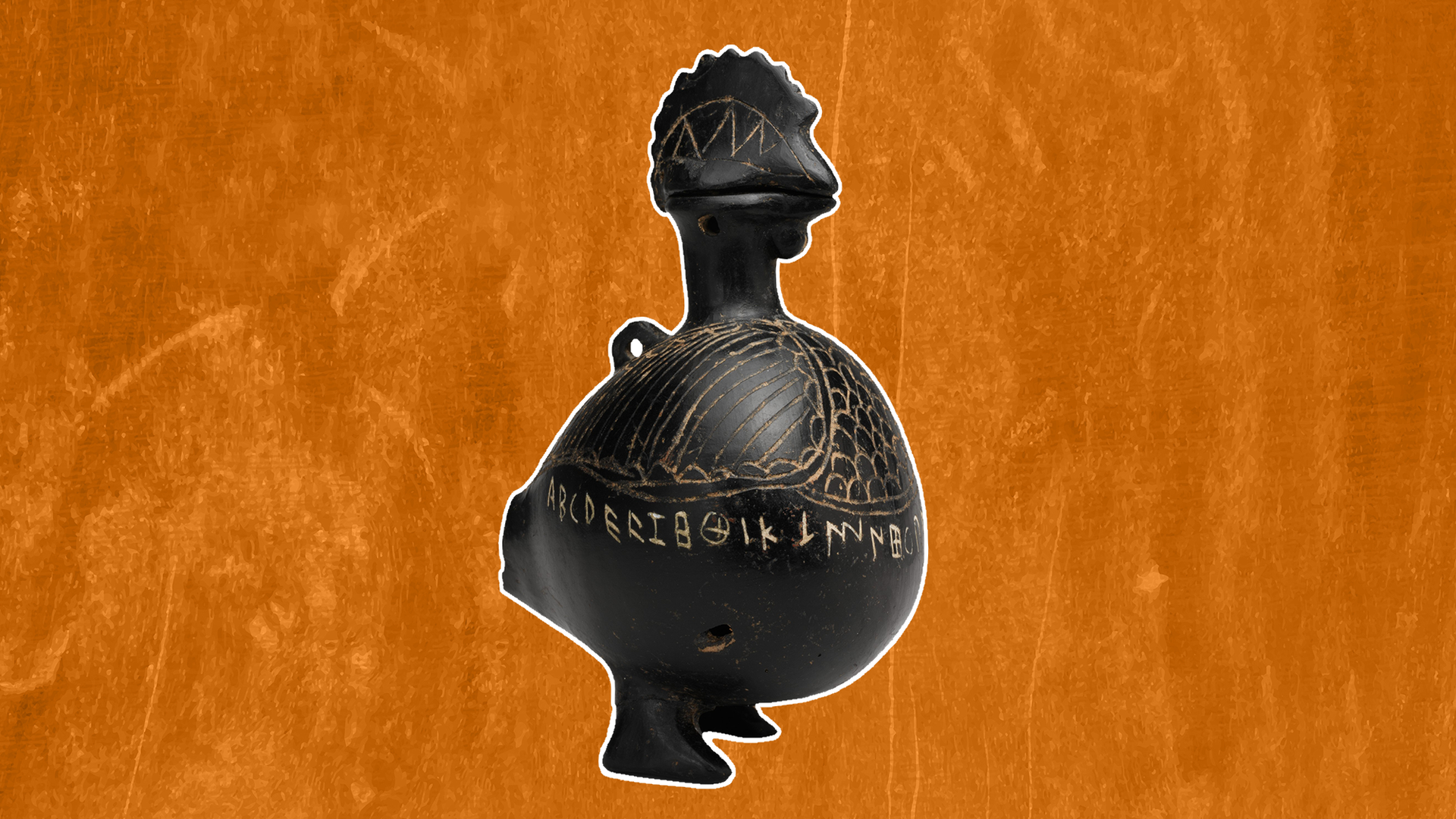
A terracotta vase shaped like a cockerel with human feet, made by the ancient Etruscans around 650 to 600 B.C., preserves an inscribed alphabet that provides clues to a still-undeciphered language. The small vessel, standing just over 4 inches tall and made of bucchero, a dark-black ceramic trademark of Etruscan pottery, now resides in the Metropolitan Museum of Art in New York City.
The vase features an abecedarium, a sequential listing of the Etruscan alphabet's 26 letters. According to The Met, the artifact may have served as a portable inkwell for someone learning to write. The cockerel's head functioned as a stopper, loosely attached to the body by a cord through loops.
The inscription contains an error. Someone inscribed the letter S twice at the end of the alphabet. The second S should appear as an X, according to The Met.
The vase likely originated from a grave in one of the cemeteries surrounding Viterbo, an ancient Etruscan town about 50 miles northwest of modern-day Rome, though its exact discovery location remains unclear.
Archaeologist Gisela Richter noted in a 1930 Metropolitan Museum catalog that the cockerel vase helped experts partially decode the Etruscan language by preserving the letter order. The Etruscan alphabet derived from a regional version of the Greek alphabet adopted in the early eighth century B.C. Although scholars can sound out Etruscan words using the Greek alphabet connection, the language remains only partially understood. Over 10,000 Etruscan inscriptions have been found, but they tend to be short, and any lengthy Etruscan literature that once existed has been lost.