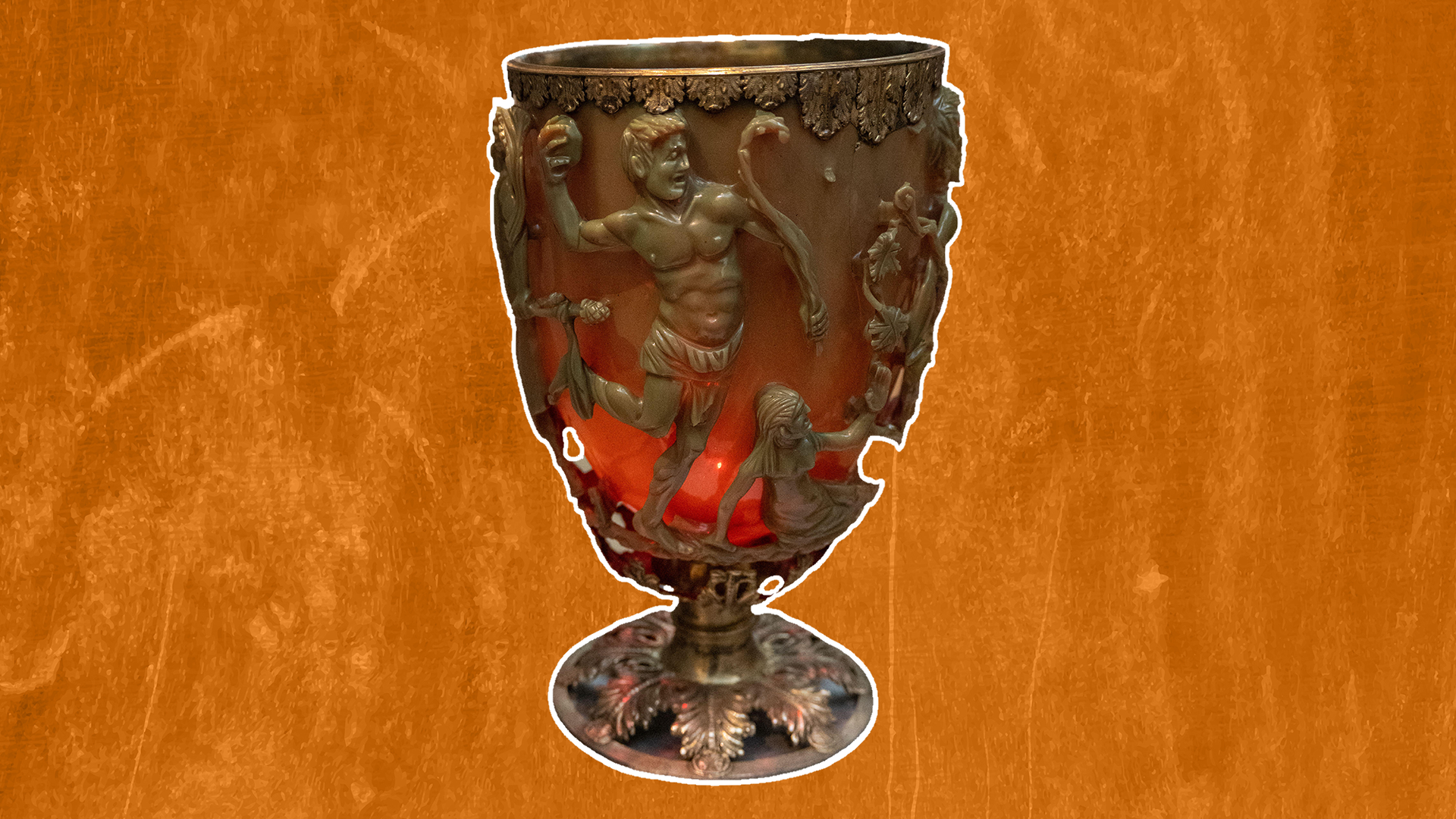
The Lycurgus Cup, a Roman glass goblet from the fourth century A.D., shifts color from jade green to ruby red depending on whether light hits its front or back. The British Museum acquired the cup in 1958 from the Rothschild banking family, which owned it since the mid-19th century.
The goblet stands about 6.3 inches tall and weighs around 1.6 pounds. It depicts the mythical punishment of King Lycurgus, who angered the god Dionysus by banishing him. The cup is a rare example of a Roman "cage-cup," made by cutting and grinding decoration into thick glass while leaving small bridges to keep the design attached, creating a cage-like effect.
Archaeologists D. B. Harden and Jocelyn Toynbee estimated in a 1959 study that the cup was manufactured in the fourth century, likely in Italy, though the bronze frame forming the stem and rim is probably a 19th-century addition.
The color-changing effect results from microscopic nanoparticles of gold and silver added during glassblowing, according to a 1963 study. These metal particles, smaller than grains of sand, interact with light to create the appearance of milky-green glass when lit from the front and nearly translucent red glass when lit from behind. Ancient Roman historical records mention dichroic cups, including a second-century letter possibly from Emperor Hadrian describing two such cups as banquet gifts. Very few fragments of this glass type survive today.
Experts have replicated the effect. Corning Glassworks produced a replica in the 1960s that shifted from green to amethyst. In 2020, researchers used silver and gold nanoparticles in 3D printing to replicate the properties. Researchers at the University of Sheffield reverse-engineered the recipe and commissioned a glass artist to create a Lycurgus-inspired design.
However, experts remain uncertain whether Roman artisans intentionally created the color-changing effect or whether traces of gold accidentally slipped into the molten glass during crafting.