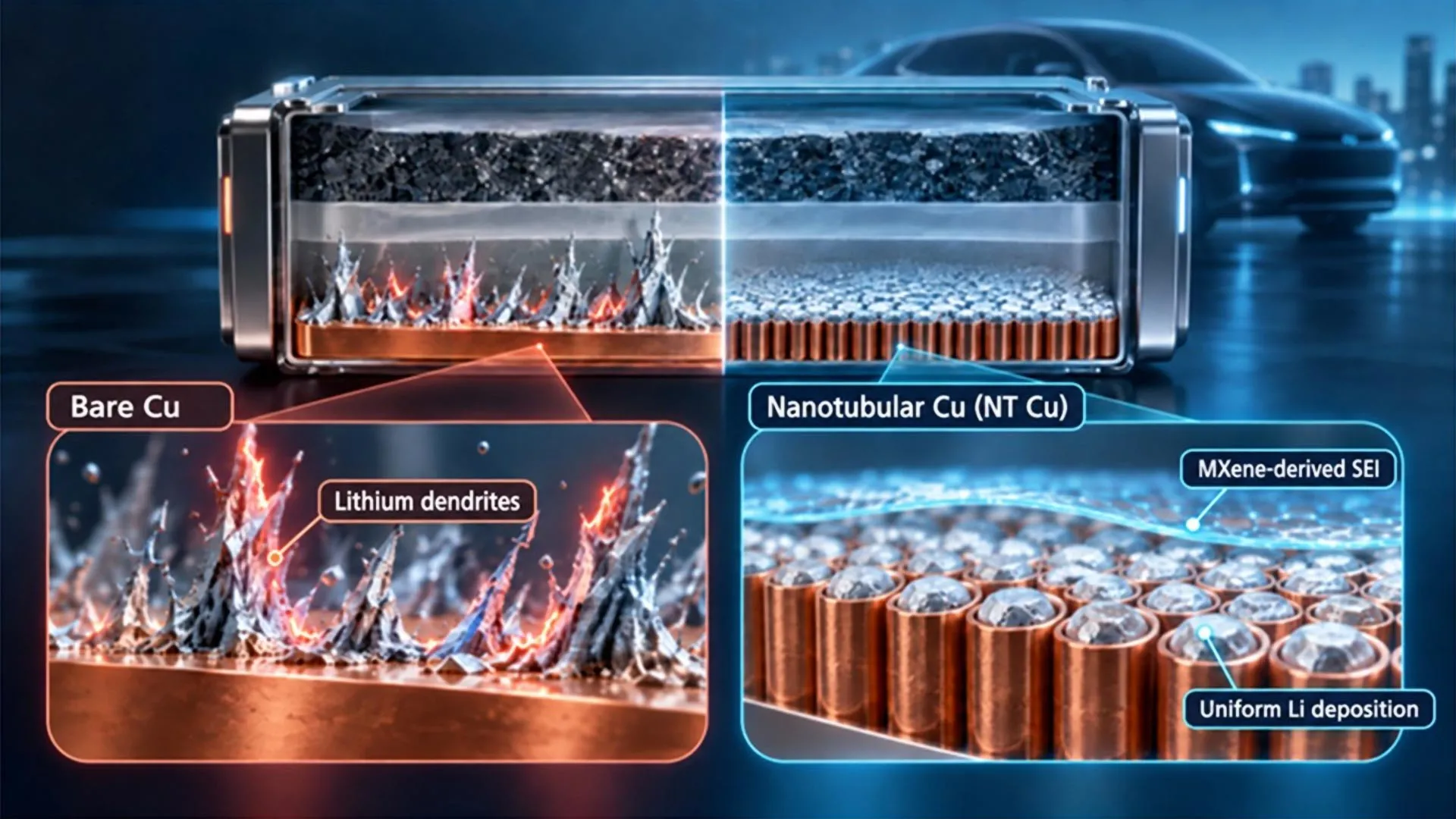
Researchers at KAIST in South Korea have developed a technique to improve anode-free batteries, which could enable smaller electric vehicle batteries with longer driving ranges. The team, led by Professors Jinwoo Lee and Hee-Tae Jung of KAIST's Department of Chemical and Biomolecular Engineering, worked with scientists from Kyungpook National University and the National NanoFab Center.
Anode-free batteries store lithium directly on copper foil instead of in graphite, reducing weight and size while storing more energy. However, lithium accumulates unevenly during charging, forming needle-like dendrites that degrade the battery and shorten its lifespan.
The researchers addressed this by adapting secondary sputtering lithography, a semiconductor manufacturing technique, to create microscopic tubes across the copper surface. Each tube measured approximately 300 nanometers across and 150 nanometers tall, increasing the copper foil's surface area for lithium deposition to roughly four times that of a flat sheet. The patterned structure distributes lithium more evenly and reduces damaging spike formation.
The team also applied a 10-nanometer-thick coating of MXene, a two-dimensional material, to the copper foil. The coating acts as a foundation that encourages development of a stable protective layer during operation. This layer contains high concentrations of lithium fluoride, which limits unwanted chemical reactions and restricts dendrite growth.
Professor Jinwoo Lee said, "This study shows how ultrafine fabrication techniques used in semiconductor manufacturing can create both uniform sites for lithium deposition and a stable protective layer without changing the bulk electrolyte formulation or adding excess lithium."
The findings, published online September 1 in Advanced Functional Materials, suggest the technology could accelerate commercial development of anode-free batteries by improving lifespan while maintaining minimal additional weight and volume.