# Earth's Day Isn't Exactly 24 Hours. The Inner Core Likely Explains Why
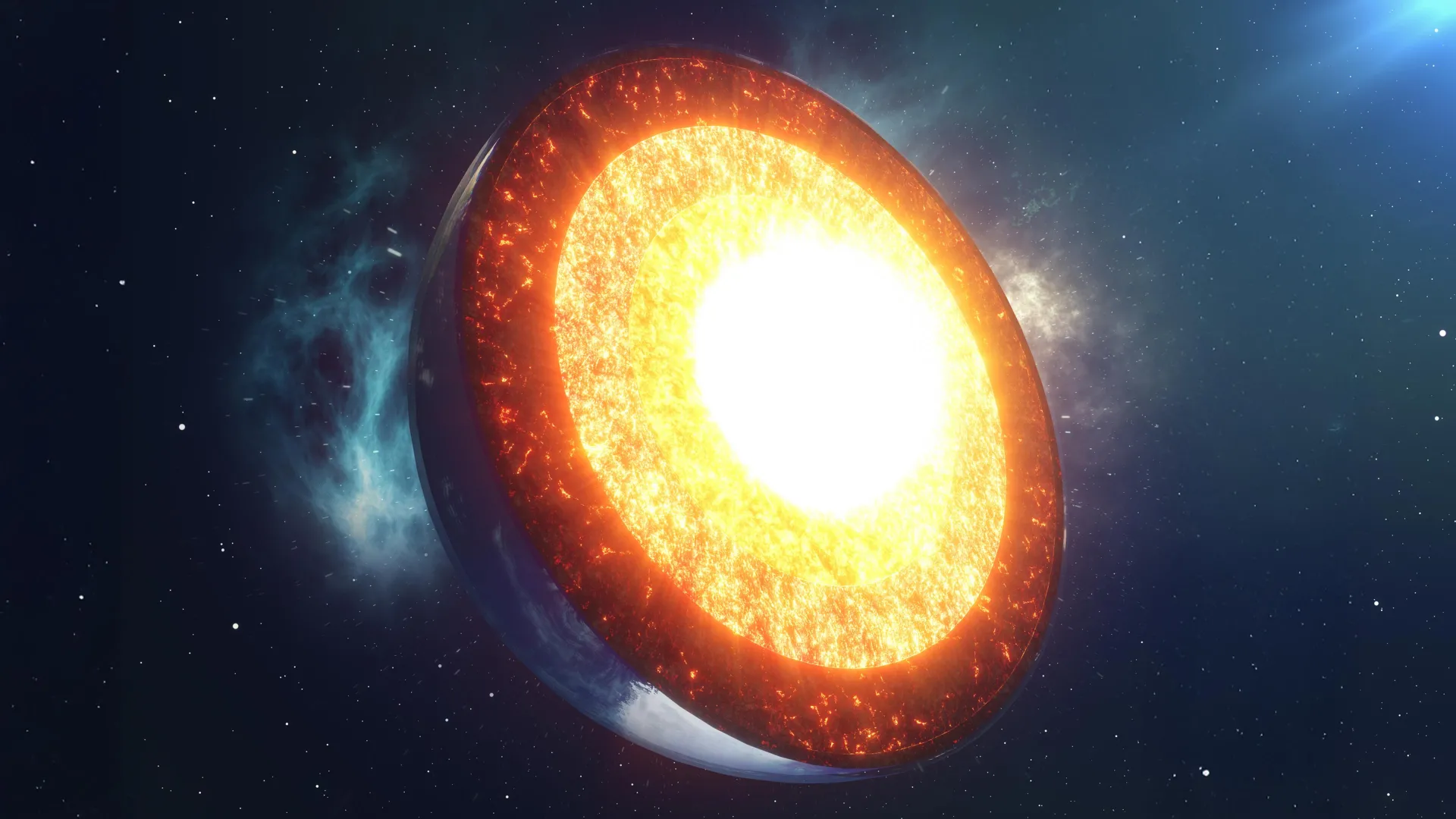
Earth's rotation speed fluctuates minutely, and scientists have identified a compelling culprit lurking nearly 3,000 kilometers beneath the surface. Shifts in the planet's inner core appear to alter the length of a day by a few milliseconds over the span of decades, according to research suggesting the planetary interior functions as a far more active system than previously understood.
The inner core, a solid sphere of iron and nickel roughly the size of the moon, does not rotate perfectly in sync with Earth's surface and outer layers. Instead, it drifts relative to the rest of the planet. This subtle relative motion creates friction and gravitational interactions that ripple outward through the mantle, ultimately affecting how quickly the entire planet spins.
When the inner core shifts, it redistributes mass and angular momentum throughout the Earth's interior. These redistributions propagate upward, modifying the torque exerted on the crust and oceans. The result manifests as tiny variations in day length, changes observable only through extremely precise atomic clocks and satellite measurements.
The discovery emerged from years of data analysis tracking minute variations in Earth's rotation. International research teams compiled measurements from diverse sources, including astronomical observations spanning centuries and modern laser ranging systems that measure the distance to satellites and the moon with millimeter accuracy. By comparing these datasets, scientists identified a periodic pattern in day-length fluctuations that correlated with the known behavior of the inner core.
This explanation resolves a long-standing puzzle in geophysics. Researchers had previously attributed day-length changes to several factors including shifts in ocean currents, atmospheric circulation patterns, and movements in the liquid outer core. While these mechanisms remain valid, they accounted for only part of the observed variations. The inner core's influence fills the remaining gap.
Understanding what happens deep within Earth matters beyond academic curiosity. Precise knowledge of planetary rotation underpins global positioning systems, telecommunications networks, and astronomical observations. As these technologies grow more refined, accounting for subtle rotational variations becomes increasingly necessary. GPS systems already incorporate relativistic corrections and atmospheric delays. Adding accurate inner-core dynamics improves positional accuracy further.
The inner core itself remains a frontier of planetary science. Scientists know it exists and that it rotates differently than the surface, but its exact composition, temperature gradients, and behavior remain incompletely understood. The new findings suggest the inner core plays a more active role in planetary dynamics than previously recognized, possibly influencing phenomena beyond rotation rates.
This research underscores how interconnected Earth's systems truly are. Changes in the deepest interior can propagate outward to affect timekeeping at the surface. The planet functions less like a static shell and more like an intricate machine with moving parts, each component influencing others through gravitational and frictional forces operating over geological timescales.
Future work will likely focus on developing more detailed models of inner-core behavior and refining measurements of how it shifts. Researchers may also investigate whether inner-core dynamics influence other phenomena such as magnetic field variations or long-term climate patterns, extending the implications of this discovery beyond the realm of timekeeping into broader Earth system science.