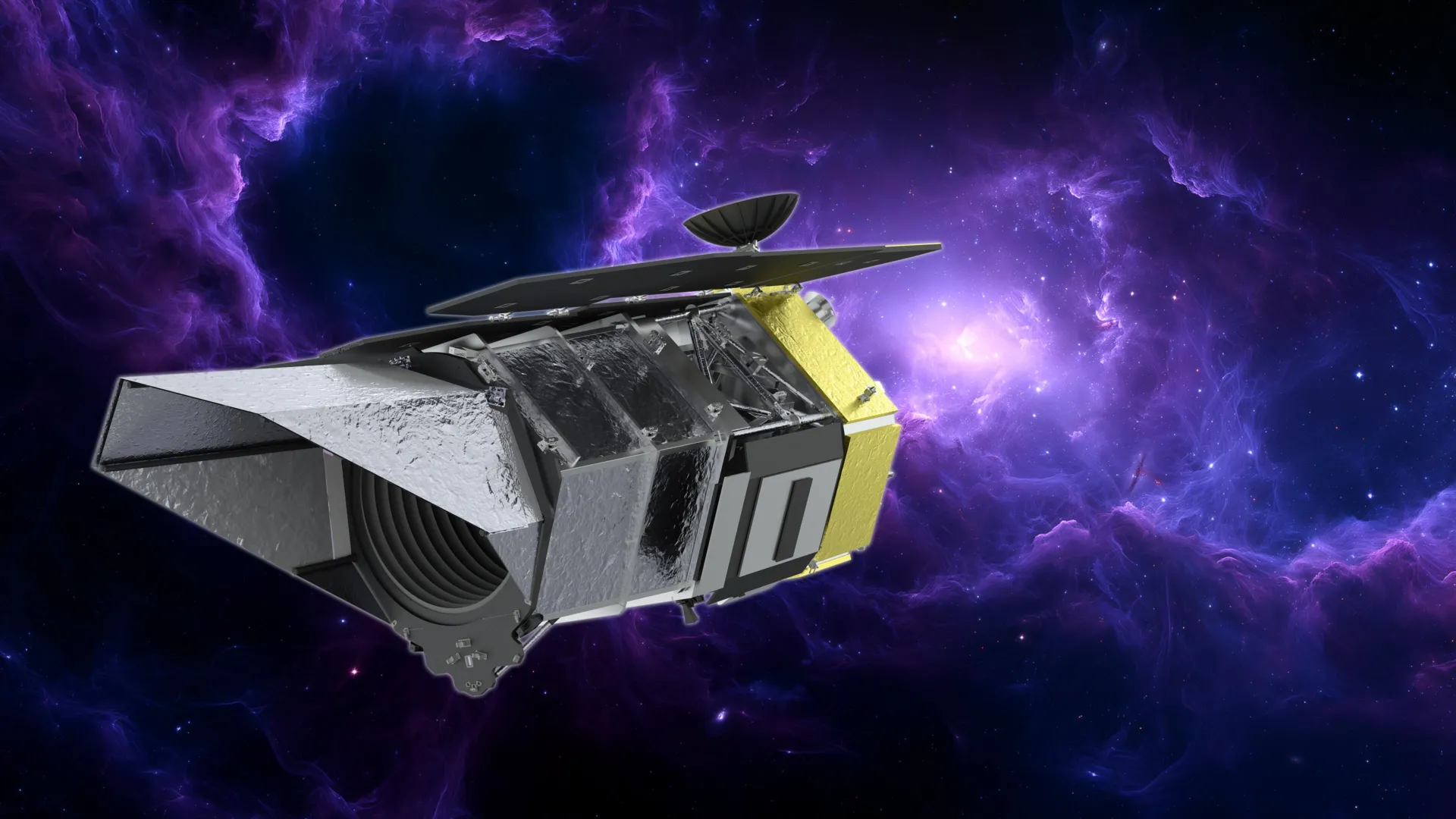
NASA has completed a major milestone for the Roman Space Telescope by powering up its primary 300-megapixel infrared camera for the first time. The Wide Field Instrument passed all activation tests and is performing at design specifications, the space agency confirmed following the successful power-on in recent weeks.
The camera represents the observatory's workhorse sensor. It will capture vast expanses of the universe in infrared wavelengths while maintaining the sharpness and clarity that made the Hubble Space Telescope an icon in astronomy. The Wide Field Instrument's 300-megapixel resolution allows it to image areas of sky roughly 100 times larger than what Hubble can observe in a single exposure, enabling Roman to survey billions of galaxies across cosmic history.
Roman's coronagraph instrument also activated without issues. This specialized tool blocks out starlight to reveal planets orbiting distant stars, a capability that opens new avenues for detecting potentially habitable worlds beyond our solar system. The coronagraph represents one of the most technically challenging components aboard Roman, designed to suppress the overwhelming brightness of host stars and image the much fainter planets nearby.
The telescope is now progressing through its commissioning phase after launching in May 2023. Both instruments returning to functional status removes major technical risks from the project timeline. NASA expects Roman to begin full science operations by 2027, roughly a decade after the space agency began developing its capabilities.
Roman represents a successor mission to Hubble while building on lessons learned from the James Webb Space Telescope. The observatory will operate at infrared wavelengths, allowing it to peer deeper into space and time than visible-light telescopes. Its wide field of view and infrared sensitivity make it particularly suited for studying the universe's earliest galaxies, mapping the large-scale structure of the cosmos, and searching for habitable exoplanets.
The $2.4 billion mission carries scientific instruments developed at multiple institutions. The Wide Field Instrument comes from Ball Aerospace and teams at NASA's Goddard Space Flight Center. The coronagraph received contributions from researchers at the Jet Propulsion Laboratory and academic partners across the country.
Successful camera activations follow months of careful testing and validation. Engineers powered up Roman's various systems incrementally after its launch, checking electrical connections, thermal performance, and sensor responsiveness. The infrared camera required particular attention because imaging sensors operate at cryogenic temperatures and demand precise calibration.
The next commissioning phases will involve further testing of image quality, focus mechanisms, and the interaction between multiple instruments. Teams will also verify that Roman's scientific data meets requirements for the wide range of observations astronomers expect to conduct. These steps typically require several months and sometimes years for space telescopes, though Roman's schedule targets completion by late 2026.
The successful activation of Roman's primary instruments keeps the mission aligned with its 2027 science operations target. Early activation success reduces the likelihood of delays that plagued other recent missions. Roman will eventually compile images that reshape understanding of cosmic expansion, the nature of dark energy, and the prevalence of planets around other stars.