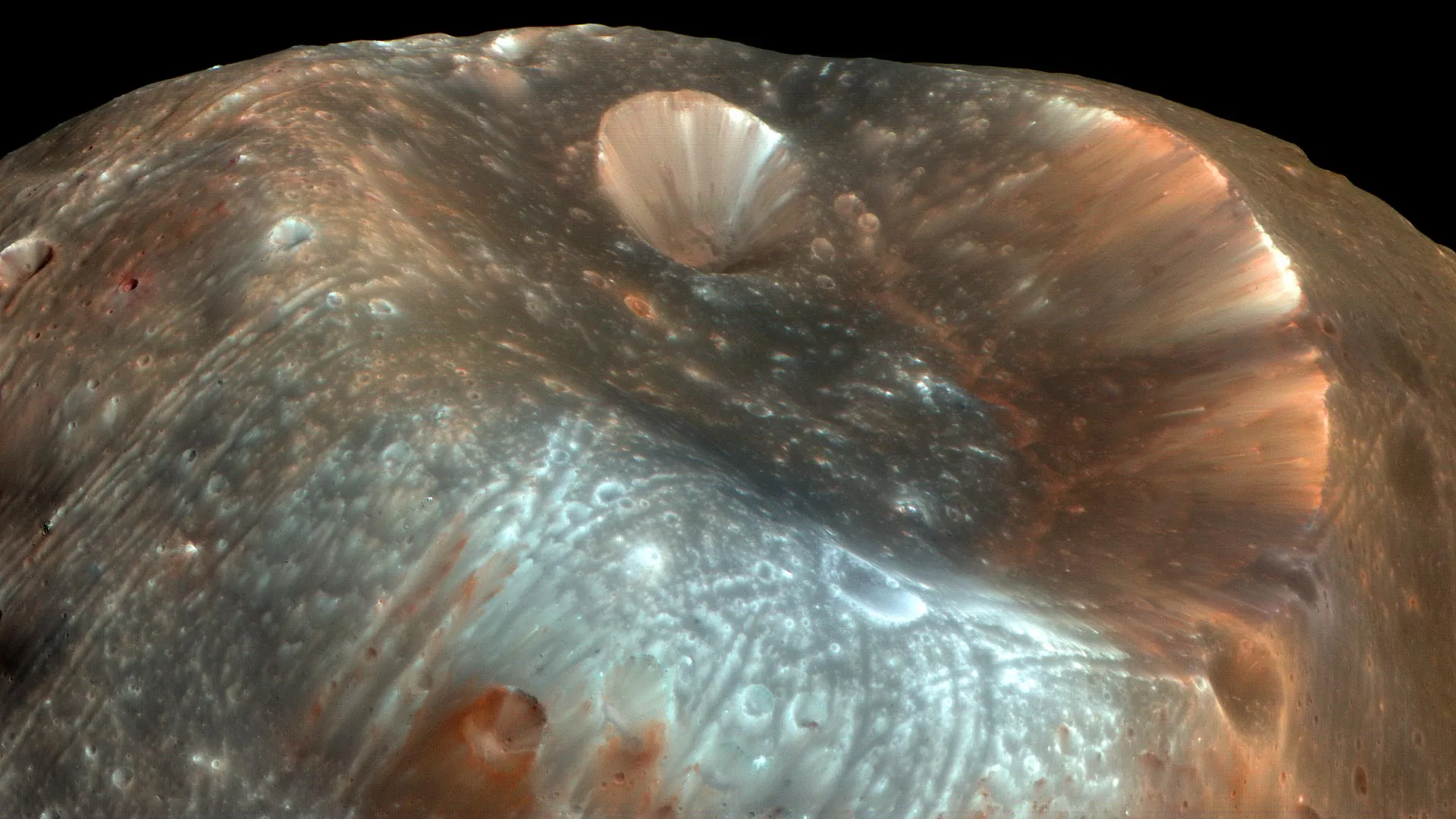
# Japanese Mars Mission Targets Phobos Crater to Solve Moon's Origin Mystery
Japan's space agency is preparing a sample return mission that could finally answer a fundamental question about Mars: Is the planet's moon Phobos a captured asteroid, or was it born from debris ejected in an ancient collision?
A massive crater on Phobos may hold the key. The crater's formation process could have exposed or compressed material that retains clues about the moon's true origin. By collecting physical samples and taking precise measurements, Japan's Martian Moons eXploration mission, or MMX, aims to distinguish between these competing theories.
The significance of this question extends beyond simple astronomical curiosity. Understanding how Phobos formed shapes our understanding of planetary formation processes, moon dynamics, and the early history of Mars itself. The two origin scenarios predict fundamentally different compositions. A captured asteroid origin would give Phobos material similar to carbonaceous asteroids found in the outer solar system. An impact-derived moon would instead contain material matching Mars' crustal composition. Laboratory analysis of Phobos samples would reveal which scenario matches reality.
Phobos presents an unusual target for sample collection. The moon orbits Mars at just 9,276 kilometers above the planet's surface, making it the closest moon to any planet in the solar system. This proximity affects its long-term stability. Gravitational forces from Mars continuously pull at Phobos, slowly drawing it closer. Models suggest the moon will either spiral into Mars and disintegrate in roughly 30 to 50 million years, or break apart before that occurs. This makes Phobos scientifically urgent. The window for studying this world directly is finite on geological timescales.
The crater's density anomaly offers a path forward. Impact events compress and alter subsurface material, potentially preserving compositional signatures that surface weathering erases. By measuring gravity fields with exceptional precision and collecting rock samples from the crater region, MMX can determine whether the compressed material matches predictions for either origin scenario.
The MMX mission represents an ambitious undertaking. The spacecraft will travel to Mars orbit, approach Phobos, and deploy a sampling device to collect material from the lunar surface. Collection points include the massive crater and other regions, providing comparative data. The spacecraft will then return these samples to Earth, where teams of scientists will perform laboratory analyses impossible to conduct remotely.
Previous orbital observations of Phobos, including data from NASA's Mars Reconnaissance Orbiter and the European Space Agency's Mars Express, have provided tantalizing clues but lack the resolution and compositional detail that direct sampling enables. These observations show Phobos is darker and less reflective than most asteroids. Some measurements suggest composition similar to carbonaceous chondrite meteorites. Yet ambiguity remains. Direct sample analysis removes this uncertainty.
The mission also addresses practical concerns for future Mars exploration. Phobos could serve as a staging point or fuel depot for crewed missions to Mars. Understanding its composition helps engineers assess its utility for resource extraction or operations support.
MMX's launch timing places it among the next generation of Mars sample return missions. While NASA and ESA pursue samples from Mars itself through their Mars Sample Return campaign, Japan targets the Martian system's most enigmatic body. Together, these initiatives promise to reshape understanding of this corner of the solar system.