# Ancient Mega-Scorpion Reveals Secrets of Arthropod Gigantism Before Forests Emerged
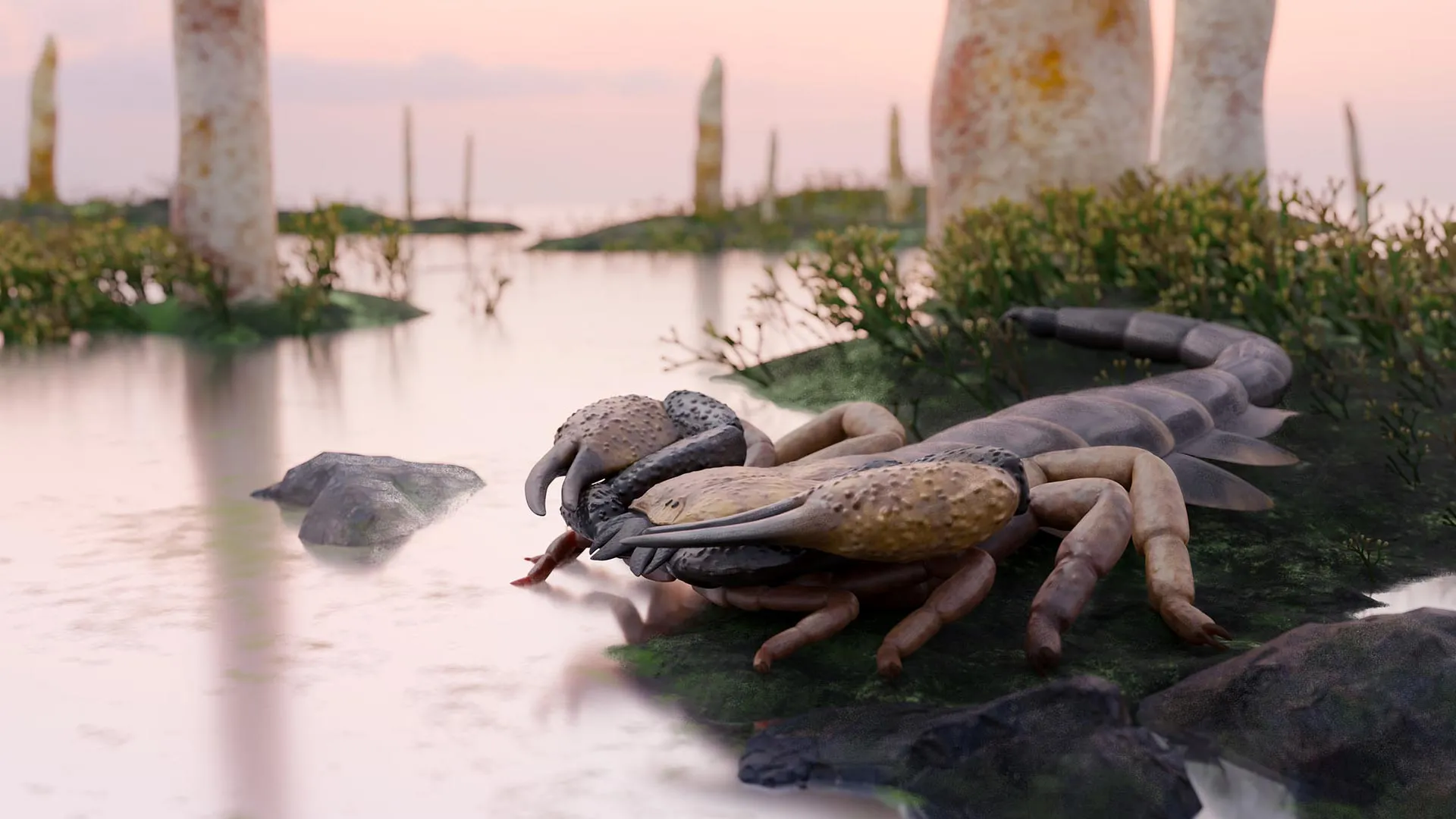
A meter-long scorpion with outsized pincers prowled ancient Britain 415 million years ago, fundamentally challenging assumptions about when and how arthropods grew to massive sizes. The discovery pushes back the timeline of gigantism in arthropods by tens of millions of years, well before the emergence of forests that scientists long believed enabled the evolution of enormous insects.
The specimen belongs to the scorpion lineage and reached approximately one meter in length, making it comparable in size to a coffee table. Researchers identified this ancient predator through fossilized remains found in Britain, dating to the early Devonian period. The creature possessed disproportionately large pincers that would have made it a formidable hunter in its environment.
The significance lies not merely in its impressive dimensions but in the timing. Conventional wisdom held that the "age of giant insects" occurred during the Carboniferous period, roughly 360 to 300 million years ago. That era featured atmospheric oxygen levels nearly 50 percent higher than today, and dense forest ecosystems that supposedly created the conditions for arthropods to achieve enormous body sizes. This discovery demonstrates that gigantism emerged in arthropods at least 55 million years before forests became dominant features of terrestrial landscapes.
The fossil evidence suggests this scorpion may have occupied a semi-aquatic lifestyle, spending time both on land and in water. This ecological flexibility offers a new hypothesis for how early arthropods could reach such sizes. Rather than relying exclusively on high oxygen levels and forest ecosystems, aquatic and semi-aquatic environments may have provided the biological conditions necessary for body size expansion. Water offers greater buoyancy, reducing the structural demands on exoskeletons to support massive weight on land.
The creature's powerful pincers indicate a predatory lifestyle. In its time, Britain lay in tropical seas near the equator. Freshwater and brackish water environments would have teemed with early fish and other invertebrates, providing abundant prey for such an apex predator. The scorpion's semi-aquatic nature positioned it to exploit resources across multiple environments.
This discovery emerged from the Rhynie chert deposits in Aberdeen, Scotland, a famous fossil site that preserves ancient ecosystems with extraordinary detail. The Rhynie chert contains some of the earliest known terrestrial organisms, capturing a moment in Earth's history when life was transitioning from oceans to land. Finding such a large arthropod predator within these deposits reshapes our understanding of that transition period.
The research carries implications beyond scorpion evolution. It suggests that the mechanisms driving gigantism in arthropods operated differently and longer than previously thought. Scientists must now reconsider what environmental factors truly enabled body size expansion across arthropod lineages. Oxygen levels alone cannot explain these giant creatures, nor can the presence of forests.
Future research will likely focus on whether semi-aquatic lifestyles were common among early giant arthropods and how often this ecological pattern appears in the fossil record. The discovery opens new questions about the relationship between aquatic and terrestrial environments in shaping arthropod evolution during the early colonization of land.