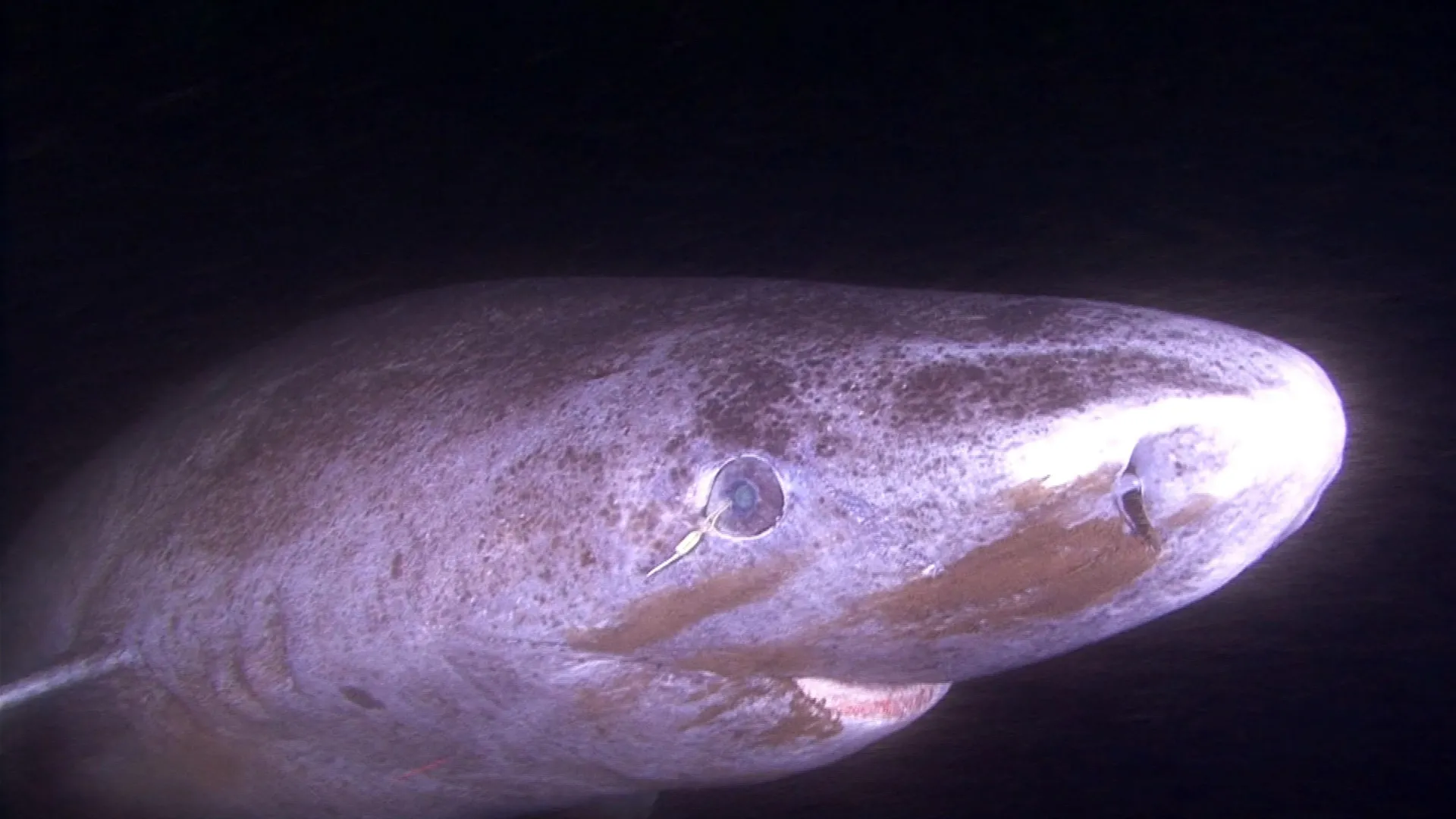
# Greenland Sharks Maintain Vision Across Four Centuries, Offering Clues for Human Eye Health
Greenland sharks possess a biological puzzle that challenges everything researchers understand about aging and vision loss. These Arctic predators live roughly 400 years without experiencing the retinal deterioration that typically accompanies age in other animals, according to new research into their eye tissue and molecular machinery.
Scientists examining Greenland shark eyes found healthy photoreceptor cells and active proteins specifically tuned to detect blue light, the wavelength that penetrates deepest into the dark Arctic waters where these sharks hunt. The tissue showed no signs of the protein accumulation and cellular damage usually seen in aging eyes.
The research team identified robust DNA repair mechanisms operating within the shark's eye cells. These cellular maintenance systems apparently work efficiently enough across centuries to prevent the buildup of mutations and oxidative damage that destroy vision in aging humans and other animals. The sharks maintain these protective systems throughout their entire lifespan, which researchers confirm extends to at least 400 years based on radiocarbon dating of specimens.
This discovery matters for human medicine because age-related macular degeneration and other vision loss conditions share common causes. When the retina's photoreceptor cells accumulate damage faster than repair mechanisms can fix it, vision declines. Understanding how Greenland sharks prevent this process could eventually lead to therapies that strengthen human DNA repair or reduce cellular damage in the eye.
The shark's specialized adaptations extend beyond just vision. Their metabolism operates at extremely low temperatures in the Arctic, slowing all biological processes. This metabolic depression may reduce the rate at which damaging free radicals form in cells. The protein modifications that allow their eyes to sense blue light also appear resistant to the misfolding and aggregation that damages vision in humans.
Researchers note that studying aging in long-lived species provides advantages over traditional laboratory models. A mouse lives two years. A human lives decades. A Greenland shark lives centuries, allowing researchers to observe how biological systems maintain function across timescales impossible to replicate in the lab.
The findings raise practical questions about translation to human medicine. Greenland sharks have evolved in extreme isolation from other vertebrates for millions of years. Their DNA repair systems may not transfer directly to human biology. Researchers must identify the specific genes and proteins responsible for eye maintenance before attempting to develop treatments.
The work also highlights how little remains known about animal biology in extreme environments. The deep Arctic ocean covers vast areas with minimal human observation. Other species living there may possess equally remarkable adaptations, waiting to be documented.
Scientists plan to continue examining other tissues in Greenland sharks to understand how their DNA repair mechanisms function across their entire bodies. The eye study focused on one organ system, but the sharks likely employ similar strategies to maintain function in their liver, heart, and other organs across their four-century lifespans.
This research demonstrates that aging is not inevitable. Evolution has produced solutions to problems that plague human health. Understanding those solutions requires patience, specialized equipment, and the willingness to study animals in their natural Arctic habitat, where Greenland sharks continue living out their centuries-long lives beneath the ice.