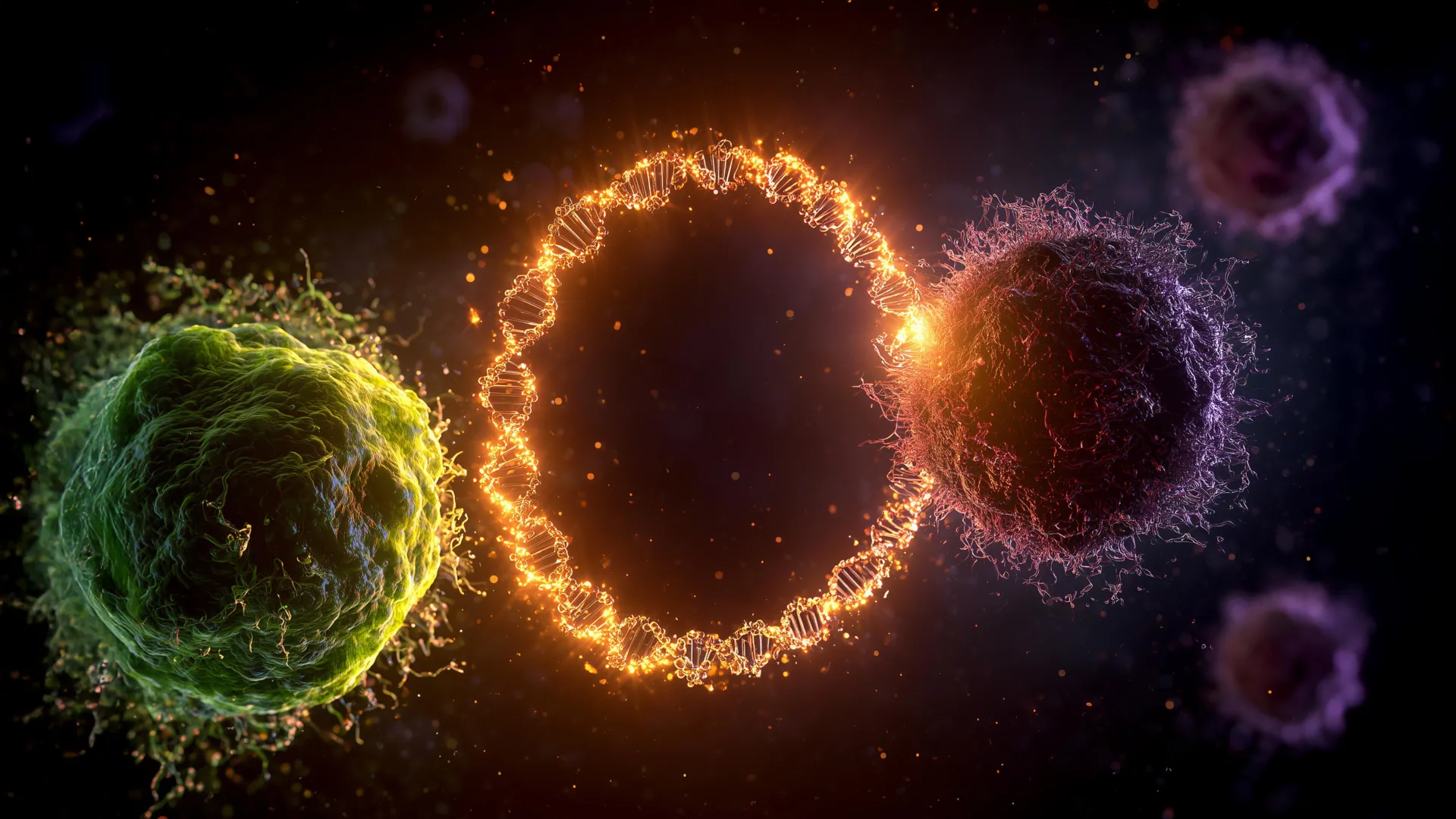
Researchers have discovered a novel mechanism for how jumping genes spread between species, potentially accelerating evolutionary change. Scientists found circular intron RNA from a predatory bacterium residing inside dead cells of another microorganism, revealing a previously unknown pathway for mobile genetic elements to transfer across species boundaries.
Jumping genes, or transposable elements, have long been understood to move between organisms primarily through viruses or plasmids. This new finding challenges that conventional view. The circular RNA, which forms a stable ring structure, resists degradation far better than linear RNA molecules. This stability allows the genetic material to persist in dead cells long enough to be acquired by neighboring organisms, providing jumping genes with an alternative delivery system beyond traditional viral or plasmid vectors.
The discovery emerged from studying microbial communities, where researchers tracked the movement of these mobile genetic elements. The ring-shaped RNA's durability proved crucial. Unlike linear RNA, which degrades quickly when exposed to cellular enzymes, the circular configuration protects the molecule from breakdown. This property gives jumping genes more time to encounter and enter new host cells.
The implications reach beyond simple gene movement. If jumping genes can transfer more frequently between species through this mechanism, evolutionary adaptation could occur faster than previously modeled. Organisms gain access to genetic innovations from distant relatives, potentially acquiring beneficial traits without waiting for traditional vertical inheritance from parent organisms.
The research opens questions about how widespread this transfer method operates across different microbial species and whether similar mechanisms function in larger organisms. Understanding these pathways matters for predicting how microbes acquire antibiotic resistance genes or other traits affecting human health and agriculture. The findings also reshape current models of horizontal gene transfer, the process by which organisms exchange DNA across species lines.
This work demonstrates that even well-established principles about genetic mechanisms contain surprises when examined closely in natural systems.