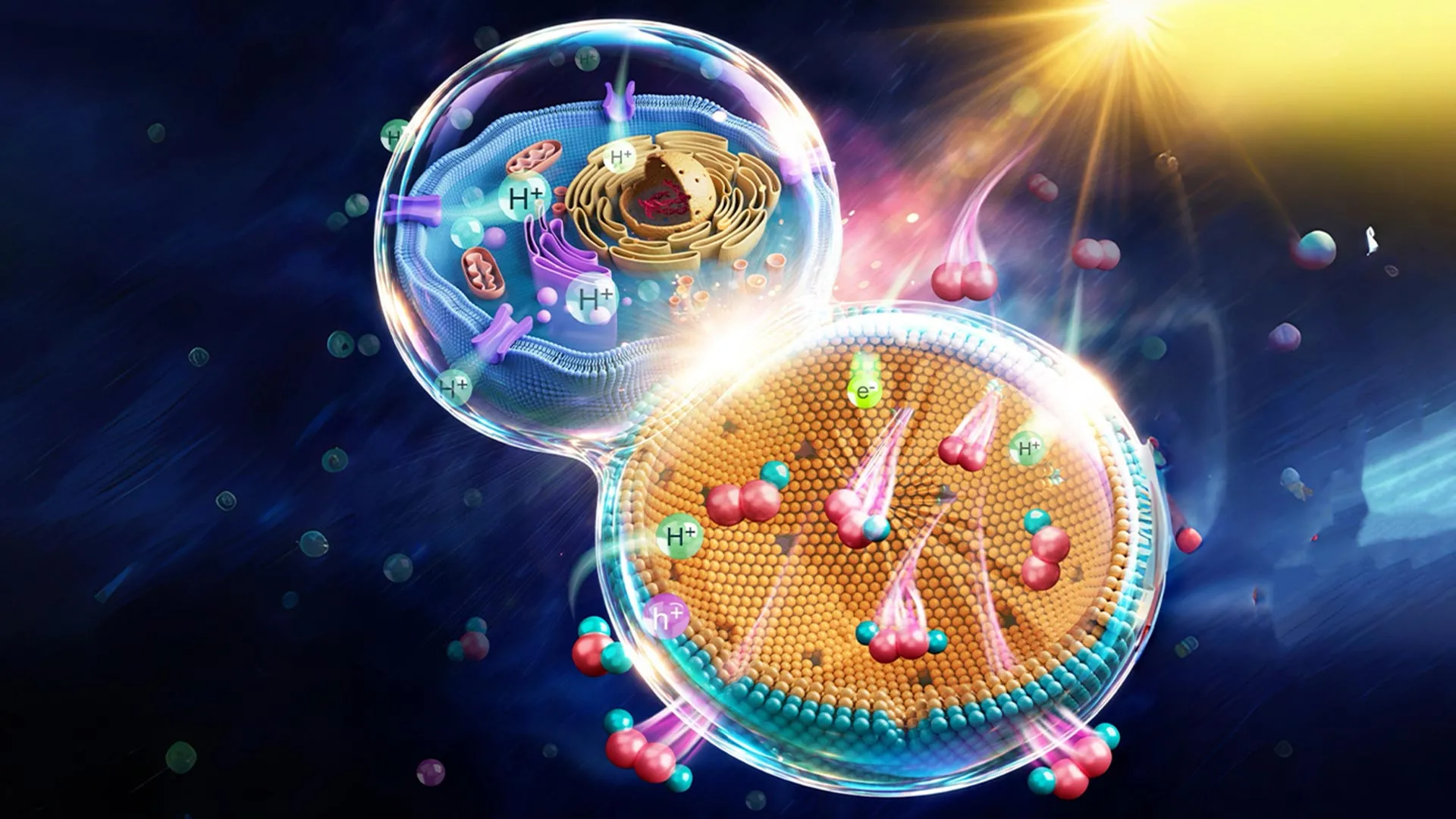
Researchers have designed a hollow nanoreactor that converts sunlight into hydrogen peroxide with greater efficiency by mimicking the architecture of living cells. The structure features a light-trapping cavity surrounded by a specialized shell that shuttles protons, enabling the direct synthesis of hydrogen peroxide from water and oxygen under visible light.
The nanoreactor addresses a long-standing challenge in green chemistry. Current industrial hydrogen peroxide production relies on fossil fuel-intensive processes that generate substantial chemical waste. This new approach offers a cleaner alternative by harnessing solar energy to drive the chemical reaction directly.
The cell-inspired design proves crucial to the innovation. The hollow interior acts as an optical cavity that concentrates and traps visible light wavelengths, enhancing light absorption. The outer shell contains organic molecules that facilitate proton transfer, replicating how cell membranes manage ion transport. Together, these features create conditions favorable for the two-electron reduction of oxygen to hydrogen peroxide.
Hydrogen peroxide has widespread industrial applications ranging from textile bleaching to pharmaceutical manufacturing. Conventional production generates significant byproducts and consumes energy from fossil fuels. A solar-driven synthesis pathway could substantially reduce the environmental footprint of these processes.
The research extends beyond hydrogen peroxide production. The team envisions adapting this nanoreactor design for other photochemical processes, including carbon dioxide reduction and nitrogen fixation. Both reactions remain essential targets for artificial photosynthesis and sustainable agriculture.
Limitations exist. Current efficiency levels require further optimization before commercial viability. The nanoreactors must demonstrate durability under extended operation and maintain performance as they scale up to industrial volumes. The research team continues testing different material compositions and geometric configurations to address these challenges.
This work represents progress toward artificial photosynthetic systems that can convert abundant solar energy into useful chemicals. By borrowing design principles from biology, researchers are developing technologies that operate closer to natural