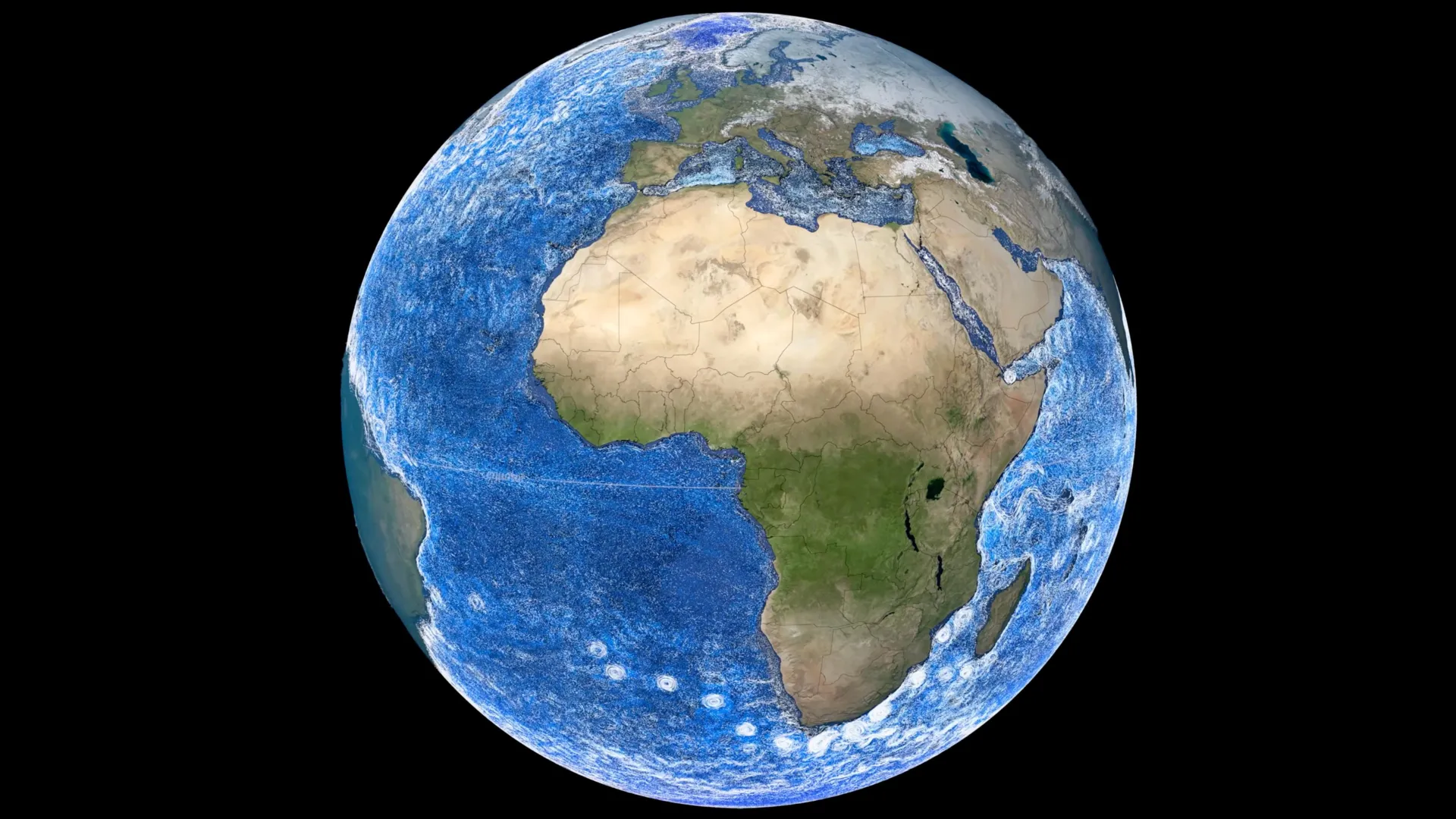
Ancient sediments from the ocean floor have upended assumptions about how the Atlantic Meridional Overturning Circulation (AMOC) responds to disruption. New research shows that during a cold period roughly 3.4 million years ago, the flow of warm, salty water from the Indian Ocean into the Atlantic nearly ceased, yet the AMOC maintained strength and even intensified in some regions.
The AMOC, Earth's primary oceanic "conveyor belt," carries warm water northward and cold water southward. Scientists had assumed that cutting off the Indian Ocean inflow—a major source feeding the system—would necessarily weaken the entire circulation. Instead, the geological record tells a different story.
Researchers analyzing ancient seafloor sediments discovered evidence that when the Indian-Atlantic connection weakened dramatically, parts of the overturning circulation compensated by growing stronger. This counterintuitive resilience suggests the AMOC has built-in redundancies and adaptive mechanisms scientists did not fully appreciate.
The findings carry implications for modern climate concerns. Scientists worry that freshwater from melting Greenland ice could disrupt the AMOC, potentially destabilizing European climate. The new evidence that AMOC survived a major external shock 3.4 million years ago might offer some reassurance. However, researchers stress that past resilience does not guarantee future stability, particularly given the rate and scale of current climate change.
The study analyzed geochemical signatures preserved in seafloor mud, tracking both ocean salinity and circulation patterns across millions of years. The 3.4-million-year-old period represents a natural experiment where external forcing—a shift in ocean gateways—tested the AMOC's flexibility.
Understanding how ocean circulation systems respond to major disruptions remains urgent. The Atlantic circulation supports fisheries, shipping, and weather patterns affecting millions of people. Whether the AMOC