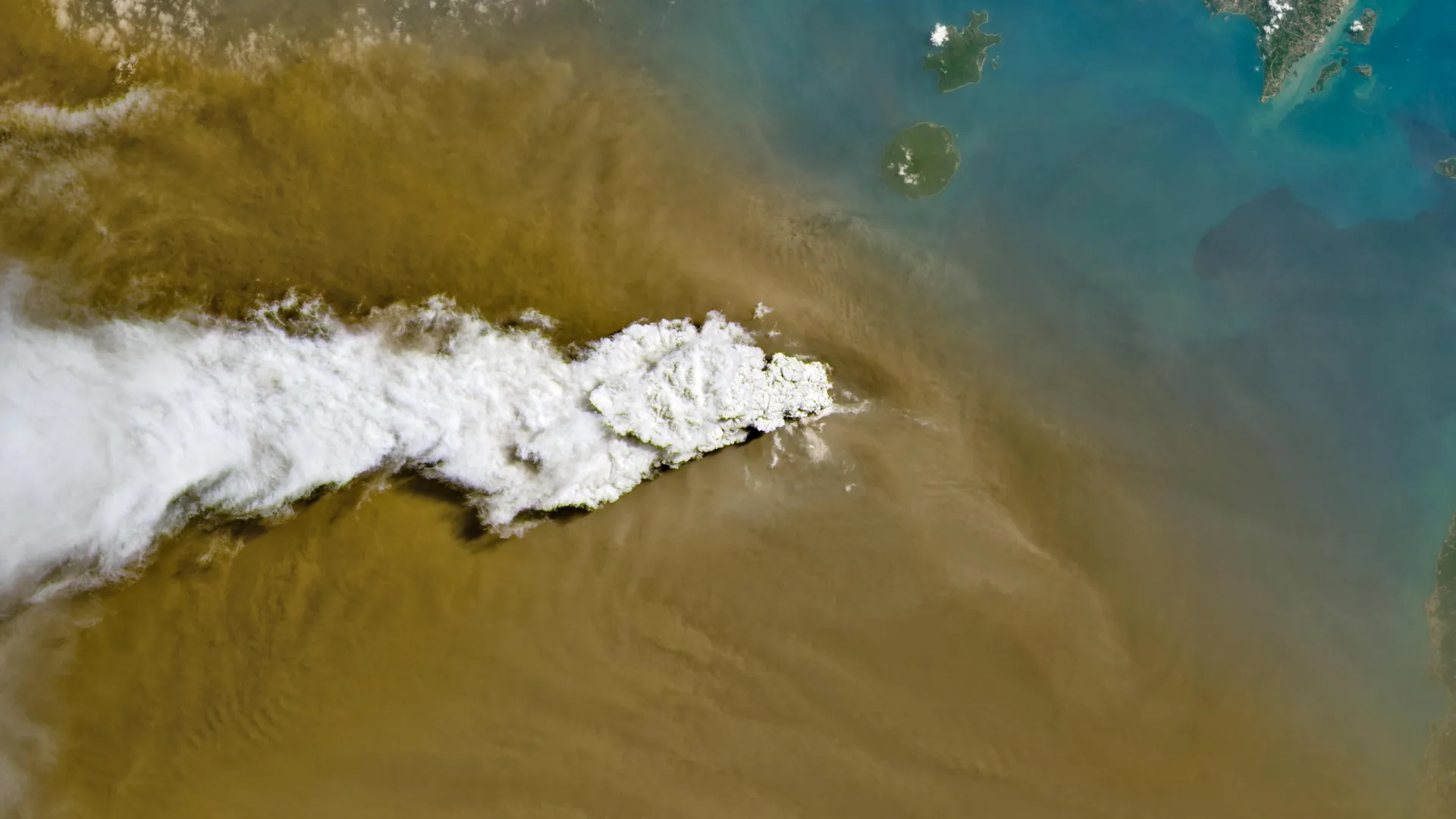
Anak Krakatau, the active volcano in Indonesia's Sunda Strait, entered a violent eruption phase in early September that disrupted regional air traffic and affected millions of residents across Southeast Asia. The volcano ejected ash columns reaching approximately 50,000 feet (15,240 meters) into the atmosphere over a continuous 24-hour period.
The eruption forced the closure of eight airports across Indonesia and neighboring regions. Airlines canceled or diverted nearly 3,000 flights as the ash plume spread across the archipelago, reducing visibility at airports and creating hazardous flying conditions. The atmospheric impact extended beyond aviation infrastructure. Air quality degraded as far away as Jakarta, Indonesia's capital city located roughly 150 kilometers west of the volcano, exposing millions of people to volcanic particulates and haze.
NASA satellites documented the eruption in real time, capturing imagery of the ash plume's expansion across the region. These observations provided scientists with detailed records of the eruption's intensity and atmospheric dispersal patterns. The satellite data helps volcanologists understand the eruption's energy and track how volcanic materials traveled through the atmosphere.
Anak Krakatau, whose name means "child of Krakatau," remains one of Indonesia's most active and closely monitored volcanoes. The volcano sits in the Sunda Strait between the islands of Java and Sumatra. It emerged from the caldera of the original Krakatau, which experienced one of the most catastrophic eruptions in recorded history in 1883, killing tens of thousands of people. Anak Krakatau has grown substantially since its initial emergence in 1927, with periodic eruptions adding layers of lava and pyroclastic material.
The September eruption reflects the volcano's ongoing geological restlessness. Previous eruptions in recent years, including a major event in December 2018, have demonstrated the volcano's capacity for sudden, powerful activity. The 2018 eruption triggered a tsunami that killed hundreds of people along the coasts of Java and Sumatra, highlighting the dual hazards that Anak Krakatau presents: both airborne ash and ocean waves generated by submarine flank collapses.
Indonesia operates one of the world's most comprehensive volcano monitoring networks through its Center for Volcanology and Geological Hazard Mitigation (CVGHM). This agency continuously tracks Anak Krakatau's seismic activity, gas emissions, and topographical changes to provide early warning of hazardous activity.
The September event demonstrates the operational challenges that volcanically active regions face in maintaining transportation infrastructure and public health. Modern satellite monitoring and airport infrastructure allowed authorities to respond rapidly to the hazard, preventing casualties. However, the disruption to 3,000 flights and regional air quality illustrates how remote volcanic activity can ripple through modern society in immediate and costly ways. Residents and businesses across the region continue adapting to life near one of Asia's most temperamental volcanoes.