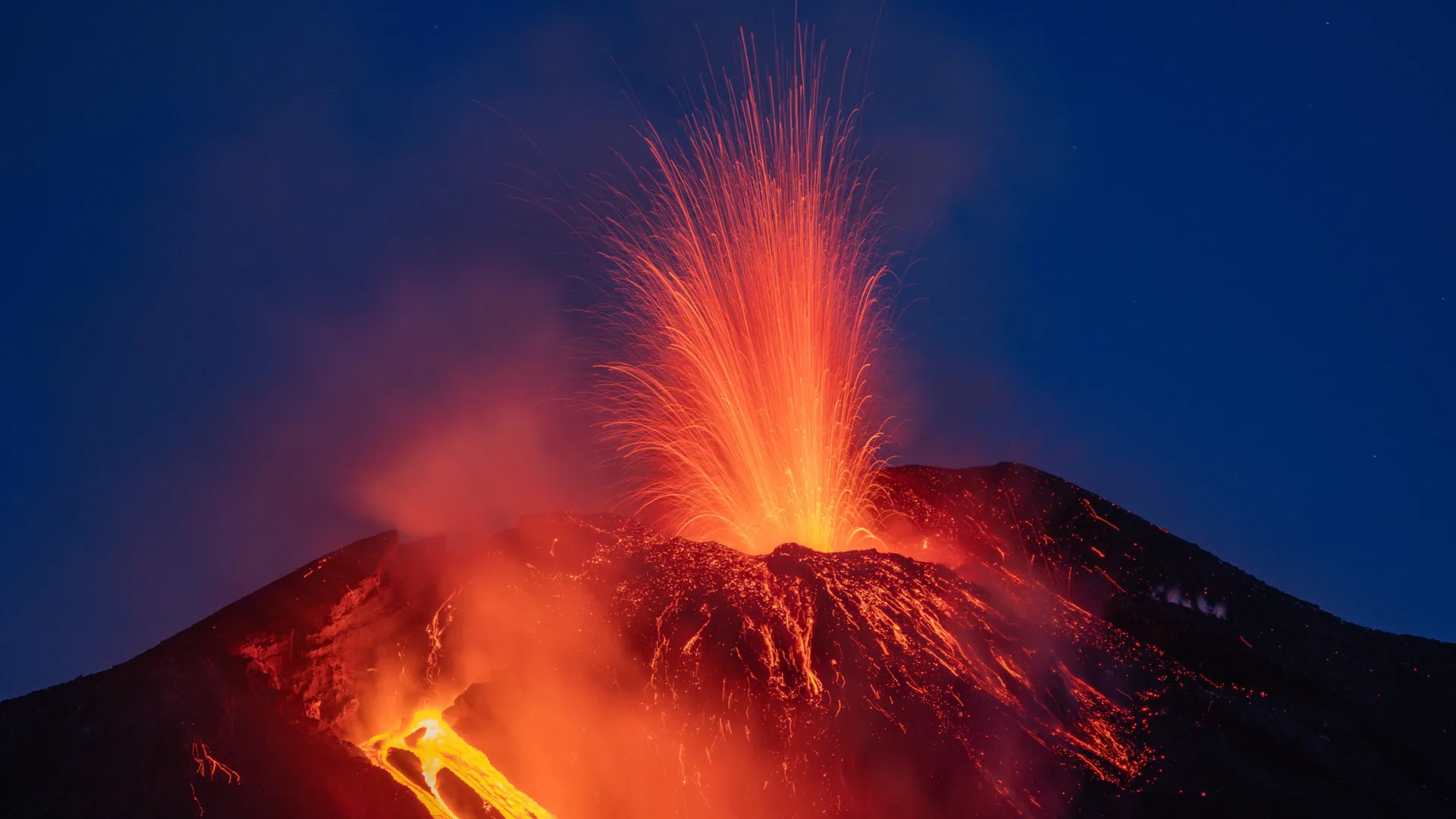
# Mount Etna's Eruptions Reveal Dual Pathways Shaped by Volcanic Gases
Mount Etna's eruption timescales vary dramatically, with some ancient outbursts unfolding over weeks while others accelerated from the deep subsurface in mere hours. A new analysis of volcanic gases trapped in magma crystals reveals the mechanism driving these radically different eruption speeds, offering volcanologists a tool for predicting future explosive activity.
Researchers studying Etna's eruption history discovered that carbon dioxide and water vapor played the decisive role in magma ascent rates. When magma carries abundant dissolved gases, it becomes buoyant and rises rapidly through the crust. Magma depleted of these gases moves much more slowly, lingering near the surface where it can cool and crystallize over extended periods.
The fastest eruptions tracked in the study involved magma ascending nearly 30 kilometers, a journey that took just hours rather than weeks. This rapid acceleration occurs when carbon dioxide and water vapor reach critical concentrations, creating enough pressure to propel molten rock upward at high velocity. In contrast, older Etna eruptions that unfolded over weeks contained less volatile material, allowing magma to degas slowly as it stalled at shallow crustal depths.
The team examined mineral inclusions, tiny pockets of magma frozen inside crystals, to reconstruct the gas content and pressure conditions that existed before each eruption. This geochemical fingerprinting technique allows scientists to look backward into volcanic plumbing systems without direct measurement. By analyzing how much CO2 and H2O remained dissolved in ancient magma, researchers determined the likely ascent duration and energy release pattern for each eruption.
Mount Etna, Europe's most active volcano, has erupted repeatedly throughout recorded history and provides an exceptional natural laboratory for this work. The volcano sits atop a convergent boundary where the African and Eurasian plates meet, feeding a persistent magma supply from the mantle. Its frequent activity gives volcanologists multiple eruption records to analyze and compare.
The research carries immediate practical value for volcanic hazard assessment. If volcanologists can identify elevated CO2 and H2O concentrations in magma feeding active craters, they gain early warning of potential explosive behavior. Current monitoring networks at Etna track seismicity and gas emissions at the surface, but this new framework connects subsurface gas dynamics to eruption acceleration.
Limitations exist. The study focuses on Etna's past eruptions recorded in crystal chemistry, which captures a snapshot but not continuous evolution. Modern monitoring technology cannot yet measure dissolved gas in deep magma bodies in real time. Researchers must infer current conditions from surface emissions and seismic data, then apply lessons learned from ancient eruptions to interpret what those signals mean.
The work also raises questions about whether other volcanoes follow the same gas-driven acceleration model. Etna's magma source and crustal structure differ from subduction zone volcanoes or hotspot systems, so the findings may not transfer universally. Future research should test whether Hawaiian, Japanese, or other major volcanic systems exhibit the same correlation between dissolved volatiles and eruption timescales.
Understanding Etna's dual eruption pathways transforms the volcano from a hazard into a teaching tool. Each future eruption becomes an opportunity to test predictions based on gas chemistry and refine models for estimating how quickly dangerous activity might unfold.