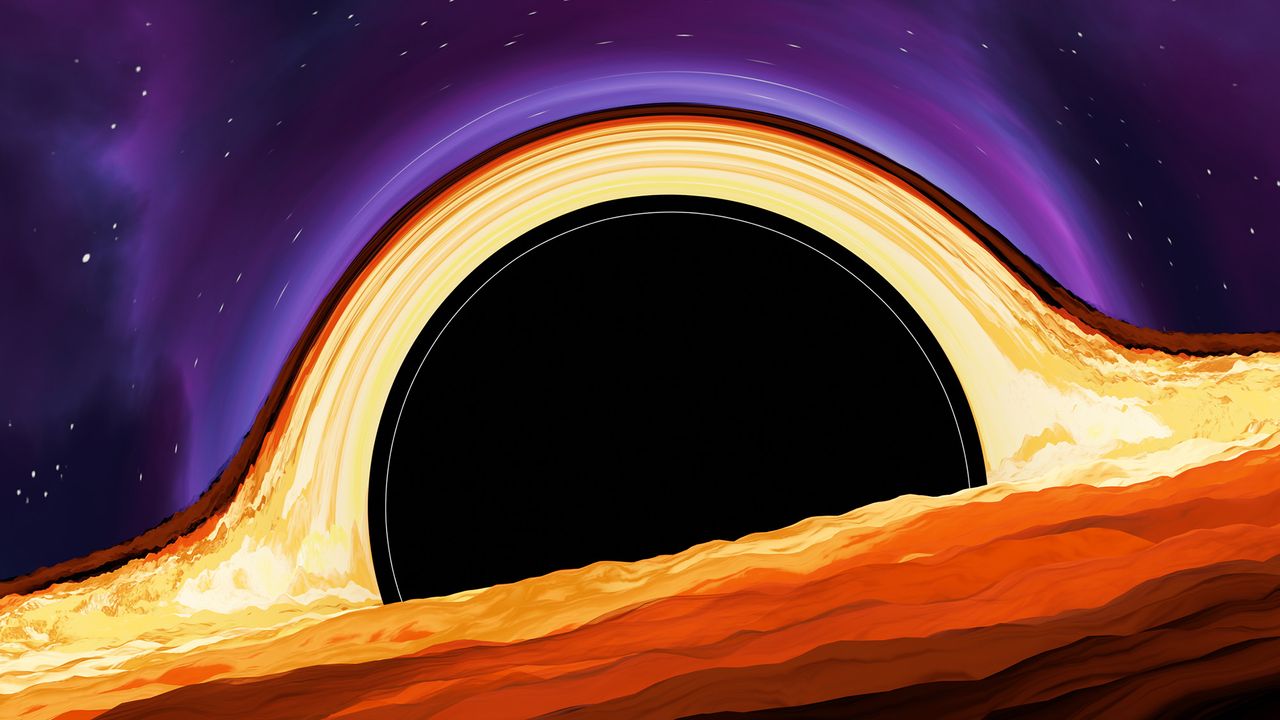
Physicists have detected gravitational waves from the final moments of two black holes merging, offering the clearest view yet of what happens at a black hole's event horizon. Researchers isolated the "last sound" generated during the collision, capturing ripples in spacetime that reveal conditions in this extreme environment.
The detection represents a breakthrough in understanding black hole physics. When two black holes spiral toward each other and collide, they emit gravitational waves. By analyzing the final burst of waves before the objects merged completely, scientists gained direct observational data about the region immediately adjacent to the event horizon, the point of no return where not even light escapes.
This work builds on previous detections from the Laser Interferometer Gravitational-Wave Observatory (LIGO) and other gravitational wave detectors. LIGO has identified dozens of black hole mergers since 2015, but the latest analysis refines techniques for extracting information from the final moments of these collisions.
The research allows physicists to test predictions from Einstein's general relativity in the most extreme gravitational environment observable. At the event horizon, spacetime curvature reaches extreme values. By studying the gravitational wave signatures from these final instants, researchers can verify whether general relativity holds true in conditions never before directly probed.
The "last sound" contains frequencies that reveal how rapidly the black holes merged, their masses, and the properties of the resulting merged object. This data provides tests of general relativity's predictions about black hole merger dynamics and the nature of spacetime itself.
The work also opens new avenues for studying black hole physics. Rather than relying solely on electromagnetic observations of material falling into black holes, gravitational wave detection provides direct information about the black holes themselves. Future detections with upgraded observatories will capture even more detail from merger events.
Scientists emphasize that this approach represents a new observational method complementary to traditional