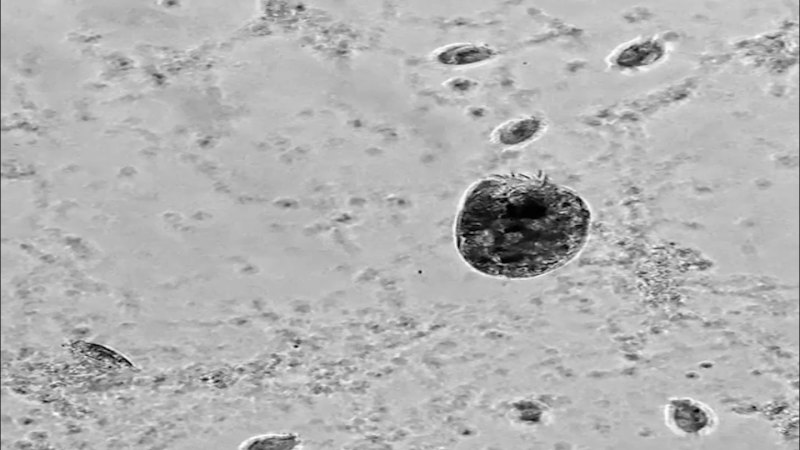
A single-celled ciliate named Euplotes gigatrox undergoes a dramatic transformation when food grows scarce, morphing into a larger, more aggressive version of itself that hunts and consumes its smaller relatives. Scientists studying this behavior believe the shape-shifting reveals how early organisms evolved complex survival strategies.
The microbe normally exists as a typical ciliate, measuring around 40 micrometers. When starved, it expands to roughly double that size and develops an enlarged mouth structure optimized for consuming other cells. Researchers observed that in this state, E. gigatrox actively pursues and devours smaller ciliates of the same species, effectively becoming cannibalistic.
This transformation involves dramatic changes in cell morphology and feeding behavior. The organism doesn't simply grow larger. Its entire body plan reorganizes to become a predatory form, complete with enhanced sensory structures that allow it to detect and track prey.
The research team suggests this behavioral switch demonstrates how unicellular organisms can execute surprisingly sophisticated survival responses. Rather than relying on rigid genetic programming, E. gigatrox exhibits phenotypic plasticity, adapting its physical form and behavior to match environmental conditions. This flexibility may have provided an evolutionary advantage that eventually led to more complex behaviors in larger organisms.
The work provides a window into how early life, before multicellularity evolved, solved the problem of resource scarcity. Single-celled organisms couldn't flee or hide effectively, so developing the ability to shift into a more predatory form represented a powerful adaptive strategy.
The discovery also raises questions about how such dramatic transformations are triggered and controlled. Scientists now aim to identify the genetic and molecular mechanisms driving this shape-shifting, potentially revealing conserved pathways that govern behavioral flexibility across different organisms.