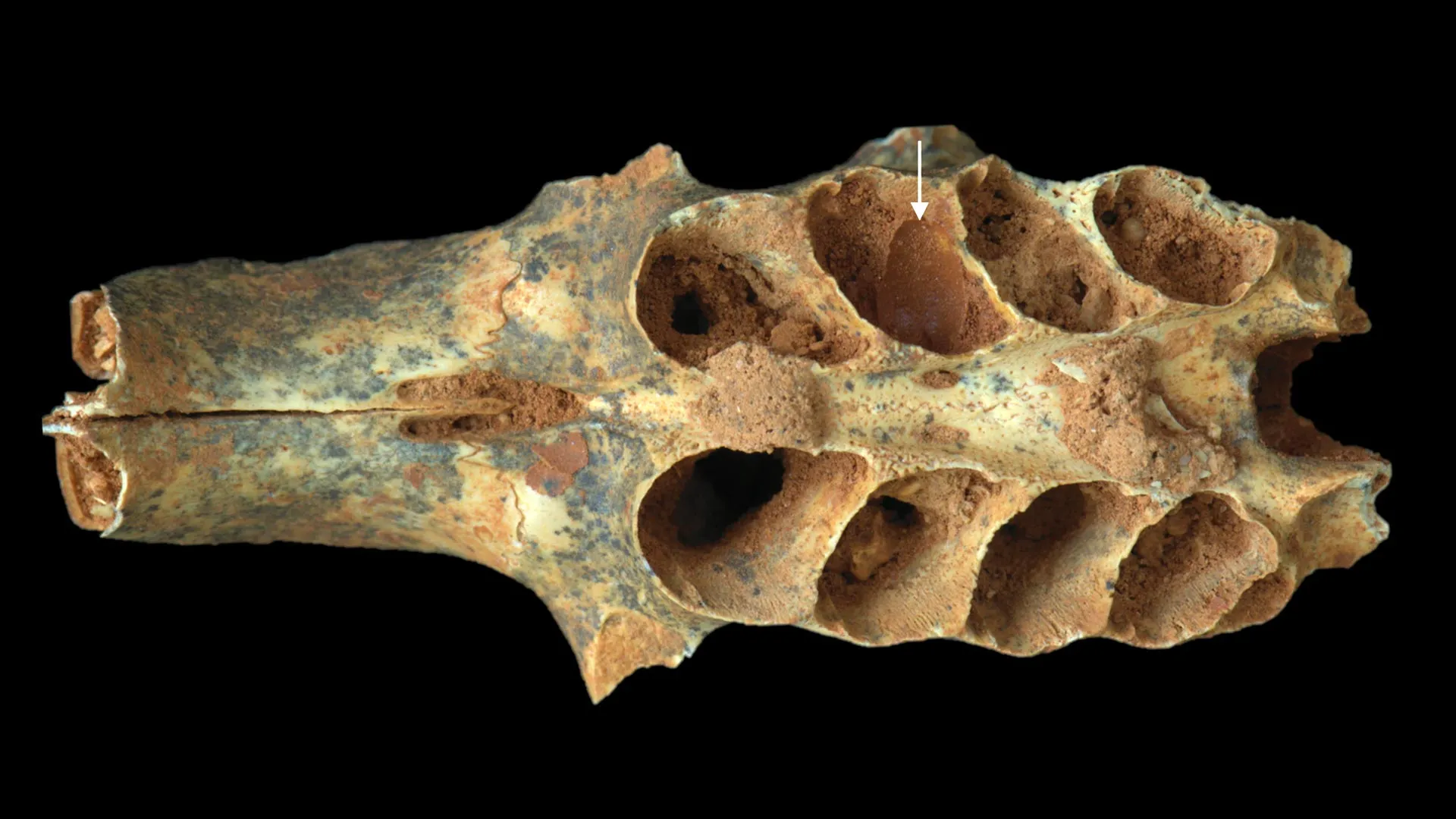
Researchers have uncovered the first evidence of ancient bees using mammal tooth sockets as nesting chambers, a discovery that rewrites what we know about prehistoric bee behavior and adaptation.
The fossils, preserved in a cave and dating back 20,000 years, show that bees colonized empty tooth sockets in scattered bones after owls had dispersed them across the cave floor. This marks the earliest known instance of bees nesting inside animal bones, according to the analysis.
The discovery reveals a striking example of ecological opportunism among ancient bees. Rather than constructing traditional wax combs or seeking out hollowed wood, these insects repurposed available cavities in bleached bone, creating shelter in an otherwise hostile environment. Each tooth socket provided a compact chamber suitable for brood rearing and honey storage.
The bones themselves tell a story of taphonomy, the process by which organisms become fossils. Owl pellets deposited bone fragments across the cave floor over centuries. Bees exploited these scattered remains as ready-made housing, demonstrating behavioral flexibility that allowed them to thrive in cave ecosystems where other nesting opportunities were limited.
Paleontologists identified the bee activity through characteristic nesting patterns preserved in the tooth sockets and residual wax deposits. The chambers show evidence of repeated occupation, suggesting the site was actively used across multiple seasons rather than representing a single colonization event.
This finding has implications for understanding prehistoric environments and animal behavior. It shows that cave ecosystems supported diverse arthropod communities and that resource limitation drove innovation among ancient insects. Modern bees display similar adaptive nesting behaviors when conventional cavities become scarce, suggesting these strategies have deep evolutionary roots.
The research adds to growing evidence that cave systems served as critical refugia during climatic fluctuations in the Late Pleistocene. The interplay between predators, prey, and pollinators