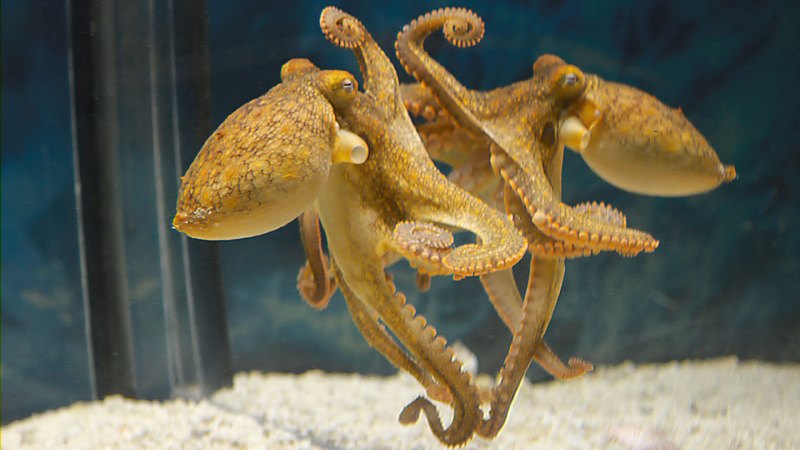
Octopuses demonstrate a sophisticated grasp of mirror reflections that allows them to hunt prey they cannot see directly, according to new research. Scientists conducted experiments where octopuses viewed crabs through mirrors and successfully located the actual animals despite having no direct line of sight to them.
The study reveals octopuses can interpret mirror images as representations of real objects in space, a cognitive ability that requires understanding how reflective surfaces work. When researchers placed mirrors in tanks so octopuses could see crab reflections without viewing the crabs themselves, the animals correctly navigated to capture their prey.
This capacity indicates octopuses possess spatial reasoning abilities beyond simple visual hunting. The animals must mentally translate what they observe in a reflection into accurate three-dimensional coordinates in their environment. Such mirror understanding ranks among higher cognitive skills in the animal kingdom, typically associated with species like great apes and dolphins.
The finding adds to mounting evidence that octopuses display remarkable intelligence across multiple domains. Previous research has documented their problem-solving abilities, tool use, and capacity to recognize individual humans. Their distributed nervous system, with neurons concentrated not just in the brain but throughout their eight arms, may contribute to their flexible intelligence.
The experiments hold practical implications for understanding predator-prey dynamics in marine ecosystems. Octopuses already rank among the ocean's most successful hunters, and the ability to use reflected information expands their hunting toolkit. This skill could prove advantageous in rocky reef environments where direct visual access to prey remains limited.
Researchers note the findings suggest octopuses may process spatial information through mechanisms distinct from vertebrate vision. The specific neural architecture underlying this reflection comprehension remains unclear, offering direction for future neurobiology studies.
The work underscores how octopus intelligence evolved independently from other intelligent animals, generating different but equally effective solutions to environmental challenges.