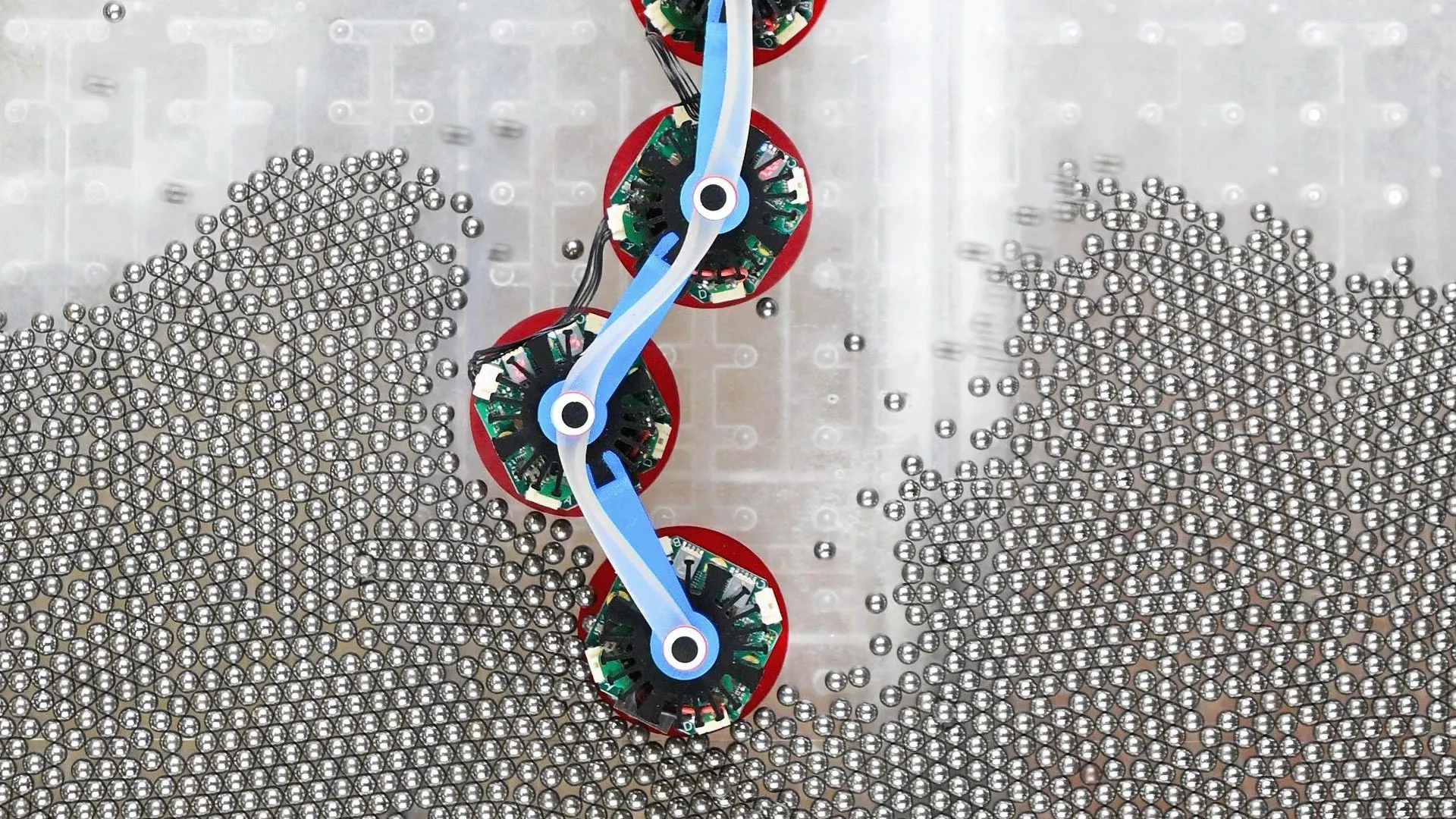
Physicists from the Universities of Amsterdam, New South Wales, and Cambridge have discovered that active materials—matter containing internal energy sources—can produce movements resembling crawling, walking, and digging. The researchers assembled flexible chains from connected rods with small motors at the joints. The motors created asymmetrical interactions where moving one rod affected its neighbor differently than the reverse would. When external forces acted on these chains, they repeatedly buckled and snapped instead of stopping after a single event, producing ongoing oscillations. This behavior emerges from a transformation into what researchers call a critical exceptional point. Sami Al-Izzi of the University of New South Wales and Yao Du of the University of Amsterdam served as joint first authors on the study, published in the Proceedings of the National Academy of Sciences.
The team also discovered that active materials violate Le Chatelier's Principle, a rule widely used in engineering that predicts how individual component changes affect overall structure. In a separate investigation led by Jack Binysh from Corentin Coulais's research group at the University of Amsterdam, researchers built a two-dimensional lattice from motors and rods. They found that increasing activity in individual components can actually reduce activity in the material as a whole. The explanation involves percolation. If many interconnected components have low activity, they can prevent elastic responses from spreading through the structure, even when other parts are highly active. The arrangement and distribution of components matters as much as their individual properties. This research was published in Physical Review X.
The researchers suggest these discoveries could inform design of soft robots and adaptable materials capable of performing multiple tasks autonomously.