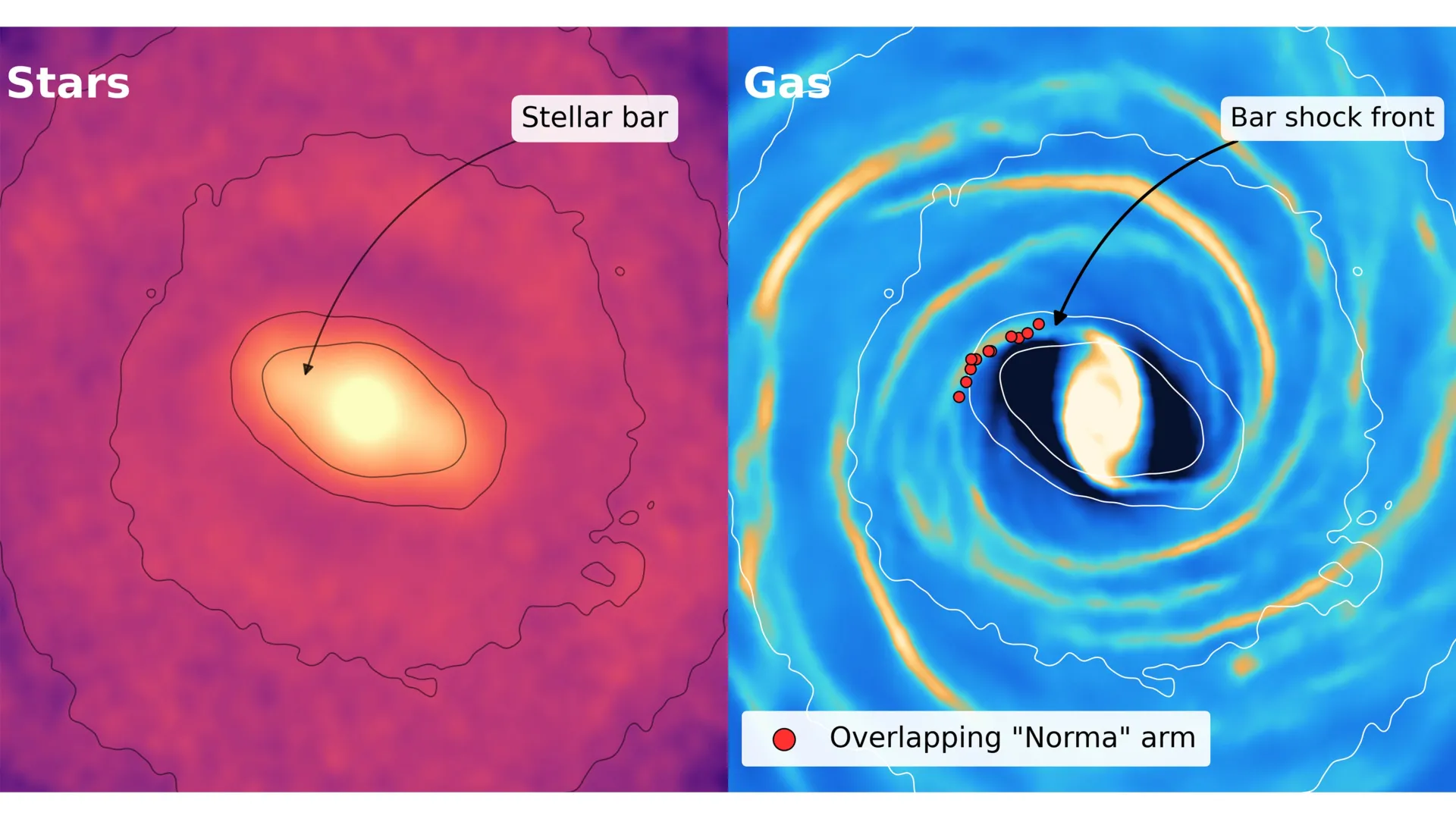
Dr. Hillary Davis at the University of Sydney's School of Physics and Sydney Institute for Astronomy led research showing that shock waves from a rotating bar of stars near the Milky Way's center compress surrounding gas and trigger star formation in an unusual location. The findings appear in Nature Astronomy.
Most barred spiral galaxies, including our own, have an elongated structure of stars stretching across their central region. As this bar rotates, its gravity drives nearby gas into shock fronts that typically suppress star formation. The Milky Way behaves differently. Davis said, "What's extraordinary is seeing this happen in a different region of our Galaxy, where shocks are usually so strong that star formation is often suppressed."
The team compared computer simulations of galactic evolution with observations of massive star-forming regions, using masers as tracers. Masers are naturally occurring sources of concentrated microwave radiation associated with massive star formation. Researchers found that masers previously linked to the Norma spiral arm aligned closely with shock fronts predicted by their simulations.
This alignment suggests that part of the so-called Norma arm may not be a spiral arm at all, but instead a star-forming region along the leading edge of the Galactic bar. Davis said, "This suggests that at least part of the so-called Norma arm may not be a spiral arm at all, but a region of star formation along the leading edge of the Galactic bar."
The analysis indicates the Galactic bar extends approximately 4.3 kiloparsecs, or about 14,000 light-years, from the galactic center along its long axis. This supports a picture of the Milky Way containing a relatively long bar that rotates slowly. The Australian Research Council, the Knut and Alice Wallenberg Foundation, the Swedish Research Council, and other organizations funded the research.