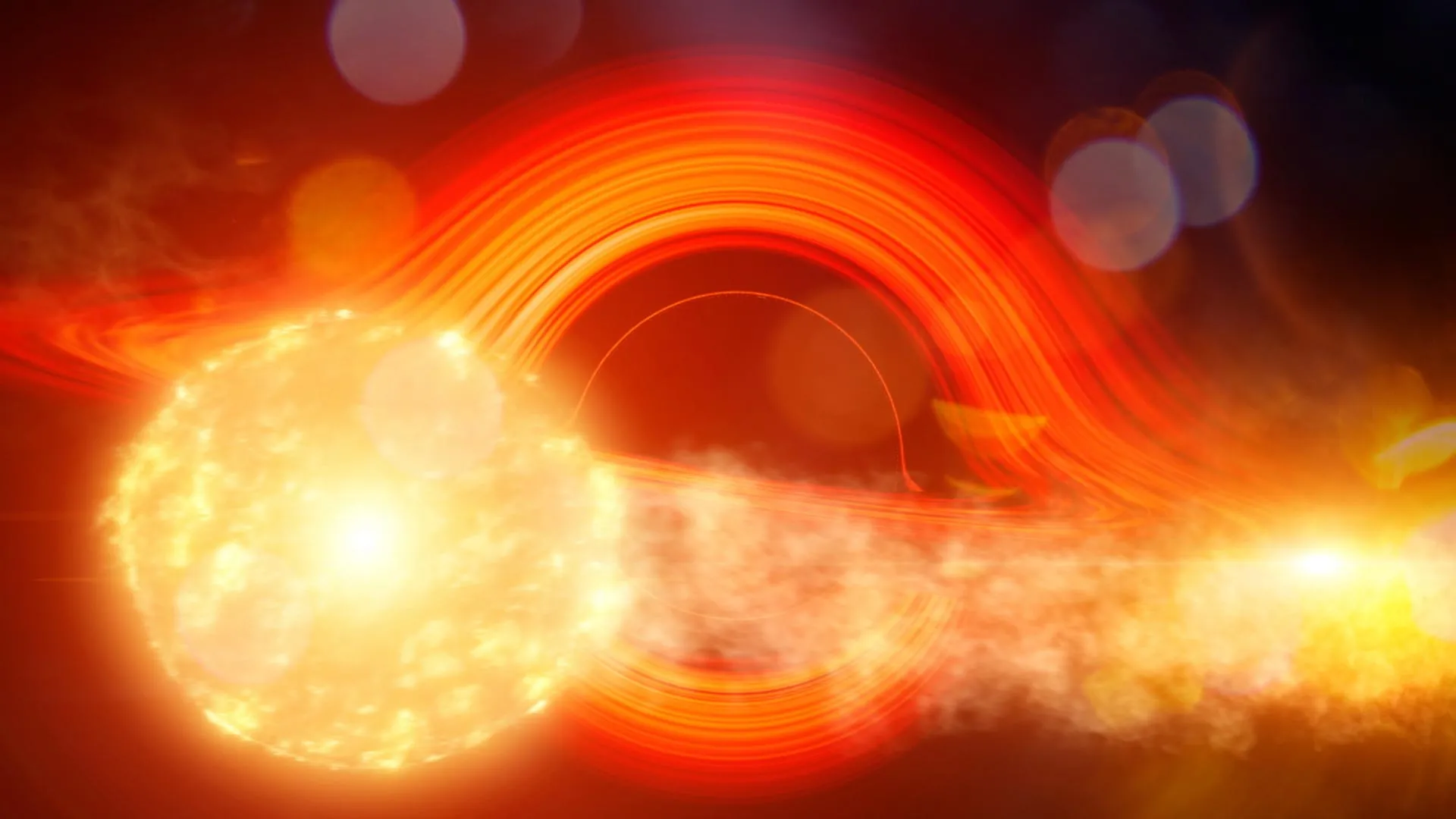
An international research team led by the Max Planck Institute for Extraterrestrial Physics has identified a probable source for mysterious gas clouds near Sagittarius A*, the supermassive black hole at the center of the Milky Way. The researchers traced the clouds to IRS 16SW, a massive binary star system consisting of two stars in extremely close proximity.
The team used the infrared spectrographs SINFONI and ERIS, both equipped with adaptive optics, to measure the positions and velocities of gas clouds labeled G1, G2, and G2t. By reconstructing their orbital paths around Sagittarius A*, the astronomers found that all three clouds follow orbits with nearly identical shapes and orientations, suggesting they originated from the same source.
The researchers worked backward from the clouds' observed motions and velocities to identify IRS 16SW as the likely source. Computer simulations supported this conclusion. The models show that powerful stellar winds from the binary system collide with surrounding material, creating a shock between the stars. Gas accumulates, becomes compressed into dense concentrations, and eventually separates from the system. Once released, these compact clouds travel inward along paths that match those observed in what researchers call the G1-2-3 streamer.
Calculations indicate that if approximately one Earth mass of gas reaches Sagittarius A* every ten years, it could sustain the black hole's current level of activity. The discovery suggests that massive stars near the Galactic Center may provide a continuing supply of gas capable of fueling the black hole through their powerful winds.