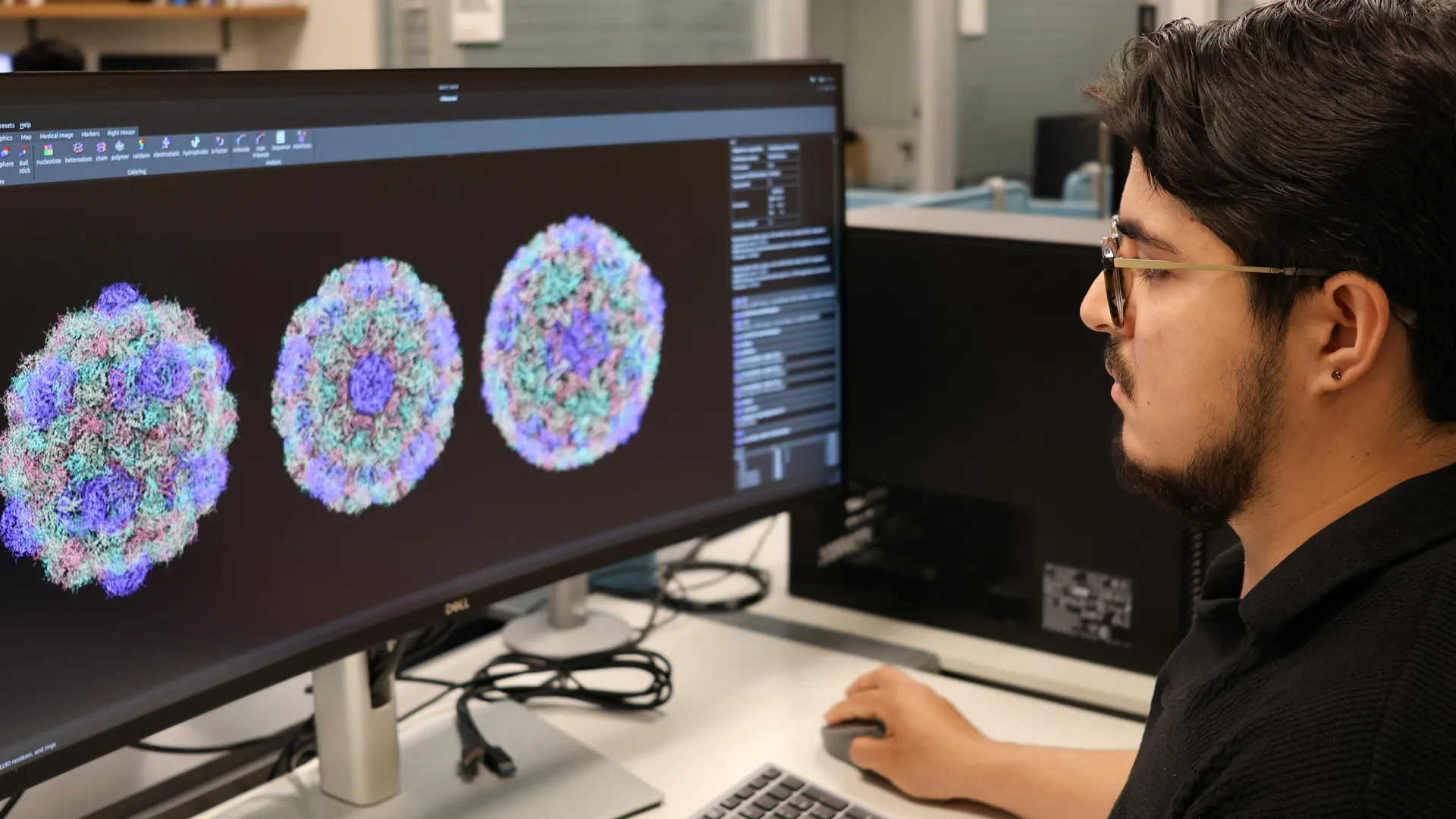
Researchers at the University of Miami discovered a previously unknown group of viruses that may bridge the evolutionary gap between viruses and encapsulins, tiny protein compartments inside cells. The team published their findings in Nature Communications.
The newly identified viruses have smaller, simpler genomes than other viruses that produce HK97-fold protein shells. These proteins fold into a distinctive three-dimensional structure found in both viruses and encapsulins. The new viruses possess characteristics of both types of structures, making them possible evolutionary intermediates.
Scientists previously believed encapsulins evolved from viruses. The new evidence suggests a more complicated relationship in which viruses and encapsulins may have repeatedly evolved from one another over millions of years.
"What makes the HK97-fold proteins so interesting is that they can form shells that enclose biochemical reactions in cellular lineages, archaea, and bacteria. But they also serve genetic purposes in viruses, storing and protecting their viral genome," said Abelardo Aguilar, the study's first author and a Ph.D. student in the Department of Biology at the University of Miami College of Arts and Sciences.
Aguilar worked with Antoni Luque Santolaria, an associate professor in the Department of Biology, who served as the study's senior author. Rather than relying on laboratory experiments, the team searched enormous genetic databases containing billions of DNA sequences. They combined bioinformatics, protein behavior models, and artificial intelligence tools, including protein language models and AlphaFold, to investigate the structures encoded by these sequences.
The databases included IMG/M, a resource associated with the U.S. Department of Energy's Joint Genome Institute and the University of California, Berkeley. The genetic information came from environmental samples collected worldwide, including soil, seawater, wastewater, and the human gut.
The researchers proposed that procapsids, immature viral protein shells, may provide a pathway between viruses and encapsulins. These shells could potentially support both genetic functions and metabolic functions involving chemical reactions.
"One implication of this research is the possibility that viral capsids could also facilitate biochemical reactions, which would open up the potential roles that capsids have in environments as a whole," Aguilar said.
The Gordon and Betty Moore Foundation and the U.S. National Science Foundation supported the project.