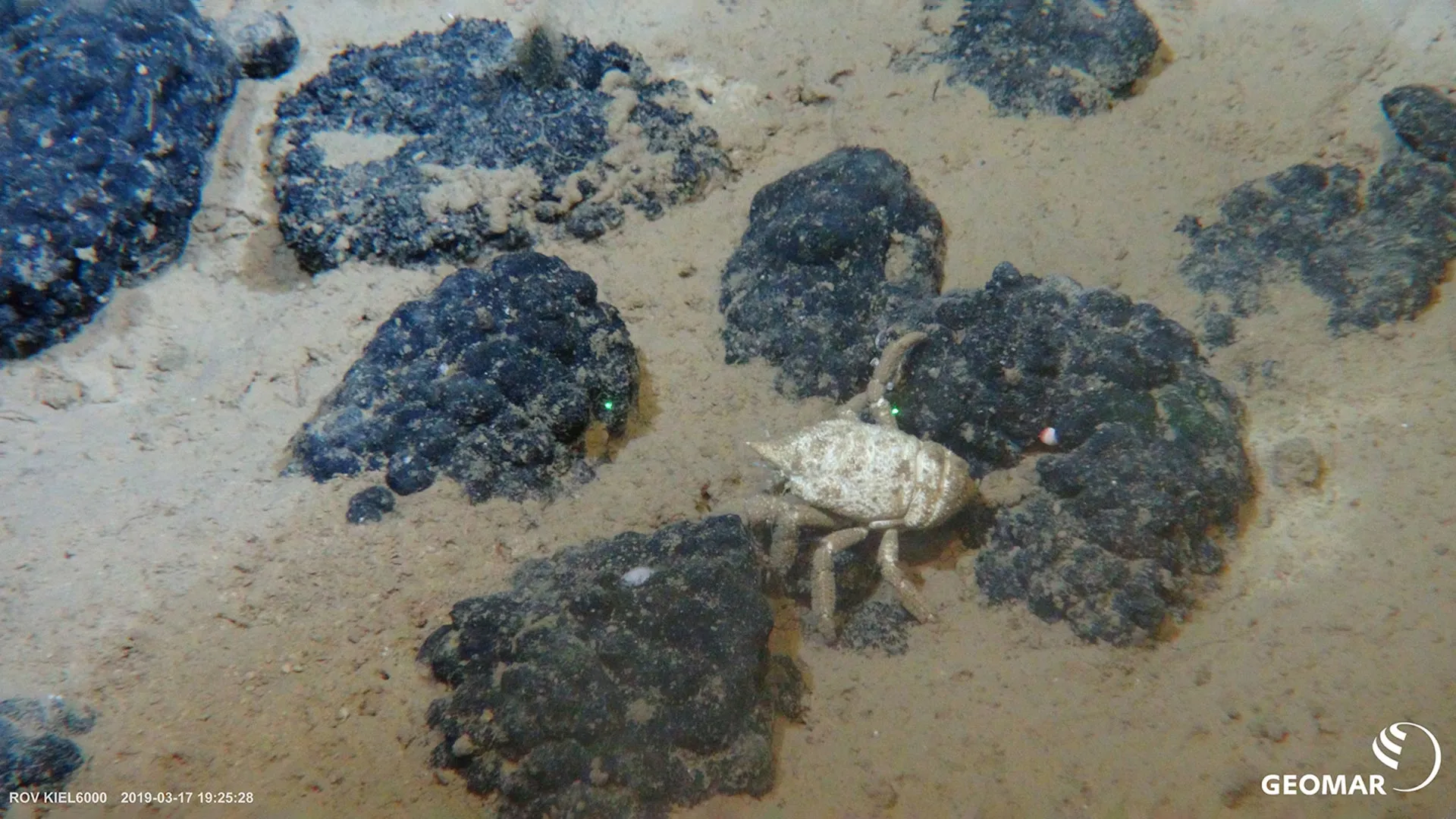
Scientists discovered 245 animals living inside a single deep-sea polymetallic nodule collected from the Clarion-Clipperton Zone in the central Pacific Ocean. Across 244 nodules examined, researchers identified 4,139 individual animals, with an average of 17 animals per nodule.
Polymetallic nodules are dark, fist-sized formations made largely of iron and manganese oxides that grow at depths of 4,000 to 6,000 meters. They accumulate only a few millimeters over a million years. The tiny cracks and cavities inside these rocks provide shelter for animals smaller than a millimeter.
Dr. Tanja Stratmann, a lead author at MARUM - Center for Marine Environmental Sciences at the University of Bremen, states: "In our study we show that the sizes of cracks inside the nodules are large enough to provide home to animals that are smaller than a millimeter in size."
The animals inhabiting the nodules formed distinctive communities that remained highly similar across locations separated by distances up to 1,000 kilometers, even though they differed significantly from organisms in the surrounding seafloor sediment. For roundworms, animals inside nodules represented approximately 10% of the number found in nearby mud. For copepods, the figure was about 25%.
Dr. Coral Diaz-Recio Lorenzo explains: "The crevices in the polymetallic nodules function as small shelters and provide home to animals that we do not encounter in the soft sediment of the seafloor."
The findings raise concerns about deep-sea mining. Polymetallic nodules contain valuable metals including nickel, cobalt, and copper. Removing nodules would eliminate their internal habitats. Since nodules require millions of years to form, mining could eliminate ecosystems that would take geological timescales to replace.
Prof. Sabine Gollner cautions: "Our findings point out that commercial mining may result in an irreversible loss of undescribed and unique biodiversity associated to nodules. This needs to be considered in environmental management of deep-sea mining."
An unanswered question remains whether organisms dependent on nodules inhabit other ocean regions, or whether some species are restricted to these habitats.