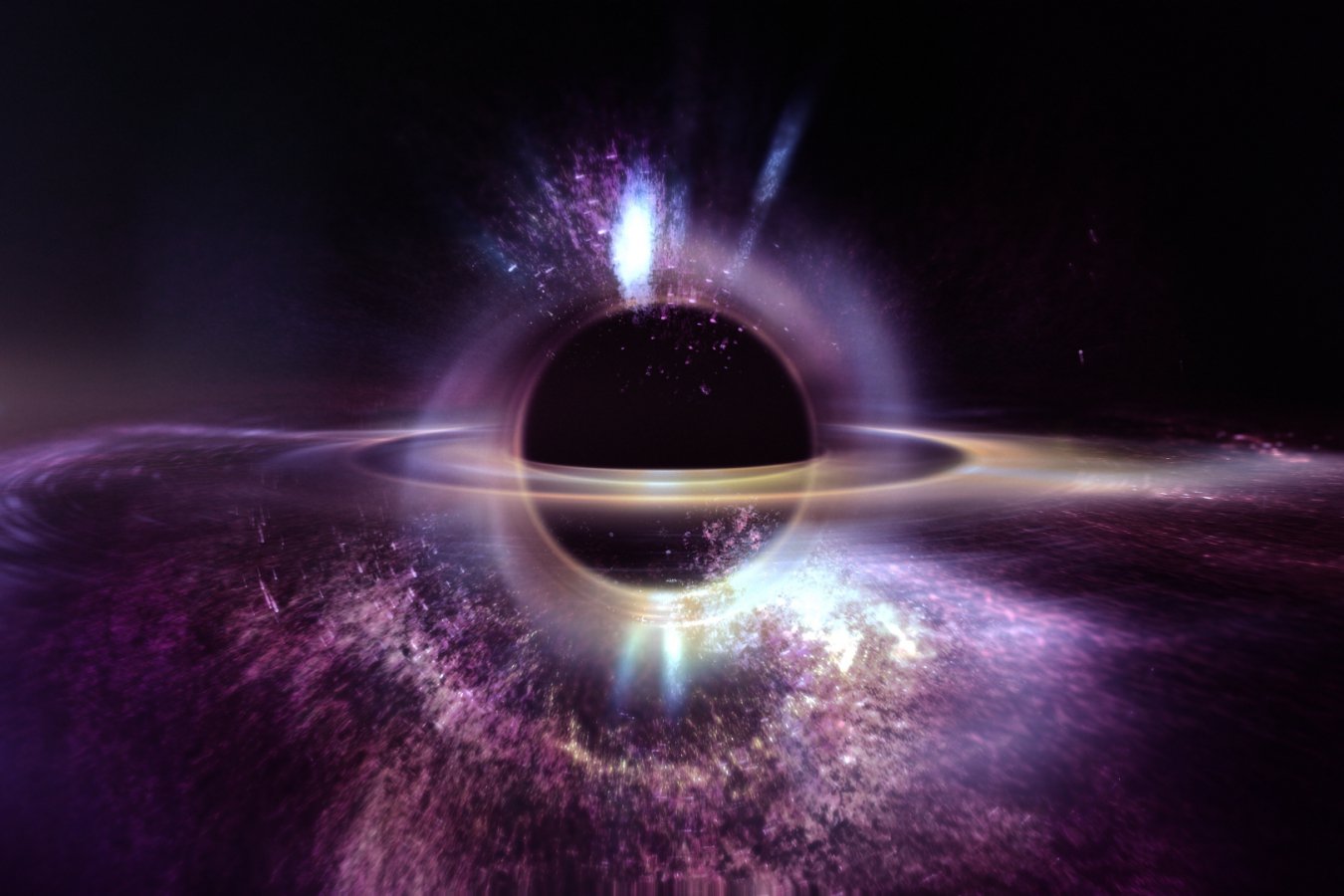
A theoretical possibility exists that the universe could end suddenly through a process called vacuum decay, in which a bubble of lower-energy "true vacuum" forms and expands at the speed of light, destroying everything in its path.
The current universe may exist in a false vacuum, a state of higher energy rather than the lowest possible energy state. Using an egg in a bowl as an analogy, the bottom of the bowl represents the false vacuum we inhabit, while the ground below represents a true vacuum of lower energy. If quantum tunneling allowed a particle to spontaneously pass into this true vacuum, it would create a bubble of fundamentally different space-time.
The properties of such a bubble remain unknown. If the bubble has low surface tension, it could expand outward at light speed, engulfing the universe. Simulations suggest the bubble universe would eventually collapse entirely. Because this expansion occurs at light speed, detection would be impossible before the bubble absorbed Earth.
Researchers currently search for stability clues in precise measurements of fundamental constants, including the mass of the Higgs boson and the strength of the strong force. Present measurements indicate the universe sits at the edge of stability. Current precision remains insufficient to determine whether these constants support universe stability.
Another avenue involves searching for tiny bubbles of true vacuum that might form between colliding black holes. These small bubbles could merge together and form detectable black holes as they evaporate.