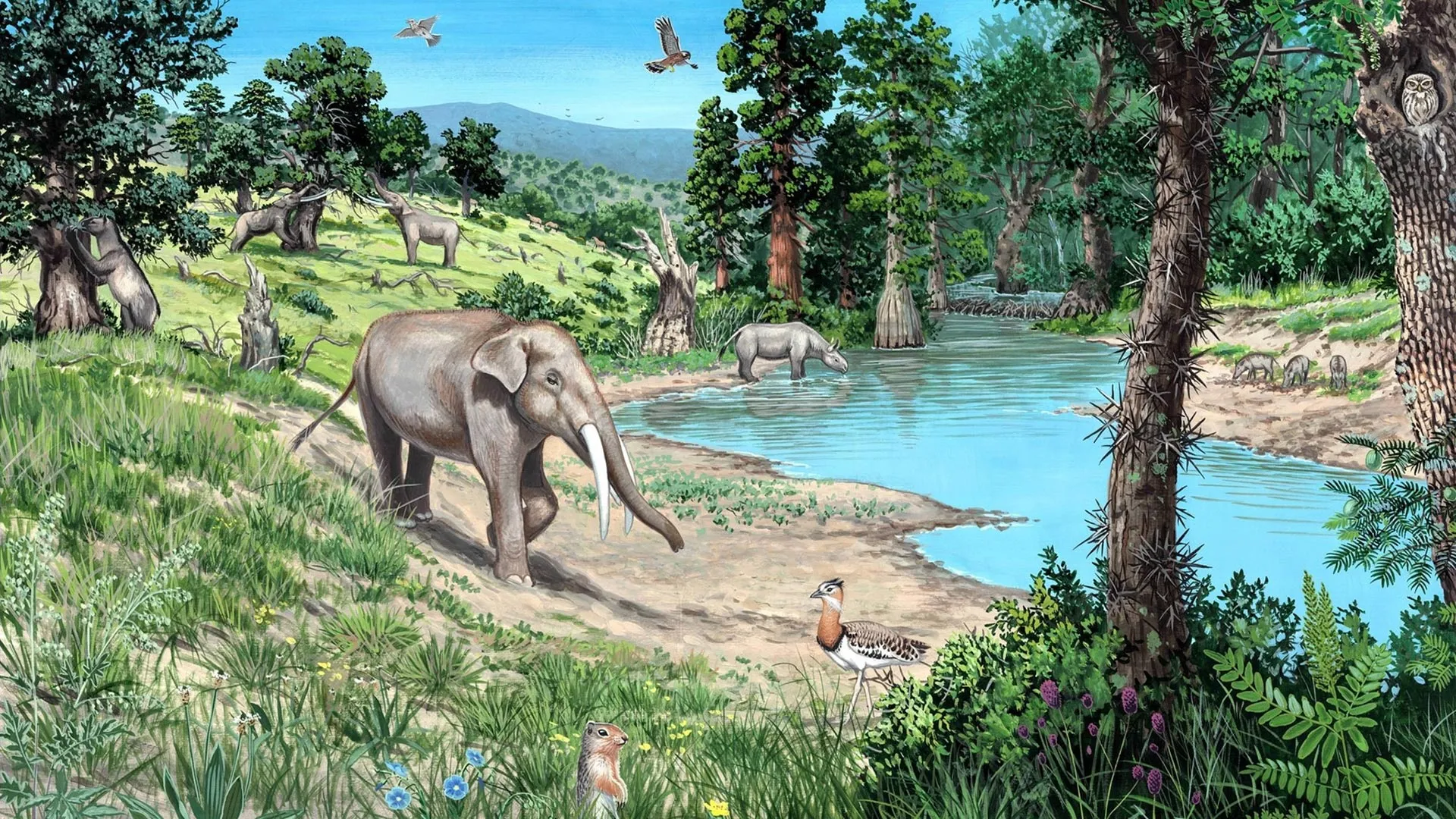
Researchers led by Aarhus University examined paleoecological records spanning more than 20 million years and found that Europe's ancient landscapes were dominated by open woodlands, grasslands, and wildflower meadows rather than dense, continuous forests. The team combined multiple lines of evidence including fossilized pollen, charcoal from wildfires, chemical signatures in animal bones and teeth, fossil insects and mammals, and ancient environmental DNA preserved in sediments.
Large herbivores such as elephants, rhinoceroses, aurochs, and bison shaped these mixed habitats by grazing and disturbing vegetation, which kept parts of the landscape open and created conditions for diverse plant and animal species. The study, published in Biological Conservation, challenges the "closed-forest paradigm" that has guided European conservation strategies for decades. This paradigm assumed dense forests represented Europe's natural state before human intervention.
Professor Jens-Christian Svenning from the Center for Ecological Dynamics in a Novel Biosphere at Aarhus University stated that current reforestation practices are problematic. "The study shows that current reforestation practices are on the wrong track - both here in Denmark, where subsidies are only granted for planting dense forests, and elsewhere in Europe. This will not only be harmful for biodiversity; it will be in direct contradiction to the type of ecosystems that Europe's species have evolved in over millions of years," Svenning said.
Lead author Szymon Czyzewski, a PhD student at Aarhus University, explained that combining different types of evidence allowed researchers to trace long-term vegetation changes with greater confidence than earlier single-method studies. The researchers found that these mixed landscapes persisted across varying climates, from temperate conditions similar to modern Europe to warmer and colder periods.
Modern Europe has lost many of the large wild herbivores that historically maintained these diverse habitats, and traditional grazing practices have declined over the last hundred years. This loss of grazing pressure has altered how vegetation develops across much of the continent.