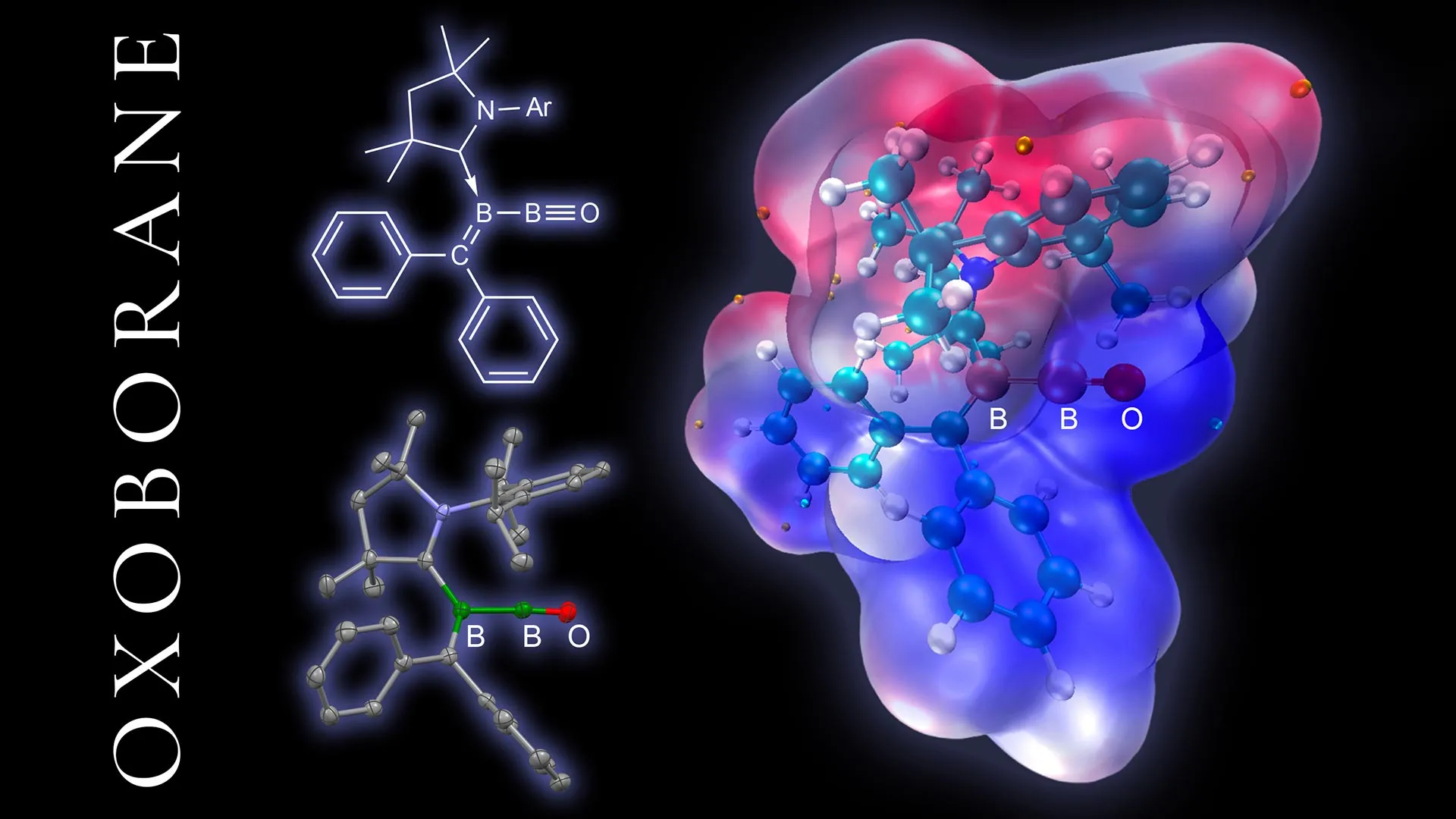
Researchers at the University of Würzburg in Germany have isolated oxoboranes, molecules with a triple bond between boron and oxygen, ending a chemistry challenge that lasted over 60 years. The breakthrough, led by Professor Holger Braunschweig and published in Nature Chemistry, involved computational support from Professor Ashwini K. Phukan at Tezpur University in India.
Oxoboranes were long considered too unstable to study under ordinary laboratory conditions. Chemists had pursued these compounds since at least the early 1960s, detecting them under extreme conditions or finding indirect evidence of their existence, but had never isolated stable examples.
The discovery emerged unexpectedly. Doctoral students Lukas Lubczyk and Christian Markl were investigating reactions between diboracumulene and ketones when they noticed unusual orange or yellow solids forming. Oxoboranes emerged as the main products, despite other chemical outcomes appearing more likely.
"Nearly everybody in the field had given up on oxoboranes, as they were thought to be just too unstable to be isolated. So we were stunned to see them spontaneously form in these reactions and stick around long enough that we could study them," Braunschweig said.
The team successfully prepared three different oxoboranes using this method. Lubczyk stated, "I never thought the diboracumulene would react the way it did, let alone with multiple different, simple substrates."
The researchers plan to investigate how broadly the technique applies and whether similar strategies could create other elusive compounds involving elements throughout the periodic table. Funding came from the German Research Foundation, the German Academic Exchange Service, and India's Department of Science and Technology.