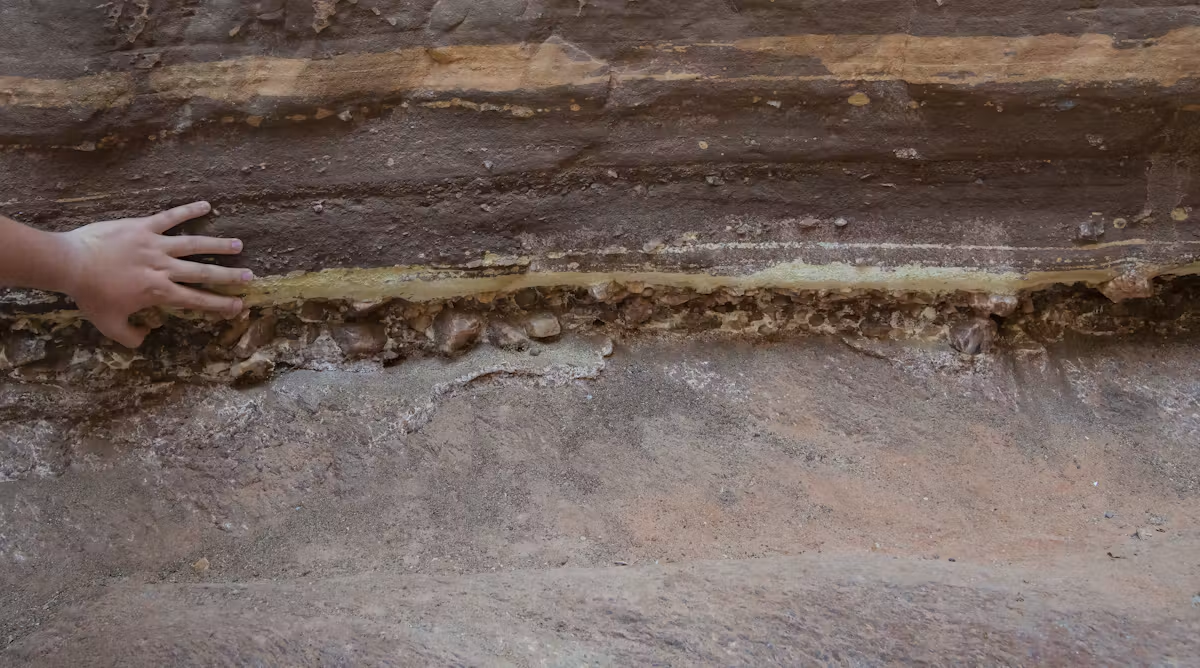
Rock layers on multiple continents show gaps spanning hundreds of millions of years, a phenomenon geologists have called the Great Unconformity since the 1870s. New research published in Nature explains this mystery by linking it to deep Earth processes.
Researchers at the University of Wollongong, including PhD candidate Santosh Dhungana and Associate Professor Nicolas Flament, used Australia's Gadi supercomputer to model how mantle convection affected continents over the past billion years. The mantle is a 2,900-kilometre thick layer of hot rock that moves slowly, pushing and pulling the surface above over tens to hundreds of millions of years.
Their models showed that mantle convection lifted ancient continental blocks including Laurentia (much of North America), Baltica (parts of northern Europe), and North China from around a billion years ago until 540 million years ago. Over the past 540 million years, those blocks have been pulled downward.
When these continents were lifted, crystalline rock layers became exposed at the surface and eroded away. When the blocks sank, new sedimentary layers formed on top. This up-and-down movement created the conditions for the Great Unconformity to form and be preserved.
The uplift predicted by the models aligned with the Snowball Earth period, roughly 720 million to 635 million years ago. During this time, enormous ice sheets scraped across uplifted continents. Glaciers erode more efficiently than rivers, even on gentle slopes, grinding away rock layers over tens of millions of years.
The researchers found that Australia and South America experienced different mantle convection patterns, with only two uplift and subsidence cycles. Accordingly, those continents show little evidence of the Great Unconformity.
The missing rock layers coincide with the Cambrian explosion, when life on Earth diversified dramatically around 540 million years ago. Scientists have speculated that erosion of entire continents during the Great Unconformity may have altered seawater chemistry and enabled animal life to flourish.