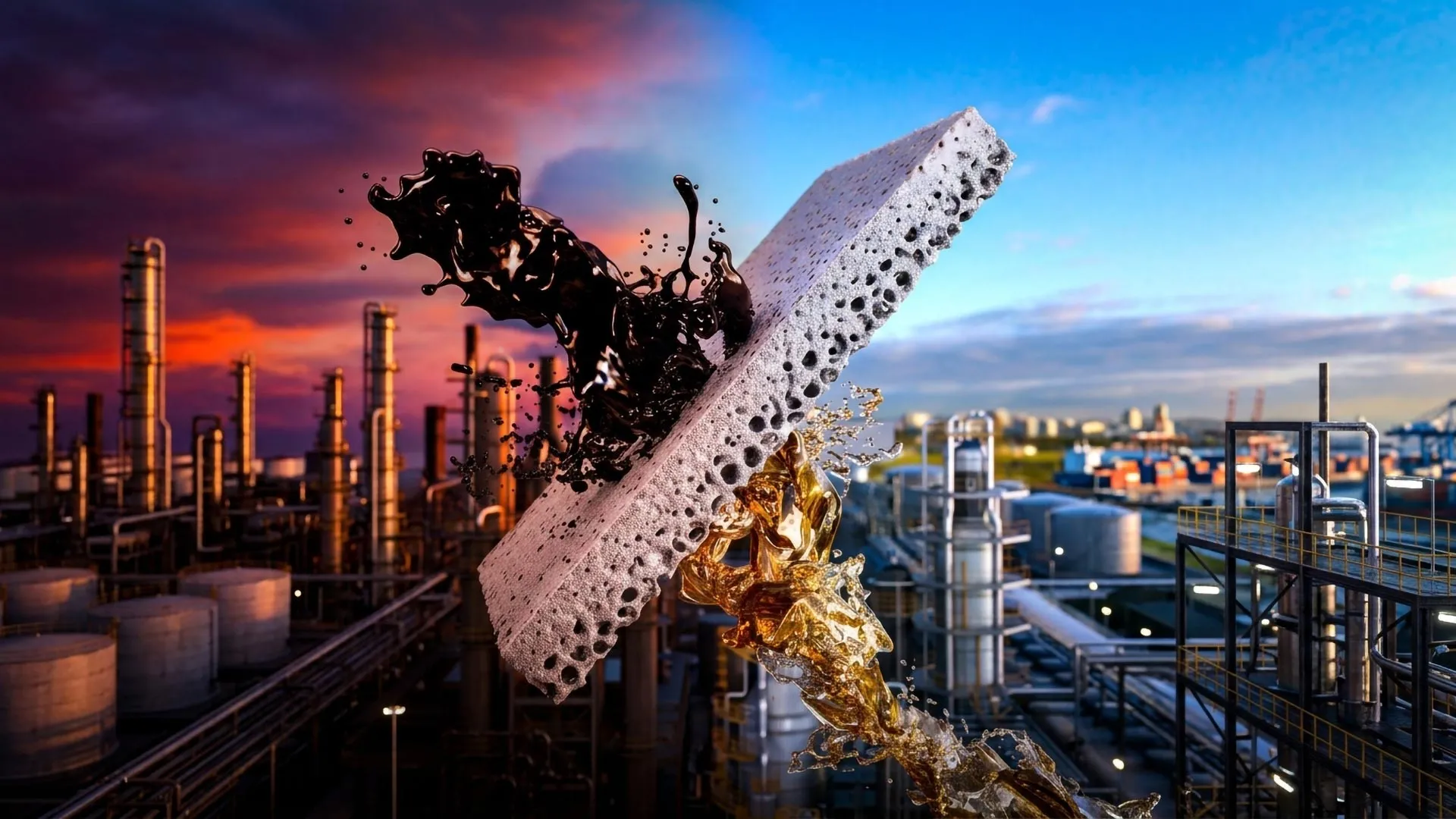
Researchers led by Professor Dong-Yeun Koh at Korea Advanced Institute of Science and Technology and Professor Ryan Lively at Georgia Tech developed a membrane that separates crude oil at room temperature without heating, potentially transforming oil refining. The findings were published in Nature.
The team used an inexpensive, bare membrane made from porous polyacrylonitrile (PAN), a polymer already used in industrial filtration. When crude oil passes through the membrane, heavier hydrocarbon molecules accumulate along the inner walls, gradually narrowing the pores to less than 2 nanometers. This buildup, normally a problem called fouling, unexpectedly creates channels that let lighter oil fractions like naphtha, gasoline, and kerosene pass through while blocking heavier substances.
The uncoated PAN membrane achieved crude oil permeation rates approximately 23 times higher than previous leading separation membranes and maintained stable performance for 28 consecutive days. Professor Lively said the results "dramatically increase the productivity of the membrane unit, to the point where industry should seriously consider adopting the technology."
Computer simulations suggest the membrane could be installed as a modular filtration system before conventional distillation equipment, reducing overall energy consumption by 31.6% and carbon dioxide emissions by 37.6%. Operating costs could fall by 36%, and cooling water consumption could drop by 20.7%. If implemented across Korea's refining and petrochemical industries, the system could prevent approximately 10 million tonnes of greenhouse gas emissions annually, equivalent to emissions from four million internal combustion vehicles.
These projections come from process simulations rather than demonstrated reductions at operating refineries. The researchers tested the membrane with real crude oil supplied by HD Hyundai Oilbank to validate performance under industrial conditions. The team plans to advance large-area membrane modularization and establish long-term operational reliability before wider deployment.