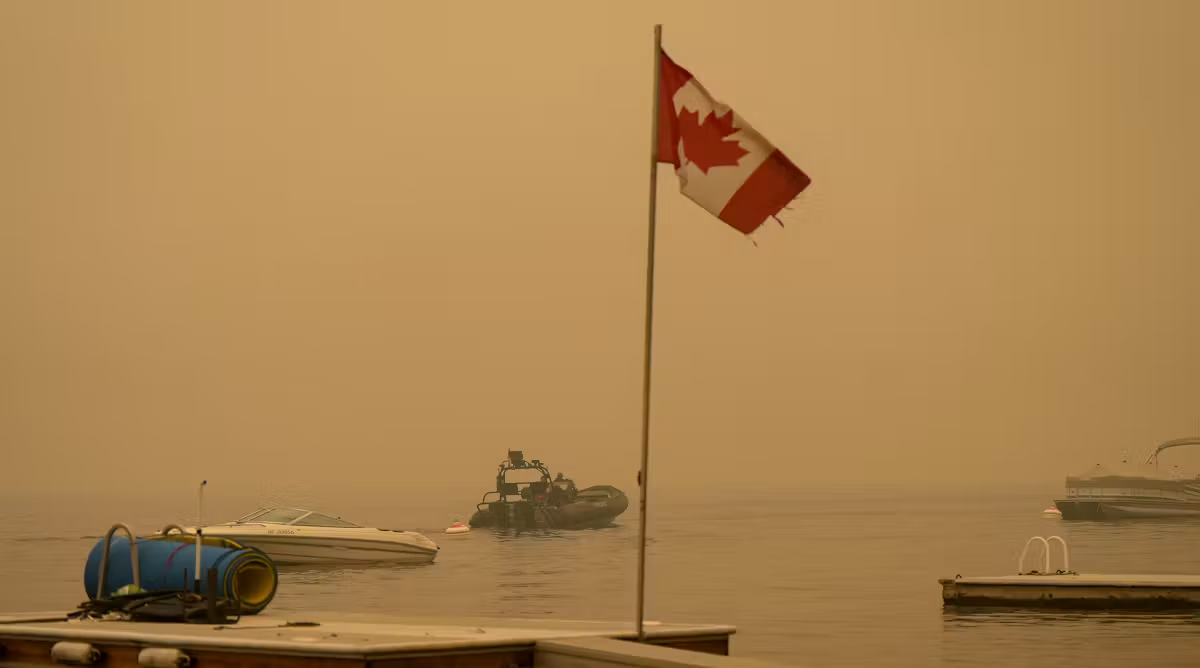
Wildfires burned approximately 4.5 million hectares in Canada over the past summer, evacuating more than 33,750 people and exposing millions to hazardous air pollutants. The 2023 wildfire season was the most destructive in Canadian history, with economic consequences potentially reaching several billion dollars.
New research led by Sian Kou-Giesbrecht at Simon Fraser University's School of Resource and Environmental Management estimates how climate change will drive the economic costs of Canadian wildfires and their carbon dioxide emissions through the 21st century. The researchers used a boreal wildfire-vegetation model accounting for interactions between weather, forest growth, lightning, human ignitions, and suppression.
If global warming remains limited to 2 degrees Celsius above pre-industrial temperatures, as outlined in the 2015 Paris Agreement, burned area and wildfire costs would stay comparable to recent decades. Under high greenhouse gas emissions scenarios, however, an additional 180,000 Canadians could be exposed to wildfires annually by century's end, though this counts only people within 50 kilometres of fires and excludes those affected by smoke.
Additional costs for fire suppression, lost timber, and lost recreation opportunities could reach up to 870 million dollars annually by the end of the century. The researchers note their estimate is conservative because it excludes evacuation costs, property and infrastructure damage, business interruption, and smoke-related health impacts, currently estimated at 19 billion dollars per year.
Approximately 78 percent of exposed communities in the projections are primarily Indigenous, despite representing only 17 percent of communities in the study. The generation born in the 2020s could experience nearly three times the lifetime wildfire exposure of those born in the 1960s under high-emissions scenarios.
Canadian wildfires' CO2 emissions create global consequences. Emissions from 2023 fires matched the annual fossil fuel emissions of several large nations, surpassed only by India, China, and the United States. Using the social cost of carbon, researchers calculated that additional worldwide damages from Canadian wildfire emissions could reach 50 billion dollars annually by century's end in a high-emissions future.
The Canadian government committed 317 million dollars over five years for additional firefighting aircraft and 48 million dollars over five years for Parks Canada wildfire preparedness. Kou-Giesbrecht notes these investments are small compared to projected direct wildfire costs from climate change, estimated between 100 and 870 million dollars annually by century's end. She emphasizes that addressing wildfires requires reducing fossil fuel reliance, not management alone.