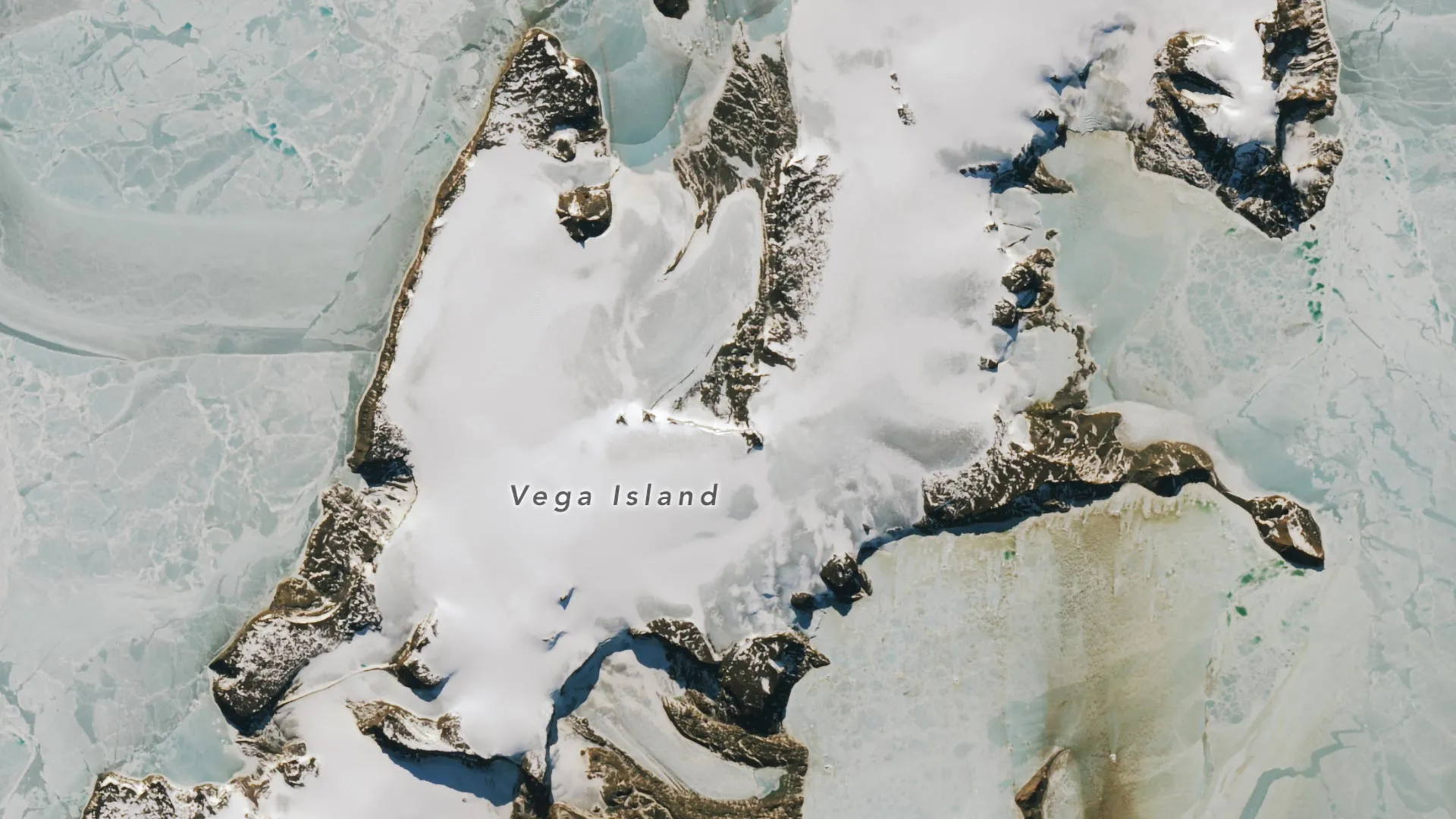
NASA satellite images reveal that Vega Island in Antarctica's Weddell Sea displays a skull-shaped formation when viewed from above, created by a rocky peak, a glacial ridge, and a glacier that resemble eye sockets, a mouth outline, and a lower jaw. The Operational Land Imager aboard Landsat 9 captured images on March 22, 2025, and October 10, 2026, showing a dramatic difference in snow coverage between the two dates.
In March 2025, snow blanketed the island as expected during the region's wettest month. By October 2026, extensive sections were free of snow, exposing darker glacier ice beneath. Mauri Pelto, a glaciologist at Nichols College, attributed the unusual exposure to warm conditions during the Antarctic winter of 2026, particularly in June, which limited fresh snow accumulation. Additional snow was lost through sublimation and wind removal.
The exposed dark ice poses a problem as Antarctica enters warmer months. Unlike fresh snow, which reflects sunlight, darker ice absorbs more solar energy. As daylight increases and temperatures rise, these surfaces will warm faster and potentially accelerate glacier melting. Pelto noted that even thin new snowfall from a spring storm could temporarily slow melting by covering the exposed ice.
The changing conditions may eventually alter the island's appearance. As Pelto explained, "When entombed in snow and ice, the skull is preserved. But when exposed to melt, it weathers away, which will lead to a changing jawline and expanding eye socket."
Scientists have monitored Vega Island's glaciers for decades. A 1982 study using early Landsat data, aerial photography, and topographic maps documented 29 glaciers across the island. Devil's Bay Glacier has been measured in detail since the Antarctic summer of 1998-1999, showing an overall reduction in mass. Satellite observations across recent decades reveal that other glaciers on Vega Island have similarly lost ice, exposing more underlying bedrock.