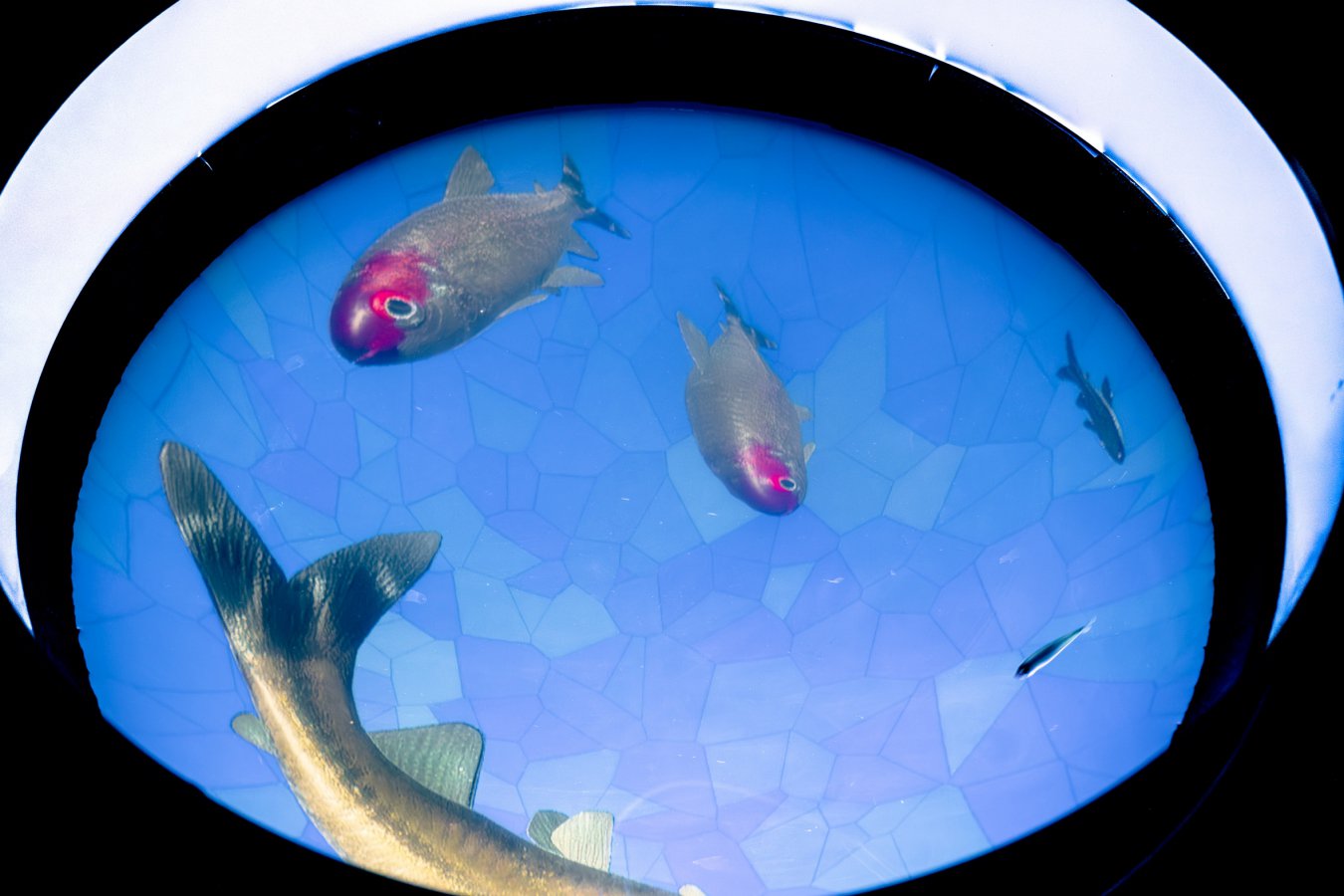
Guy Theraulaz at the University of Toulouse in France and colleagues used virtual reality to study how individual fish pay attention to their neighbours in a group. They placed a single rummy-nose tetra fish in a hemispherical bowl and projected four virtual tetra fish onto the bowl's interior. A camera tracked the real fish's movements, and the projections adjusted in real time based on the fish's behaviour, creating a feedback loop.
The team tested three hypotheses: that one fish would have the most influence on the real tetra, that two fish would be jointly most influential, or that the real tetra would respond equally to all four virtual fish. They found clear evidence for the first case. The real fish focused on a single most influential neighbour at any given time.
Theraulaz suggests this behaviour reduces cognitive and sensory demands. "By focusing on just one neighbour, the fish reduce their sensory and cognitive demand," he says.
Iain Couzin at the Max Planck Institute of Animal Behavior in Germany says the study confirms earlier ideas about tetra behaviour. He notes that virtual reality sidesteps a major challenge in collective animal behaviour research: isolating one animal from its group typically disrupts the group dynamics researchers want to study.
Guy Amichay at Northwestern University in Illinois points out that virtual reality allows researchers to design controlled environments. "You could technically design any virtual world you want," he says. Couzin suggests applying the method to fish species for which no mathematical models yet exist.
Theraulaz and colleagues plan to advance the experiment by making some virtual fish act stressed, simulating predator threats, to see how this affects the real tetra.