Scientists have discovered that two experimental metal alloys made from niobium and titanium can resist cracking at extremely low temperatures, challenging the assumption that body-centered cubic metals inevitably become brittle in severe cold.
The findings appear in Nature on October 14, according to research led by teams from the University of California, Berkeley, Lawrence Berkeley National Laboratory, and the University of Oxford. The alloys maintained damage resistance even when cooled to 20 kelvin (-253°C or -424°F).
Normally, body-centered cubic metals like iron, tungsten, and chromium lose their flexibility as temperatures drop. Tiny defects in their crystal structures called dislocations become harder to move, making cracks more likely to spread rather than allowing the metal to bend and absorb stress.
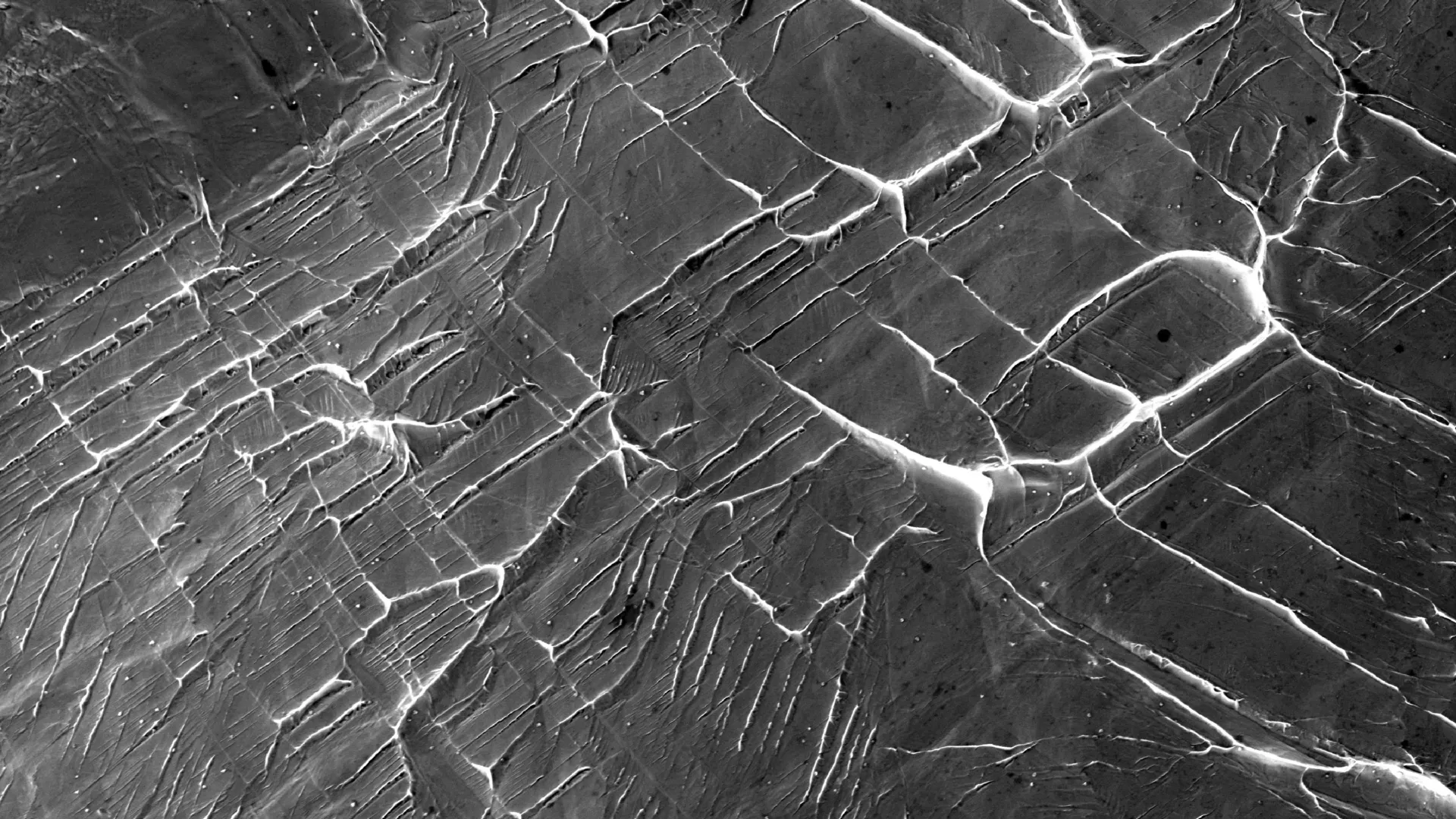
The new alloys activate a different mechanism. Researchers observed a process called nanoscale twinning, in which tiny sections of the crystal structure rearrange into mirror-image patterns alongside a localized change in the crystal structure itself. When these newly formed regions meet crystal boundaries, they create stress concentrations that generate additional defects. These defects provide new pathways for the metal to absorb force instead of fracturing.
Dr. David Cook from the University of Cambridge, who led the study at UC Berkeley, said: "Traditionally, the focus was on how readily existing dislocations can move through a metal, but now it appears that the ability to create new dislocations at interfaces may also be critical."
The team tested the samples using the Engin-X instrument at ISIS Neutron and Muon Source in Oxfordshire. They cooled metal samples with gaseous helium and directed neutron beams through them while stretching the samples. Electron microscopes and atom-probe analysis revealed the structural changes responsible for the alloys' toughness.
Professor Dong Liu from Oxford noted: "For decades, the ductile-to-brittle transition has been viewed as a fundamental limitation of body-centered cubic metals."
The discovery could inform design of structural metals for aerospace, energy, and transportation applications that encounter extreme temperatures.