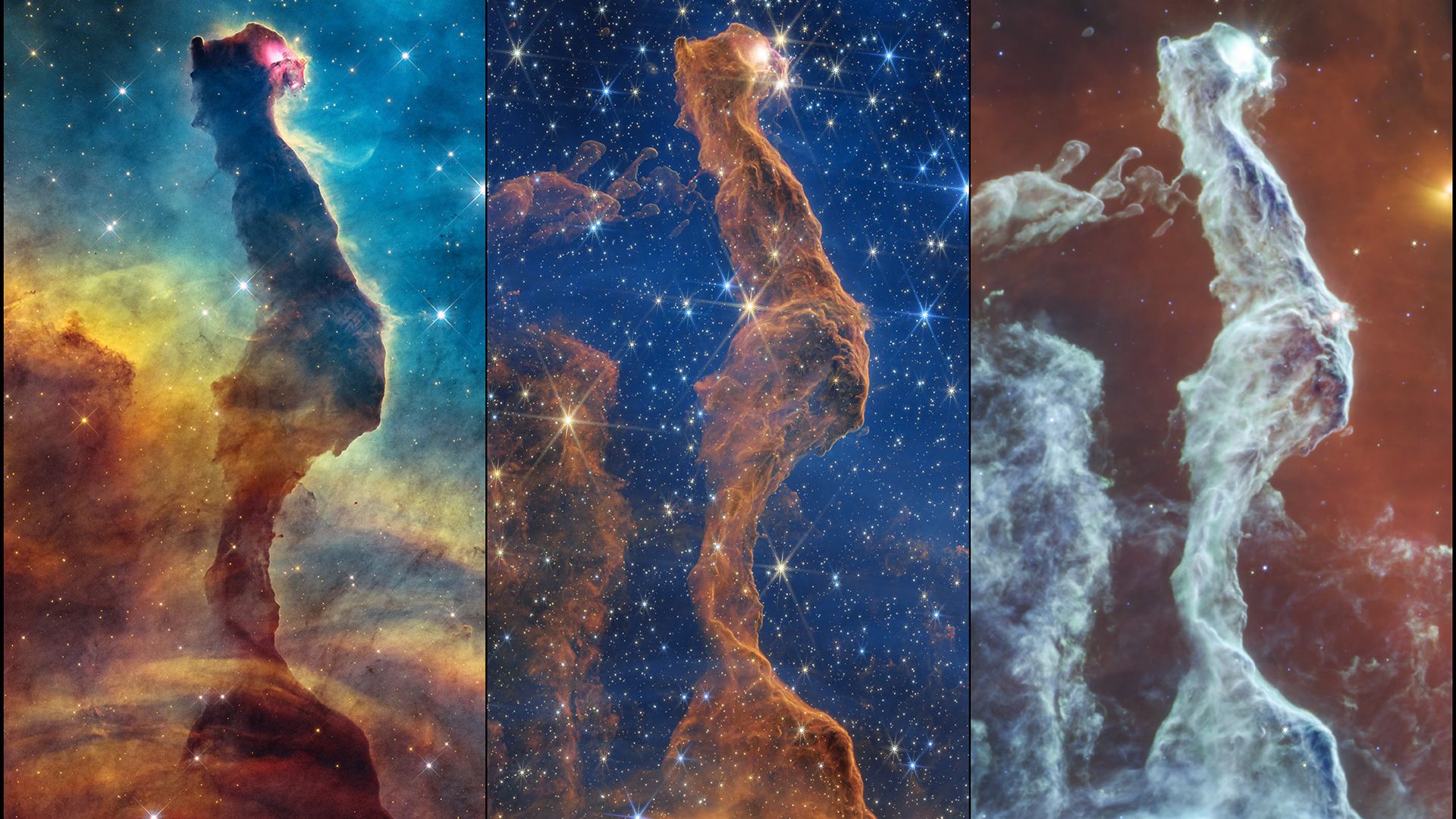
The Hubble and James Webb space telescopes have captured three different views of the Cat's Head Nebula, a column of gas and dust located 7,500 light-years from Earth in the Carina Nebula. The nebula gets its name from its resemblance to a feline head with a single red eye, which is actually a young star embedded within the dust.
The European Space Agency released the three images in honor of Halloween. Each view reveals different structures as it observes different wavelengths of light. Hubble's optical light view shows the dark dust pillar and the colorful glow where starlight interacts with oxygen, hydrogen and sulfur molecules. The Near-Infrared Camera aboard JWST penetrates the outer dust layers to reveal the denser material at the column's center and shows additional stars and galaxies. That view also shows a hand-like structure to the left of the cat's head.
The James Webb Mid-Infrared Instrument captures the ghostly core of the nebula, displaying emissions from polycyclic aromatic hydrocarbons, which the ESA describes as colorless molecules of carbon and hydrogen. A bright orange spot appears to the right of the cat's head in this view. According to the ESA, this spot is a true mystery, and its relationship to the rest of the nebula remains unknown.
The nebula forms when radiation from young stars erodes the surrounding gas and dust, a process similar to how molecules in Earth's atmosphere produce auroras when excited by solar radiation.