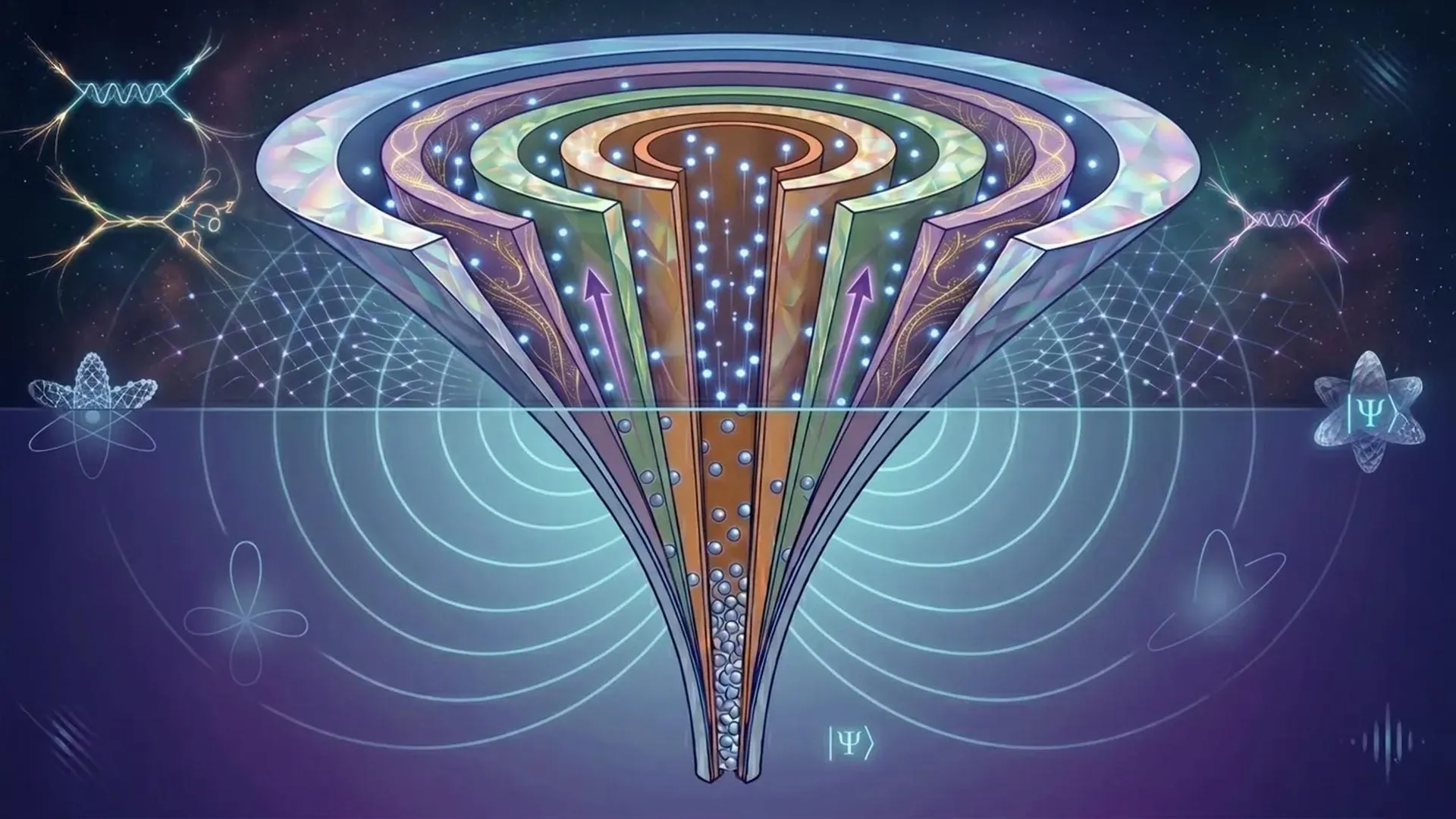
Physicists have created an unusual quantum state in ultracold atoms that contradicts conventional understanding of how matter organizes itself. The new state, termed a "fractional Fermi sea," exhibits high excitation levels while maintaining unexpected order.
The discovery emerges from research into quantum matter behavior at extreme cold temperatures. Ultracold atoms in this configuration defy the typical rules governing particle arrangement and interaction, suggesting fundamental gaps in current quantum theory.
The research team identified exotic quasiparticles within this state, which scientists have called potential "super-Fermions." These theoretical particles represent a novel category of quantum entities that do not fit existing frameworks for understanding matter.
A fractional Fermi sea represents a highly excited yet paradoxically orderly arrangement. This combination challenges the expectation that highly excited quantum states should appear chaotic or random. The discovery indicates that matter can maintain organization under conditions previously thought to produce disorder.
The findings suggest that established quantum theories require revision or expansion to account for this new state of matter. The existence of potential super-Fermions opens research directions into quasiparticles with unprecedented properties.
Ultracold atom experiments provide controlled environments for discovering exotic quantum states impossible to create under normal conditions. These laboratory demonstrations help physicists refine theoretical models and identify phenomena that guide future research in quantum mechanics and condensed matter physics.