# Quantum Entanglement Confirmed at Record-Breaking Energy Scales in LHC Experiment
Physicists at CERN have detected the first strong evidence that massive Z bosons become quantum entangled during the decay of Higgs bosons, proving that Einstein's famously skeptical concept of "spooky action at a distance" persists even under extreme laboratory conditions never before tested.
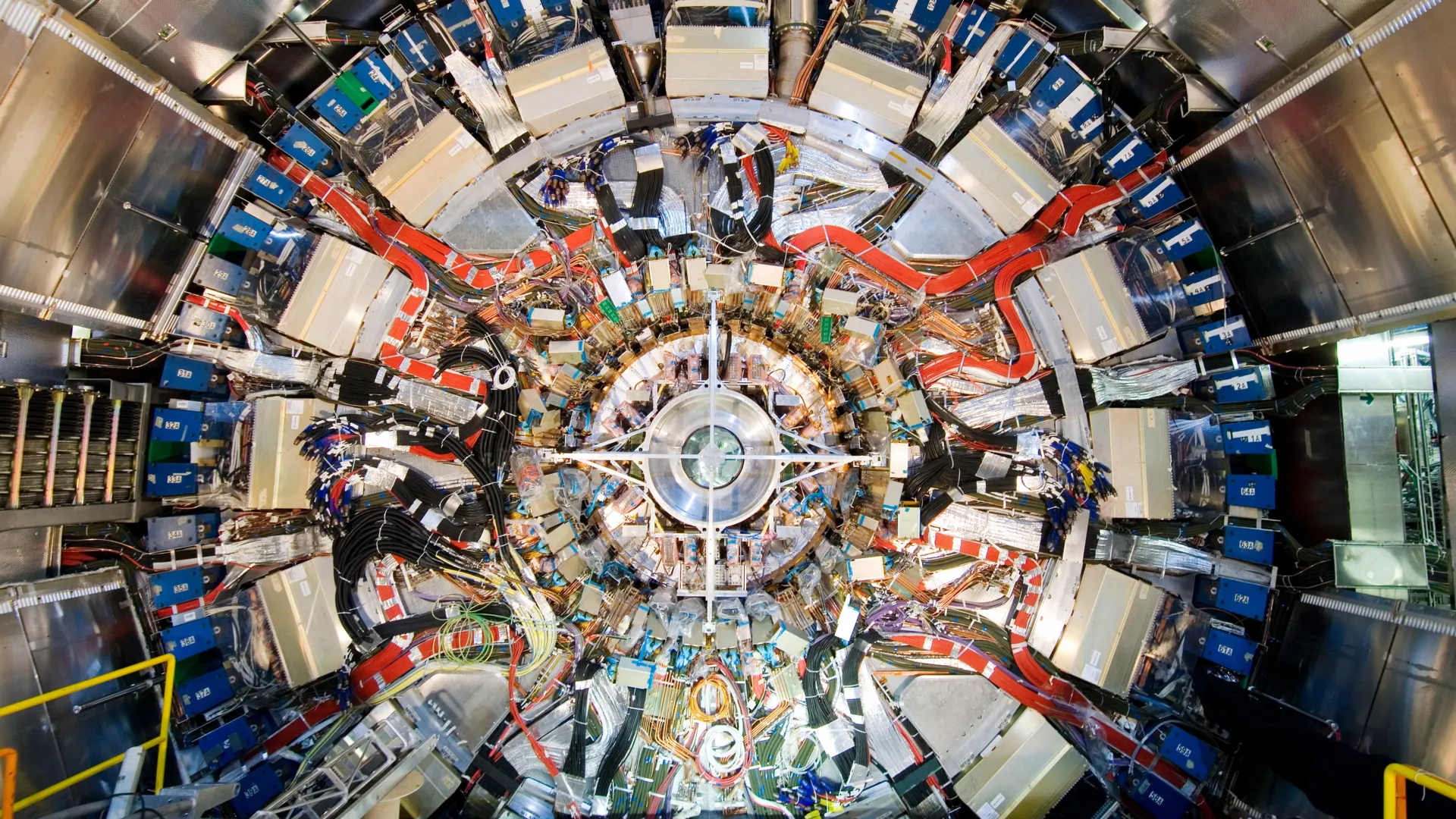
The finding emerges from data collected at the Large Hadron Collider near Geneva, where protons collide at energies of 13 trillion electron volts. When Higgs bosons decay in these collisions, they occasionally produce pairs of Z bosons, the heavy particles that mediate the weak nuclear force. Researchers discovered that these Z bosons exhibit quantum entanglement, a phenomenon where two particles become correlated in ways that violate classical physics principles and remain connected regardless of distance.
This result matters because it extends entanglement observations far beyond their traditional domain. Previous studies confirmed entanglement in photons, electrons, and other relatively lightweight particles. Demonstrating entanglement in Z bosons, which weigh roughly 97 times more than protons, represents a dramatic leap upward in particle mass. The energy scales involved dwarf most other entanglement experiments by orders of magnitude.
Einstein himself called quantum entanglement "spooky action at a distance" because it troubled him deeply. The phenomenon suggests that measuring one particle instantaneously influences its entangled partner, even when separated by vast distances. Einstein believed this violated a fundamental principle that nothing travels faster than light. Decades of experiments have proven Einstein wrong on this count, though the mechanism remains philosophically perplexing.
The LHC team used advanced statistical methods to rule out classical explanations for their observations. They measured the correlations between the decay products of the Z bosons with enough precision to demonstrate that these patterns could not arise from independent particles behaving according to classical physics. Instead, the data matched predictions from quantum mechanics with high confidence.
The research addresses a longstanding question in physics: does entanglement require special conditions, or does it appear naturally whenever quantum systems interact? This work suggests the latter. Entanglement appears to be a robust feature of quantum reality, present even in violent, high-energy collisions that barely resemble the carefully controlled laboratory conditions where entanglement has typically been studied.
Understanding entanglement at these energy scales carries implications for quantum information science and future technologies. If entanglement persists at all mass and energy scales, it opens possibilities for applications researchers haven't yet imagined. The result also provides a cleaner window into fundamental aspects of the Higgs boson itself.
The experiment does carry limitations. Detecting individual Z bosons at the LHC proves difficult because they decay almost immediately into lighter particles. Researchers must reconstruct Z bosons from their decay products, introducing systematic uncertainties. The statistical confidence in the result, while strong, falls short of the five-sigma standard physicists typically demand for claiming new discoveries, though this reflects the genuine challenge of the measurement rather than weakness in the underlying physics.
This work will likely inspire follow-up measurements at the LHC and future colliders with higher energies, where even more massive particles could be tested for entanglement. The result strengthens the view that quantum mechanics operates uniformly across all regimes.