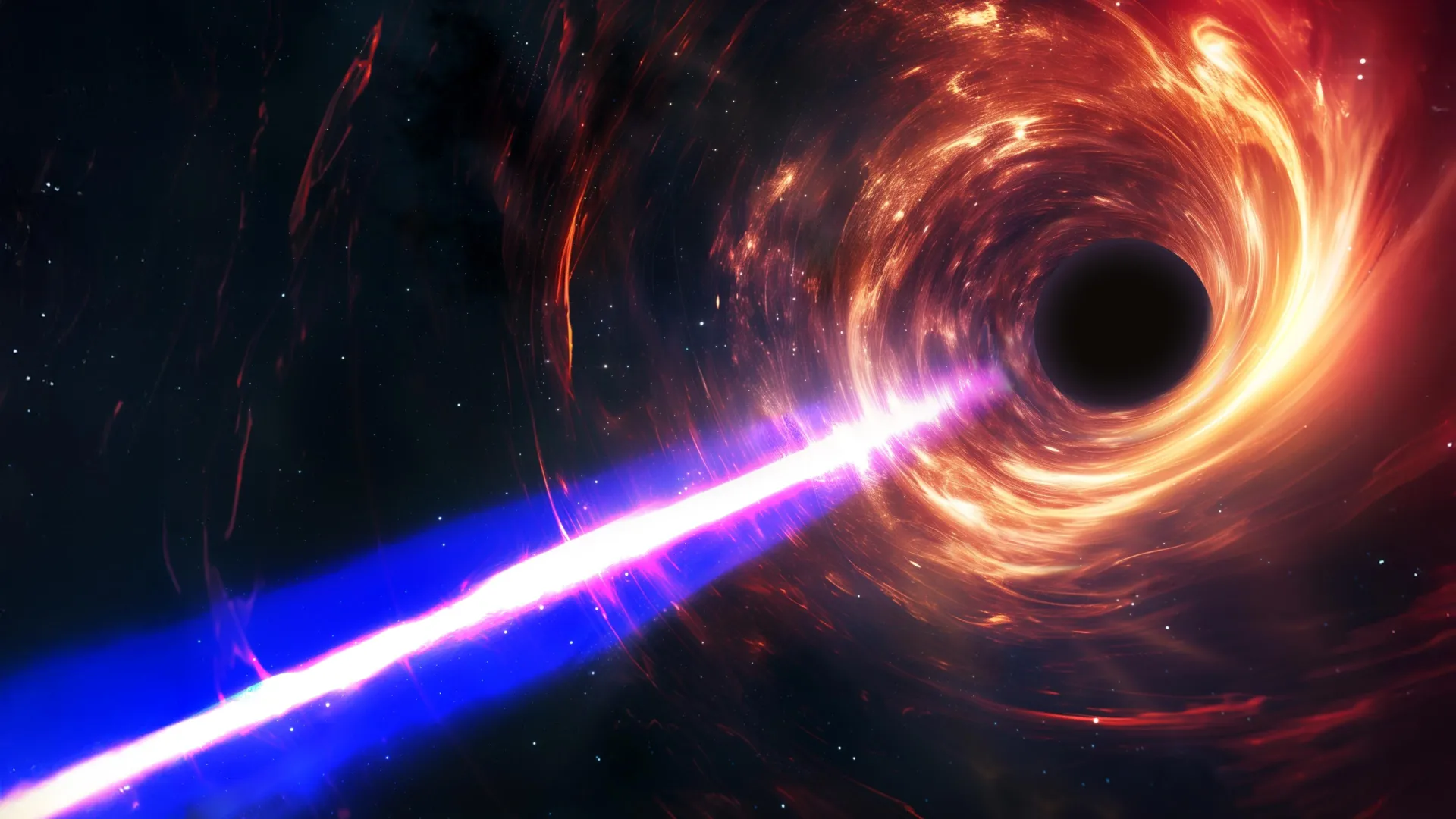
# Black Holes Across the Universe Follow the Same Universal Jet-Launching Rule
Researchers have discovered a unifying principle that governs how black holes of radically different sizes produce powerful jets of radiation and matter. Supermassive black holes at galaxy centers and stellar-mass black holes in our galaxy appear to trigger jets according to the same physics, a finding that simplifies our understanding of these extreme objects.
The research centers on a critical threshold: jets activate when a black hole's feeding rate drops to approximately 2% of the Eddington limit, the maximum rate at which a black hole can accrete material without radiation pressure pushing away incoming gas. This threshold applies whether the black hole weighs millions of times the Sun's mass or merely ten times more.
Supermassive black holes demonstrate this principle through a distinctive pattern. When they tear apart a star, they initially launch jets shortly after the disruption event. Then activity quiets. Hundreds or thousands of days later, as the accretion rate plummets to that critical 2% threshold, the jets ignite again. This same pattern occurs in stellar-mass black holes within our Milky Way, where the much shorter timescales compress the entire sequence into days or weeks rather than months or years.
The Eddington limit itself represents a fundamental balance in black hole physics. Material spiraling into a black hole heats up and radiates energy outward. When this radiation pressure becomes too strong, it prevents additional material from falling inward, capping the accretion rate. At the threshold the researchers identified, something about the accretion geometry or magnetic field configuration shifts, enabling jet formation.
This universal rule offers astronomers a powerful tool. It allows them to predict when jets will emerge from black holes of any mass, using only knowledge of the black hole's mass and current feeding rate. The discovery also suggests that black hole jets operate through similar mechanisms across the entire mass spectrum, from remnants of dead stars to the supermassive engines powering quasars.
The implications extend beyond pure science. Understanding jet production informs models of how black holes influence their host galaxies. Jets can heat surrounding gas, quenching star formation and shaping galactic evolution. A unified framework for jet physics helps researchers map how these feedback mechanisms operate across different cosmic scales.
The research builds on decades of observations across multiple wavelengths and telescope facilities. Astronomers studied both historical data on past tidal disruption events and contemporary monitoring of active black holes, compiling a dataset that revealed the 2% pattern consistently.
One limitation remains: researchers must account for variations in black hole spin and accretion disk inclination angles, factors that may influence jet launching. The precise mechanism triggering jets at this threshold awaits deeper investigation. Future observations with instruments like the James Webb Space Telescope and radio arrays may reveal whether magnetic reconnection, instabilities in the accretion disk, or other processes activate jets at this critical point.
The discovery reinforces a broader theme in astrophysics: nature often employs similar solutions across vastly different scales, from atoms to galaxies.